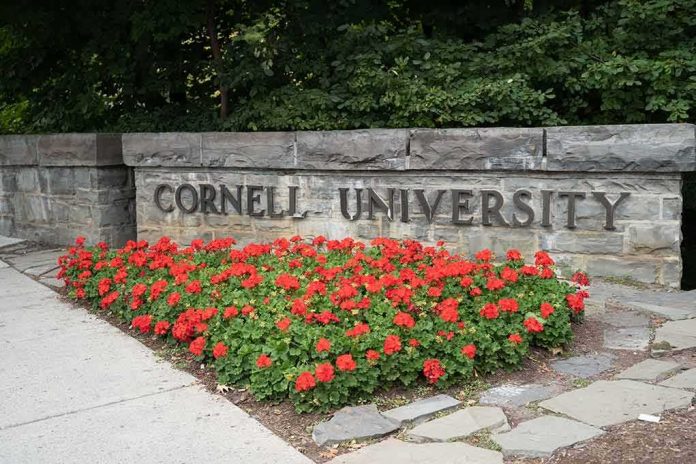
When a university president calls an alleged crime on his own campus “a defining moment in the institution’s history,” he is making a bet — that owning the crisis publicly will cost less than appearing to manage it privately. Cornell President Michael Kotlikoff made that bet on October 3, 2026, and the evidence since suggests the wager was necessary but not sufficient: contrition alone cannot settle the harder question of what the university actually knew, when it knew it, and whether that information reached the prosecutors who decided not to pursue charges.
Key Points
- Kotlikoff publicly called the 2024 alleged gang rape at a Cornell fraternity “deeply disturbing” and committed to an outside law firm’s independent review of the university’s handling of the case.
- Cornell’s Title IX process had already produced expulsions and suspensions, and the university backed Governor Kathy Hochul’s decision to move the criminal probe to Attorney General Letitia James.
- A sharp, unresolved dispute persists over evidence: the Tompkins County district attorney says he received only a six-page summary, while a far longer police transcript reportedly existed and was not reviewed before the original decision not to prosecute.
- Students, faculty, and the governor herself have publicly challenged Cornell’s response as inadequate, turning a campus disciplinary matter into a statewide institutional-trust crisis.
- Resolution now depends less on rhetoric than on documents — the full police transcript, the Title IX record, and a published outside review.
What Kotlikoff Said, and Why It Mattered
In a video statement that circulated widely across national outlets, Kotlikoff described the case as “deeply disturbing” and told the Cornell community, “we as an administration and we as a community must do better.” He announced that Cornell’s board of trustees would name an outside law firm the following week to conduct an independent review of the university’s handling of the 2024 case, and he said he supported Hochul’s decision to strip the matter from the Tompkins County district attorney and hand it to Attorney General Letitia James as special prosecutor. He also pointed to a presidential task force on sexual assault, formed in early 2025, that he said had already changed education, prevention, and support practices on campus.
None of this was cosmetic. An outside review commissioned by a board of trustees is a real accountability mechanism, not a rhetorical gesture — it creates a paper trail that outlives a single news cycle and can be cited by regulators, plaintiffs’ attorneys, and accreditors alike. Cornell’s Title IX process had already resulted in two expulsions and two suspensions tied to the case before Kotlikoff spoke publicly, which demonstrates the university did not treat the matter as dormant at the campus level. Still, Kotlikoff’s own words cut against any claim of vindication: he told the community plainly that Cornell does not “have all the answers,” an admission that is honest but that also concedes the factual record remains incomplete.
The Six-Page Summary and the Missing Transcript
The fault line running through this story is evidentiary, not rhetorical. Tompkins County District Attorney Van Houten has said his office built its original decision not to prosecute on a six-page statement supplied by Cornell police and signed by the student identified publicly as Jane Doe. Reporting since has described a far more extensive document — a transcript running past one hundred pages, recorded over a multi-day police interview beginning weeks after the alleged October 2024 assault — in which the student describes being incapacitated and resisting assault by multiple men at the Chi Phi fraternity house. Van Houten has said that transcript, if authentic, would have changed his office’s handling of the case; he also says his office declined to review additional materials Cornell police had gathered, a decision for which the university and prosecutors each assign blame to the other.
This is not a dispute about tone or perception — it is a dispute about documents that either exist in a particular form or do not, and about who had custody of them at a decisive moment. Cornell has said its police followed protocol and shared “all investigatory information” with the district attorney, while CNN has reported it has not itself seen the underlying Title IX filings, which remain confidential to the parties involved. Until the chronology of what was transmitted, to whom, and when is settled by documentary evidence rather than competing assertions, no institutional actor in this case — university, police department, or prosecutor’s office — can credibly claim its handling was adequate.
A Confidentiality Shield That Cuts Both Ways
Title IX’s statutory logic requires universities to protect complainants’ and respondents’ privacy even while demanding institutional accountability to the broader community, and that tension is structural, not unique to Cornell. Kotlikoff cited exactly this bind when explaining why communication had been limited, telling the community he understood the resulting frustration and promising greater context going forward. The difficulty is that confidentiality, however legally required, also happens to be the single most convenient explanation an institution can offer for why its account cannot yet be independently verified — a point researchers who study campus sexual-assault disclosure have raised with open skepticism toward universities that invoke survivor protection as a reason to withhold basic process information.
Why the Backlash Outran the Apology
Kotlikoff’s statement was a response to pressure that had already escalated well beyond campus. Governor Hochul said the case raised “serious questions about Cornell campus culture” and that she had “lost faith” in the Tompkins County DA’s ability to oversee it fairly — language from a sitting governor, not an anonymous critic, that effectively repudiated the local justice system’s handling of the matter. Cornell’s own AAUP chapter called the administration’s communications, both in 2024 and in 2026, “failures.” Student Assembly president Eeshaan Chaudhuri said students were “absolutely ashamed,” and another student, Jane Wang, said she had separately reported an assault to Cornell and felt unsupported by its Title IX process — testimony that, whatever the outcome of the underlying case, documents a wider pattern of dissatisfaction with how the university’s process functions in practice.
Cornell President Michael Kotlikoff said he supports an independent investigation into the university's handling of the 2024 sex assault allegations, as well as the state's criminal investigation into the case. https://t.co/3akUtVvWYT
— FOX 29 (@FOX29philly) October 4, 2026
What Would Actually Settle the Question
Statements of contrition, task forces, and even disciplinary expulsions answer the question of whether Cornell is now responding seriously. They do not answer the prior question of whether its original process — police intake, evidence handling, referral to prosecutors — functioned as it should have in 2024. That answer requires the actual record: the full police transcript, the Title IX hearing file, a published outside-review report with findings rather than promises, and sworn accounts from Cornell police, Title IX administrators, and the district attorney’s office reconciling who held what evidence and when. Until those documents surface, the fairest reading of the record is this: Cornell’s public posture has been responsible and its reforms are real, but they are reforms announced under pressure, not proof that the system worked the first time.
Sources:
youtube.com, cnn.com, democratandchronicle.com, edition.cnn.com, latimes.com, wskg.org, cbsnews.com, aol.ca, abcnews.com, csmonitor.com