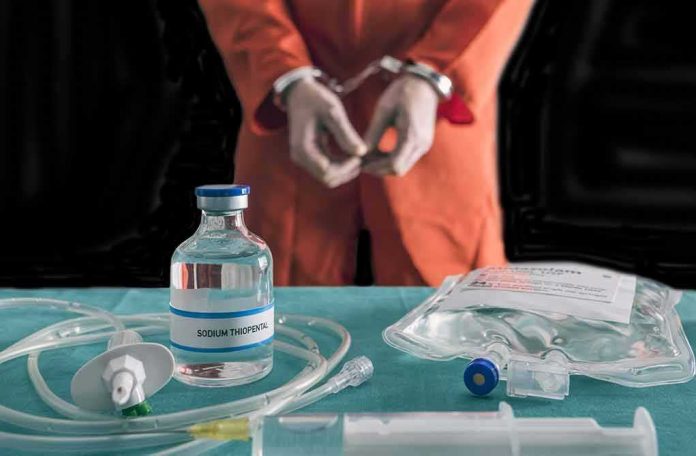
When an execution fails, it isn’t just a technical malfunction; it exposes the tight seam where medicine, law, and secrecy meet, and forces a hard accounting of whether a state’s protocol is an instruction manual or a set of assumptions that break under stress.
At a Glance
- Tennessee’s officials maintain the Pike team followed the state’s approved protocol; the governor ordered an outside review rather than conceding a procedural breach.
- Defense filings and medical commentary allege repeated failed IV attempts and sublethal drug delivery, pointing to vascular-access failure and protocol gaps.
- Independent reporting documents Tennessee’s prior drug-testing lapses, making confidence in chemical integrity and process discipline a central question.
- The Pike episode sits inside a longer U.S. pattern: lethal injection is the most failure-prone modern method, amplified by operational secrecy and constrained medical participation.
What the state says it did, and why that matters
After the attempted execution of Christa Pike, Tennessee’s Department of Correction asserted it followed “every step” of the state’s lawful, attorney-general-approved protocol and used a chemical it described as “consistently…effective.” The governor did not void that account; he ordered a comprehensive third‑party review and paused further executions, signaling that the state treats the incident as an anomaly to be diagnosed rather than an admission of rulebreaking. Those are not small positions. Protocol compliance, if substantiated by logs, chain‑of‑custody, and staffing records, would frame the failure as either a rare physiological event or an equipment/vein‑access breakdown within the four corners of the plan—problems a system can, in theory, remediate without redesigning its premise.
But state declarations alone are not dispositive. The credibility of “we followed the book” ultimately rests on documentary specifics: timing sheets, IV-placement notes, drug lot numbers and temperatures, witness statements, and any contingency steps triggered after the first dose didn’t achieve its endpoint. Until that record is public, the state’s narrative is an official claim that awaits its evidence.
What the counter-record alleges: access failure, sublethal delivery, and missing contingencies
Pike’s lawyers filed a very different picture: multiple needle sticks—at least seven in one arm—one bent on removal, visible blistering, and a patient audibly breathing or “snoring” after injections that should have produced apnea and cardiac arrest. Their retained anesthesiologist, Joel Zivot, argued the only plausible medical mechanism for survival is that pentobarbital never achieved a lethal blood concentration, most likely because venous access failed and the drug infiltrated tissue rather than circulating systemically. If borne out by photographs, nursing notes, and toxicology, that’s a concrete mechanism, not a slogan. It also dovetails with the allegation that Tennessee’s protocol does not clearly specify next steps if a prisoner remains alive after a second dose—an operational cliff edge that, in a high-consequence setting, looks like design debt rather than bad luck.
Two facts amplify those claims’ weight. First, the state acknowledged transporting Pike to an outside hospital, a de facto concession that the event deviated materially from the expected course. Second, Tennessee’s recent execution history is not a clean slate: in 2022, an independent review found the department had failed to consistently test lethal‑injection drugs for potency, purity, and contaminants, and local investigative reporting described noncompliance with its own 2018 protocol on potency testing. Those findings do not prove drug failure here, but they make a demand for verifiable drug integrity—lot, assay, and storage—both fair and necessary.
How lethal injection fails in practice: the mechanics, not the metaphors
Pentobarbital kills by rapidly inducing deep anesthesia, respiratory arrest, and, with sufficient blood concentration, cessation of cardiac activity. Two things usually defeat that endpoint. The first is access: scarred or small peripheral veins, dehydration, clotting disorders, and inadequate placement increase the odds that the drug will extravasate—leak into tissue—producing local injury (the blisters defense counsel described) without achieving systemic levels. The second is chemistry: degraded, contaminated, or miscompounded barbiturate will not reach the concentration-time curve needed for death, even if access is perfect. In either pathway, the monitor is physiology, not paperwork: is the patient apneic; is the capnograph flat; is the pulse absent. When those signs fail to materialize after an infusion window the protocol anticipates, systems rely on contingencies. Protocols that stop after a second dose, or do not specify escalation steps when a subject remains ventilating, are courting indeterminacy precisely when clarity is most valuable.
There is a third layer here: the people executing the protocol are not practicing medicine; physicians and nurses face ethical and licensure barriers to participation. That structural reality shifts a medicalized procedure into a quasi‑clinical domain where training, simulation, and emergency algorithms must substitute for professional culture. Historically, that domain has produced a higher observed rate of “botches” than other methods; multiple analyses and reporting have long placed lethal injection at the top of the modern error table, even as absolute numbers remain low relative to total executions.
Where the evidentiary center of gravity sits today
On the state’s side, the strongest facts are formal: the execution proceeded within a live litigation track that reached the Supreme Court and, according to officials, under an approved protocol; the governor ordered an external review rather than defending the event on press lines alone. On the challenger’s side, the strongest facts are granular: specific counts of needle attempts, observed physiologic signs inconsistent with successful barbiturate lethality, and a named expert offering a testable mechanism of failure; they are also reinforced by Tennessee’s documented legacy of testing lapses that make chemical integrity a fair question in any reconstruction. In a weighing exercise, concrete, falsifiable particulars typically outrun generic assurances. That doesn’t convict the protocol; it sets the burden for the review to meet with data.
What would settle the core disputes? Three items: (1) independent lab assays of retained pentobarbital from the lot actually used—potency, purity, and pH; (2) a vein-access timeline with placement sites, catheter gauges, infiltration checks, and photographs; and (3) a synchronized physiologic record—pulse oximetry, respiratory activity, and the precise intervals between doses—to anchor claims of snoring, gasping, or apnea against the pharmacology. Those are ordinary forensic asks in a high‑stakes adverse event; their absence keeps argument in the realm of assertion.
Governor says Tennessee's prisons chief is resigning after failed execution of Christa Pike pic.twitter.com/ETNeiOvjaf
— NBC 26 News (@NBC26) October 3, 2026
Why this episode reverberates beyond one chamber
The Pike attempt lands on a well‑worn fault line in American capital punishment. Lethal injection promises a clinical veneer; its practice depends on secrecy, supply chains, and nonmedical teams performing a medicalized act. That combination repeatedly yields the same public posture after failure—“we followed protocol; we’ll investigate”—and the same advocacy rebuttal—“the visible deviation is the proof of systemic defect.” Tennessee has lived this cycle before; in 2022 it paused executions to audit problems and emerged with changes. The policy question now is whether a system that fails cleanly at its highest‑stress point can credibly repair itself with tighter checklists—or whether the method’s dependencies make certain failures ineradicable.
There is also a narrower, immediate consequence. If the review confirms that venous access or drug integrity stopped pentobarbital from reaching lethal levels, Tennessee faces a choice: codify explicit, humane contingencies (including hard stop conditions) and disclose enough process to rebuild confidence, or accept that secrecy and sparse protocols will continue to translate isolated mishaps into reputational body blows. Either path starts in the same place—releasing the record. Until then, the state holds the burden its own assurance created.
Sources:
cnn.com, nbcdfw.com, edition.cnn.com, nbcnews.com, cbc.ca, news.un.org, thehill.com, tennessean.com