Nuclear signaling around Kaliningrad is not bluster at the margins; it is the center of how Moscow intends to deter coercion of its most exposed territory, and it sets the escalatory ladder for any NATO-Russia crisis in the Baltic.
At a Glance
- Russian embassies warned, on the record, that any attempt to isolate or blockade Kaliningrad could trigger a response with “all means,” explicitly including nuclear weapons.
- The trigger Moscow names is specific: an air or naval blockade or other moves to cut Kaliningrad off from mainland Russia.
- Putin has separately said Russia has the means to destroy anyone who attacks Kaliningrad, reinforcing the deterrent line.
- This rhetoric fits a long-running pattern of nuclear-tinged signaling to defend geographically vulnerable but heavily militarized territory.
What Moscow said, and why it matters
Russian diplomatic missions in Europe issued explicit warnings that any NATO military action to isolate Kaliningrad—Russia’s Baltic exclave wedged between Poland and Lithuania—would be met with a response using “all means,” including nuclear weapons. The statements, carried by TASS from the Russian embassies in Ireland and the UK, linked the threat to a concrete contingency: an air or naval blockade that would sever the region from the rest of Russia. The embassies also widened the aperture beyond nuclear use, raising the prospect of preemptive strikes against “decision-making centers” in NATO countries early in a conflict. These are not offhand remarks; they are deliberate signals of threshold and consequence.
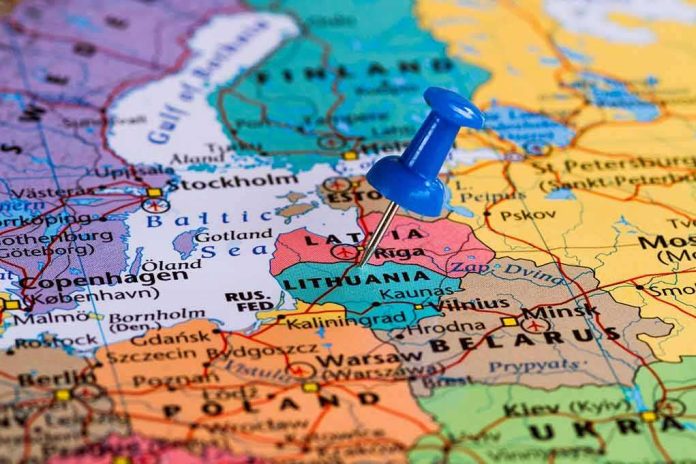
Kaliningrad is not a rhetorical prop. It hosts Russia’s Baltic Fleet elements, layered air defenses, and nuclear-capable short-range missiles. It is also physically detached from mainland Russia and encircled by NATO territory, which makes resupply a natural pressure point in crisis. In such a geography, the act Moscow most fears—an isolation attempt—can be imagined with plausible tactics and short timelines. That is why the trigger Moscow chose to name is specific: it addresses what Russian planners see as the most accessible way for adversaries to coerce the exclave without crossing into a declared, large-scale ground invasion.
How this fits Russia’s deterrence playbook
The warnings align with years of Russian nuclear-adjacent signaling designed to constrain opponents’ conventional options. In May 2026, President Vladimir Putin stated that Russia had all the means necessary to destroy anyone who attempts to attack Kaliningrad—an assertion that complements, rather than contradicts, the embassies’ message. In crisis theory terms, Moscow is sharpening “tripwires”: specifying that a blockade equates to an attack and that escalation could be immediate and multidomain. Security analyses of the Kaliningrad theater consistently flag it as a flashpoint where short distances, dense forces, and compressed decision times magnify miscalculation risk.
Deterrence signaling typically does three things at once: it names a red line, advertises capability, and asserts resolve. The Kaliningrad warnings did each. The red line is isolation of the exclave; the capability is “all means,” with nuclear weapons cited explicitly; the resolve is conveyed by the threat of preemptive strikes on allied decision nodes at the outset of conflict. By moving the conversation from “how far could NATO push?” to “would you risk nuclear war over a blockade?”, Moscow hopes to freeze allied planners at the threshold.
Mechanism and escalation pathways: from blockade to nuclear risk
Why single out a blockade? Because it creates a contest of timelines. A blockade—air, maritime, or hybrid interdiction of transport corridors—can be implemented rapidly, imposes immediate operational pain, and does not require the political audacity of seizing territory. But to Moscow, it is functionally a strategic strangulation of a Russian region. The embassy language recasts blockade as attack, collapsing the political space between limited coercion and major war. Analysts track that in nuclear dyads, disputes tend to feature higher escalation potential precisely when one side believes vital assets are at risk and when command-and-control or logistics lifelines could be targeted early.
Once blockade equals attack, the escalatory ladder steepens. Russia’s stated options—preemptive strikes on command nodes, rapid employment of long-range conventional fires, and, if necessary, nuclear use—are designed to reimpose deterrence through shock and to raise costs beyond what allies would tolerate for a limited objective. Crisis research underscores that expanded strategic ambiguity can open unpredictable escalation pathways, particularly when domains entangle and signals compress in time.
Why Kaliningrad’s geography drives strategy
Kaliningrad’s position on the Baltic Sea, separated from mainland Russia by the Suwałki Gap and surrounded by NATO members, makes it both a forward bastion and a vulnerability. The exclave anchors Russian anti-access/area-denial (A2/AD) arcs across the Baltic approaches and provides a launchpad for maritime and air operations. But its sustainment relies on air corridors and sea lines NATO could, in theory, threaten in crisis. That duality—fortress and hostage—explains why Moscow ties its most severe threats to any attempt at isolation. It is also why Western planners treat even hypothetical blockades as escalatory gambits rather than routine military options.
Seen through alliance politics, the stakes extend beyond one region. If Russia can credibly bind nuclear use to Kaliningrad’s integrity, it deters not only blockades but also a family of pressure tactics—from intensified air policing to maritime interdiction drills—that might otherwise become leverage in a standoff. The inverse holds for NATO: any perception that Russia’s red line is performative rather than real could invite risk-taking behavior that, in a tight theater, could race up the ladder faster than leaders intend.
Law, doctrine, and the “decision-center” threat
The embassy language about striking “decision-making centers” matters because it maps to real targets—national command authorities, key headquarters, strategic communications nodes—and signals a punishment strategy aimed at political leadership at the outset. While the statements did not publicly cite chapter and verse of Russian nuclear doctrine, they align with Moscow’s longstanding approach of integrating nuclear threats into conventional crisis management when leadership survival or territorial integrity is perceived to be at stake. In parallel, legal analysts have argued that a NATO blockade of Kaliningrad would face high hurdles under international law absent a valid self-defense claim or UN mandate—another reason both sides frame such a move as extraordinary rather than routine.
The operational implication is simple: if a crisis ever trends toward interdiction of Kaliningrad’s lifelines, the speed of political communication and the clarity of intent on both sides will determine whether the situation stabilizes or cascades. History suggests the latter can happen quickly when command-and-control fears and territorial stakes converge.
🚨 BREAKING NEWS: Putin warns West on Kaliningrad defense
Russian leader Vladimir Putin stated that Moscow is prepared to use every weapon to protect Kaliningrad. He insisted that Russia is not threatening anyone but is merely responding to statements by Western leaders. This… pic.twitter.com/APhqQPoD25
— Globenews (@newsglobeorg) October 1, 2026
What to watch if the situation heats up
Three indicators would signal that rhetoric is migrating into operational posture. First, changes in Russian alerting of dual-capable systems in and around Kaliningrad—missile units, air assets, and naval platforms—paired with more explicit doctrinal references in public statements. Second, allied moves that test sustainment lines to the exclave (airspace control measures, maritime inspections), even if framed as exercises; these would probe the red line Moscow has drawn. Third, tempo and content of crisis communications—both military deconfliction channels and diplomatic exchanges—which, if they thin or harden, often presage riskier military behavior. The throughline is constant: Kaliningrad compresses time and space in ways that reward early, unambiguous signaling and punish improvisation.
Sources:
insiderpaper.com, tass.com, noticias.foxnews.com, reuters.com