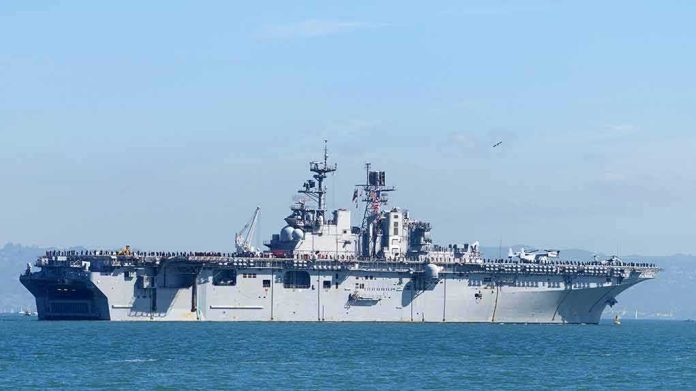
When a state uses its embassy account to threaten named officers of another nation’s warship on the day that ship returns from a combat cruise, you’re seeing more than online bravado—you’re seeing coercive signaling aimed at the human command chain that executed lawful military missions.
At a Glance
- USS Spruance returned to San Diego after a 357-day deployment that included launching Tomahawk cruise missiles at Iranian military targets and extensive air and maritime defense.
- The Iranian embassy in South Africa publicly posted “We will find you,” naming Spruance’s commanding and executive officers in an overt threat.
- Navy accounts document Spruance’s combat actions during Operation Epic Fury and force defense against drones and anti-ship missiles.
- The threat fits a longer pattern of Iran-linked targeting rhetoric and intimidation directed at U.S. officials and service members.
What unfolded: a warship’s combat record meets a public threat to its leaders
The destroyer USS Spruance completed a historic 12-month combat deployment and pulled into San Diego with a record that is straightforward on the essentials: the ship launched dozens of Tomahawk Land-Attack Cruise Missiles against Iranian military targets between February and August 2026 and served as a key air- and missile-defense node for its carrier group. The Navy also credited Spruance with destroying multiple inbound threats—12 unmanned aerial vehicles and four anti-ship cruise missiles—during the same period, and described the ship’s gunnery engagement of the Iranian cargo vessel M/V Touska after it attempted to evade a U.S. blockade. Cmdr. Leigh R. Tate, identified by the Navy as Spruance’s commanding officer, framed the crew’s experience plainly: intense, kinetic operations executed under operational-security constraints that limit public granularity even after the fact.
Hours after the homecoming, the Iranian embassy in South Africa posted images naming Tate and Spruance’s executive officer, Lt. Cmdr. Jeffrey E. York, accompanied by the words “We will find you.” The message was not an unattributed leak or rumor; it was a contemporaneous statement from a government account, making it (at minimum) a deliberate act of intimidation aimed at identifiable U.S. officers linked to recent strikes.
How Spruance fought: platform, mission, and command roles
Spruance is an Arleigh Burke–class guided-missile destroyer built around the Aegis combat system. In carrier strike group operations, such destroyers integrate sensor data, prosecute air and missile threats with Standard Missiles and Close-In Weapon Systems, and, when tasked, execute long-range precision strike with Tomahawks. In Operation Epic Fury, Navy reporting says Spruance launched some of the first strikes on February 28 and sustained land-attack missions through the summer, while simultaneously serving as an alternate air-defense commander—a role that concentrates tactical coordination and deconfliction responsibilities in the ship’s combat information center and wardroom leadership. The operational picture that emerges is not episodic: it is a months-long cycle of detect, decide, and engage against Iranian-linked aerial and maritime hazards, punctuated by planned Tomahawk salvos on military targets ashore.
Command relationships on a U.S. destroyer are clear. The commanding officer holds ultimate responsibility for the ship and its combat actions; the executive officer is the second-in-command, managing execution and readiness. Target development, rules of engagement, and strike authorizations, however, flow across echelons—from national command authority through theater and task-force commanders to the unit. That’s why Navy communications identify Tate and York to establish who led the ship, while not attributing specific weapon-release decisions to any single individual in public materials. The point is accountability for mission performance, not a public targeting log.
The embassy’s message in context: coercion aimed at people, not platforms
States coerce in many ways: by maneuver, by sanction, by strike—and by singling out human decision-makers for retribution. Iran and Iran-linked actors have for years oscillated between formal threats and clandestine plotting against U.S. personnel following episodes of armed confrontation, a pattern that intensified after the 2020 killing of Qassem Soleimani. Publicly naming serving officers and promising to “find” them fits that repertoire, shifting focus from the state-to-state clash at sea to the officers who embody it on the bridge and in the combat information center.
Legally and operationally, the distinction matters. In armed conflict, uniformed combatants—including naval officers—are lawful military targets by virtue of their status, not because of a social media call-out; outside armed conflict, threatening to locate and harm foreign officers travels a very different legal lane. Either way, the embassy’s post is evidence of intent to intimidate particular individuals, not a substitute for a legal targeting rationale. The posture communicates deterrence-by-fear directed at the human chain of command rather than the steel hull that carried out the mission.
What the record establishes—and what it does not seek to prove
The public record does several things decisively. First, it documents that Spruance used force against Iranian military targets over an extended period, including Tomahawk employment and layered defense against drones and anti-ship missiles. Second, it identifies Tate as the commanding officer during that combat cruise and York as the executive officer. Third, it captures, on the day of return, an attributable embassy-level threat naming both officers. Those facts rest on Navy releases and mainstream reporting that quote identified commanders and detail ship-level actions.
What the record does not attempt is an adjudication of individual culpability for any specific strike’s effects; that is neither the purpose of Navy after-action communication nor a requirement for understanding the embassy’s threat. From a civilian reader’s standpoint, conflating the ship’s documented combat activity with a social-media accusation about a specific casualty event confuses categories. The through-line that matters for policy and risk is simpler: a named U.S. warship executed state-authorized strikes and defensive engagements against Iranian forces; Iran responded, in part, by threatening the identifiable officers who led that ship.
Iranian Embassy Post Targets Two Navy Officers as USS Spruance Returns to San Diego
AI narration and illustration. pic.twitter.com/zLfsg5BJZS— BreakingNewsNation.com (@BreakingNNation) November 15, 2026
Implications: deterrence, duty of care, and the next deployment
Threats against individual officers impose operational and ethical obligations on the United States beyond force protection at sea. They require a duty of care that extends homeward—protective measures for service members and families, security coordination with local and federal partners, and disciplined information practices that minimize exposure of personally identifiable information without muzzling legitimate public recognition of service. They also shape adversary calculus: if naming officers appears to rattle a command, expect more naming; if it hardens resolve and prompts tighter defensive counterintelligence, expect escalation to take different forms.
For Iran, the upside of public threats is narrative—projecting reach and moral reprisal; the downside is galvanizing allied resolve while underscoring the professionalism of the very crews being menaced. For the Navy, the lesson is old and durable: platforms deter by presence and capability, but people carry the weight of command decisions. In the Spruance’s case, the record speaks cleanly. A destroyer did what destroyers are designed and ordered to do under the law of armed conflict; its leaders brought their crew home after 357 days at war; and an adversary government chose to make those leaders the face of its retaliation rhetoric. The strategic conversation now is not whether that happened—it did—but how the United States protects its commanders while they continue to fight, decide, and return.
Sources:
redstate.com, foxnews.com, the-express.com, newsfinale.com, globalsecurity.org, whmi.com, ground.news