

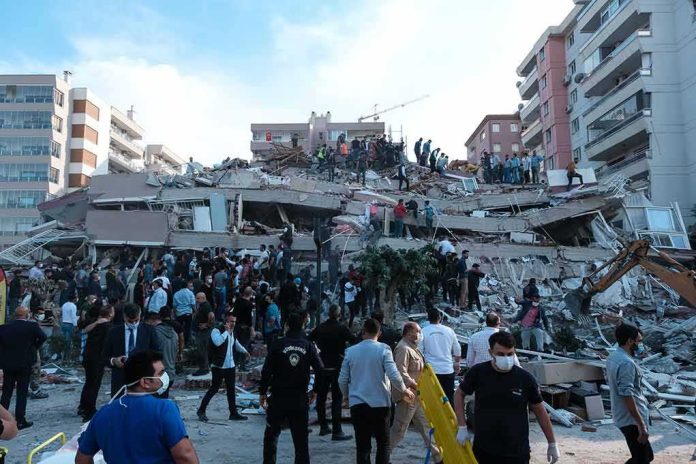
In urban wars, the mechanism of harm is brutally simple: precision weapons strike imprecise lives. The Gaza apartment blast that killed a Christian mother and daughter sits squarely in that pattern—civilian deaths established quickly by converging local and wire-service records, while intent, target value, and legality remain contested long after the bodies are buried.
At a Glance
- Reliable first-order facts: an Israeli strike on a Gaza City apartment building killed at least five people, including a Christian mother and her daughter.
- The public record formed through hospital tallies, church mourning notices, and wire-service reporting; Israel issued no immediate comment at the time.
- This evidentiary sequence is typical in urban conflicts: death counts solidify fastest; accountability and proportionality trail behind.
- Gaza’s small Christian community has suffered repeated wartime losses, underscoring how densely built environments erase practical distinctions between “near” and “safe.”
What is firmly established: the strike, the victims, the setting
Multiple contemporaneous accounts align on the core facts. Health and civil defense officials in Gaza reported that an Israeli airstrike hit an apartment building in Gaza City, killing at least five people—four of them women. Among the dead were a Christian mother, named in reports as Maisa (or Maysa) Abu Dawoud, and her daughter Mary; a Reuters dispatch and on-the-ground video corroborated both the civilian setting and the identities relayed by medics and the local church community. A funeral for the two was held at St. Porphyrius Orthodox Church, one of Gaza City’s most enduring Christian institutions, further anchoring their identities within a named, verifiable community record.
The chain of immediate documentation—emergency services, hospital intake, and religious institutions—matches how civilian fatalities in Gaza typically enter the public ledger. Wire services rely on these first sources under access constraints while pressing militaries for operational details. In this case, there was no immediate comment from the Israel Defense Forces (IDF) at the time of the initial reporting. That silence does not negate the strike; it leaves open the questions that matter most for accountability: what, if anything, the IDF sought to hit and why this building, at that hour, with this yield.
How civilian truths harden faster than legal conclusions
In dense urban combat, the early, most reliable element is usually the who and how many; the why and with what justification can take weeks or never arrive. Analysts who have mapped conflict reporting across cities from Aleppo to Mariupol to Gaza note the same cadence: casualty counts cohere via hospital and civil defense lists, while the combatant status of the dead, the proximity of military targets, and the law-of-war proportionality analysis lag because they require access to strike logs, munition fragments, or independent site investigations that are often impossible mid-war. The result is a public record that stabilizes around deaths long before it can adjudicate responsibility beyond the fact of the trigger-puller.
Gaza sharpens these dynamics. Access is restricted, infrastructure is degraded, and independent investigators face safety and political barriers. Still, years of third-party assessment suggest that, while Gaza’s health-record systems do not separate civilians from combatants, aggregate fatality data have been broadly credible as minimum counts of the dead—a point reached by outlets and researchers who have scrutinized methodology rather than rhetoric. That broader lens explains why the baseline claims in this case—location, manner of death, and identities through church and hospital—are on solid evidentiary ground, even as motive and target intelligence remain opaque.
The particular vulnerability of Gaza’s Christians in a war built for density
Gaza’s Christian community is small, tight-knit, and geographically co-mingled with Muslim neighbors in precisely the neighborhoods—like central Gaza City—most exposed to aerial and artillery fire. Churches have doubled as shelters, and they, too, have taken damage and casualties in previous strikes; the pattern documents not a targeting of Christians per se, but the operational reality that in high-density environments, sacred and residential spaces sit in the blast radius of any nearby military objective. When a munition collapses an apartment stack, the faith affiliation of the dead only becomes legible because families and churches can name them; the law of armed conflict, by contrast, asks narrower questions: did a fighter or weapons cache drive the choice of aim point, and were the expected civilian harms excessive in relation to the concrete and direct military advantage anticipated?
Absent a detailed IDF strike file, outside observers cannot complete that proportionality equation here. What they can do—confidently—is state that five people died in a civilian apartment, that two were a Christian mother and daughter publicly mourned at St. Porphyrius, and that this conforms to a grim catalog of incidents in which Gaza’s Christians have joined the civilian dead alongside their Muslim neighbors.
How to read “no immediate comment” and what it does—and doesn’t—mean
Militaries frequently delay comment for operational security, deconfliction with other strikes, or internal review. In this incident, initial reports recorded no immediate IDF statement. For the careful reader, that establishes two things: the strike attribution stands on hospital, civil defense, and wire-service triangulation rather than an Israeli admission; and the legal-justification half of the ledger awaits sourcing beyond first-day records. It does not, however, cast doubt on the deaths themselves or the apartment as the blast site; those have independent anchors. As with many Gaza cases, the evidentiary asymmetry is not a flaw in the reporting so much as a feature of wartime information flow.
The discipline here is intellectual honesty: treat the uncontested facts as established and resist the urge to fill the silence around targeting with convenient surmise. The law does not infer intent from tragedy; it examines means, methods, and intelligence. The human stakes, by contrast, are more direct and do not require a completed legal brief to be grasped.
What this episode shows about modern air war—and what it demands of policy
Precision-guided munitions reduce circular error probable; they do not eliminate civilian harm in vertical cities where combatants and civilians share floors, walls, and courtyards. The limiting variable becomes not guidance, but judgment—choice of aim point, munition size, timing, and the threshold for acceptable risk to noncombatants. When that calculus plays out across thousands of strikes, the aggregate civilian toll becomes the most legible outcome data available to outsiders, even as the military record remains sealed. That is why independent monitoring of strike environments, reinforcement of battle-damage assessment protocols that privilege civilian-risk mitigation, and credible post-strike investigations matter more than rhetoric in proving compliance.
How to hold two truths at once
It is simultaneously true that this Gaza strike killed identifiable civilians—including a Christian mother and daughter mourned by name—and that we lack the full operational context to adjudicate proportionality and intent. The first belongs to the historical record now, supported by local institutions and wire services. The second remains an open file that fair analysis neither prejudges nor ignores. In a war where access is hard and emotions run hotter than the blast plume, that is the posture that preserves both accuracy and conscience.
Sources:
youtube.com, aa.com.tr, reuters.com, ground.news, gulf-times.com, en.royanews.tv