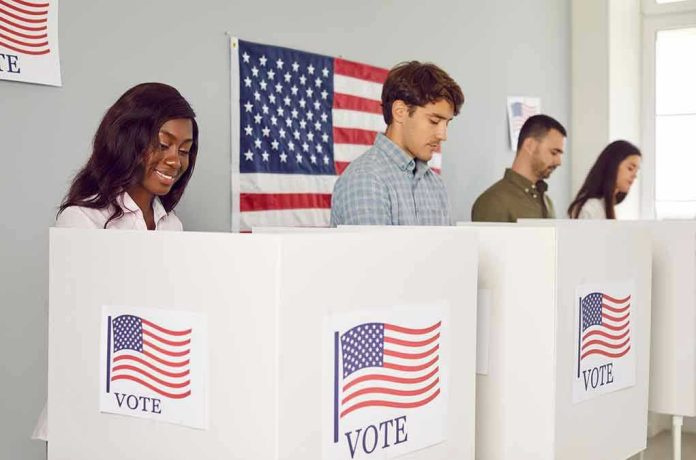
When the Pentagon orders an institution-wide pause so every service member can register, request a ballot, or cast one, it is not a culture-war gesture; it is a practical fix for a chronic, well-documented failure point in American election administration: military votes often die on logistics’ shoals, not for lack of interest.
At a Glance
- Defense Secretary Pete Hegseth directed a one-day, force-wide October stand-down to give every service member protected time to register, request absentee ballots, and vote.
- Commanders must complete the stand-down by mid-October, and the Pentagon intends to repeat the practice in even-numbered election years.
- The initiative is framed as apolitical: leadership facilitates the process; troops choose their candidates.
- The policy targets structural barriers UOCAVA voters face—especially late-arriving absentee ballots and state-by-state rule complexity.
What the order does, and why it matters
Defense Secretary Pete Hegseth instructed commanders at every echelon to conduct a one-day stand-down in October, with the explicit purpose of giving troops protected time to complete voting actions—registering, requesting and transmitting absentee ballots, or voting in person where feasible. The directive sets a completion window by mid-October and establishes the stand-down as a recurring feature in election years, elevating voting assistance from an ancillary duty to a scheduled, commander-owned event across the force. Hegseth’s public framing is unambiguous: the Pentagon will not tell service members how to vote; it will ensure they have the opportunity to do so.
For the military community, timing is not a nicety—it is the difference between a ballot counted and a ballot wasted. Research across federal and academic bodies has shown that Uniformed and Overseas Citizens Absentee Voting Act (UOCAVA) voters encounter higher failure rates than domestic voters because the process is fragmented by state rules and constrained by transit times that routinely collide with statutory deadlines. A one-day stand-down is a blunt administrative instrument aimed at a precise operational problem: getting thousands of individual voters to initiate and complete time-sensitive steps early enough for their ballots to make it home and back again.
The mechanics: from policy to practice
The stand-down shifts voting assistance from “available if you find the office” to “built into the duty day.” Units can concentrate tasks that commonly fall through the cracks: confirming registration eligibility for the right jurisdiction (frequent confusion for mobile troops), completing a Federal Post Card Application to request an absentee ballot, and—critically—returning ballots with enough lead time to beat state receipt deadlines. Commanders execute within their operational realities, but anchoring these actions to a single, mandatory day creates a forcing function that ad hoc briefings and posters rarely achieve.
This is not unprecedented in spirit. The Department has long maintained Voting Assistance Officers and programs, and Congress strengthened timelines with the MOVE Act to push states toward mailing ballots earlier to UOCAVA voters. What is new is elevating voting completion to the level of a formal, department-wide operational pause—recognition that in a 24/7 global force, time is the scarcest resource and must be explicitly allocated if outcomes are to change at scale.
The structural problem the policy targets
Military voters’ obstacles are systemic, not sporadic. Studies catalog persistent frictions: uncertainty about where to register after multiple moves; varying state rules on application formats, notary requirements, and ballot transmission channels; and the brute physics of mail across oceans and austere posts. Among rejected UOCAVA ballots, late arrival is the modal cause; by the time a ballot clears the local post office near a duty station and traverses the military and civilian networks back to a county clerk, statutory deadlines in many states have already lapped it.
This is why “earlier is everything.” A single institutional day to trigger requests and returns pushes the whole cohort left on the timeline, increasing the probability that ballots arrive and are counted. It also concentrates expert help on the day it matters: Voting Assistance Officers can resolve state-specific questions in minutes that otherwise cost weeks of back-and-forth or deter participation altogether. If the outcome metric is ballots counted, not just intent to vote, this approach targets the right failure mode.
Apolitical intent and the command-influence line
Military voting policy must walk a bright line: maximize access without exerting, or appearing to exert, command influence on individual political choices. The stand-down order hews to that norm by defining the commander’s role as creating time and access to process—not steering preferences—and by coupling the pause with nonpartisan assistance mechanisms already embedded in Department policy. In Hegseth’s words, it is about opportunity, not instruction.
That balance is not optional; it is essential to civil-military trust. The apolitical framing aligns with longstanding guidance that commanders facilitate civic participation and enforce prohibitions on partisan activity in the workplace. In practical terms, that means the day’s agenda centers on mechanics—forms, deadlines, mailing, and where possible, secure transmission—not messaging about candidates or issues. Done properly, the stand-down reduces barriers while preserving the force’s nonpartisan ethic.
TWO FRONTS. ONE MISSION: PROTECT THE ELECTION & PROTECT THE RIGHT TO VOTE
On October 2, 2026, Defense Secretary Pete Hegseth directed all military commanders and supervisors at every level to conduct a one-day “Military Voting Stand Down” during October, with this year's…
— Unite4Freedom (@Unite4Freedom) October 3, 2026
Comparative perspective and expected effects
Compared with the Department’s traditional reliance on information campaigns and decentralized assistance, a mandated stand-down is more likely to move the needle on two outcomes that matter: initiation and timeliness. Centralizing the effort within a defined window reduces the variance introduced by operational tempo, field exercises, deployments, and permanent changes of station—life patterns that predictably depress completion of time-sensitive administrative tasks. By bundling registration checks, absentee requests, and ballot returns in one protected block, the policy lowers cognitive and logistical load at the very moment it matters most.
Will it erase the UOCAVA gap? No single-day event can eliminate structural challenges rooted in fifty sets of state laws and the hard constraints of distance. But the intervention is well aimed. Academic and federal research converge on the same theme: start earlier, simplify steps, and ensure ballots have enough time to make the round trip. On those criteria, a force-wide, commander-executed pause is a rational lever. Even modest reductions in late-arrival rejections translate into thousands of additional counted votes across a global force.
What to watch as implementation matures
The most important signals will be operational, not rhetorical. First, completion rates: how many eligible service members initiate absentee requests during the stand-down window compared with prior cycles. Second, transit success: the share of UOCAVA ballots received by state deadlines; declining late-arrival rejections would validate the timing hypothesis. Third, help-desk efficacy: whether Voting Assistance Officers close common knowledge gaps quickly, especially for first-term troops navigating jurisdictional questions after multiple moves.
Because the Pentagon intends to repeat the stand-down in even-numbered years, the policy can be iterated. Commands that document bottlenecks—mailroom capacity, connectivity at remote sites, or confusion over state-specific instructions—can adjust processes in the next cycle. Over time, the stand-down becomes less an event than a predictable part of the operations calendar, like medical readiness or annual training, with measurable outcomes and accountable owners.
Bottom line
In a system where the most common reason military absentee ballots fail is that they arrive too late, the simplest, most effective intervention is to start earlier and do it together. Hegseth’s one-day stand-down does exactly that. It treats the right to vote as a readiness task—planned, resourced, executed—and leaves the choice itself where it belongs: with the individual in uniform.
Sources:
feedpress.me, stripes.com, yahoo.com, x.com, ground.news, democracydocket.com, thedailybeast.com, washingtonsun.com, washingtonpost.com