

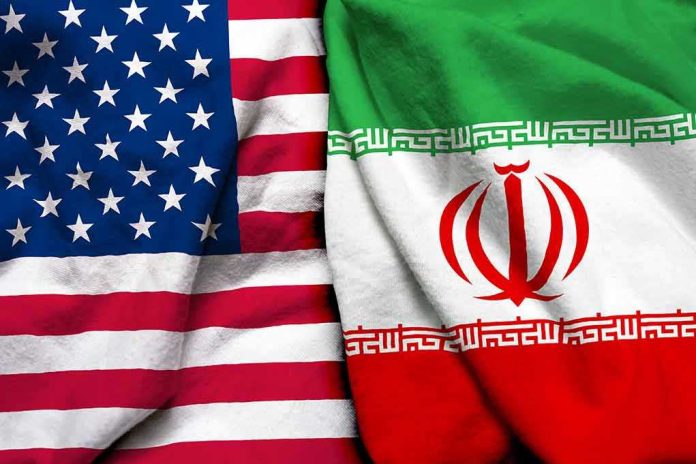
Congress’s most durable leverage over war is not a speech or a resolution; it is the appropriations line that can stop or sustain operations, and the current intraparty fight among Democrats over whether to use the December funding deadline to curb Iran-war spending is a case study in how that power actually works—and where it often falters.
At a Glance
- Democrats have a concrete legislative vehicle, H.R. 8707, that would bar funds for using military force in or against Iran absent a new authorization or a declaration of war.
- The White House has identified discrete, large-dollar needs tied to the conflict, making “Iran-war funding” budgetarily targetable rather than abstract.
- Party leaders are divided on tactics: some members want a hard cutoff now; others favor a stopgap that preserves leverage without risking a shutdown.
- Congress undeniably holds the purse; history shows funding curbs can bite—if the votes exist and the measure survives a veto.
The mechanism: how funding restrictions actually bite
When lawmakers talk about “ending a war” by cutting funds, they are invoking a straightforward constitutional mechanism: Congress decides whether the executive can spend money, on what, and under what conditions. The No Funds for Iran War Act (H.R. 8707) operationalizes that principle by forbidding obligation or expenditure of federal dollars for “any use of military force in or against the Islamic Republic of Iran,” unless Congress passes a fresh authorization or declares war after the bill’s enactment. The restriction runs through December 31, 2026, creating a time-limited, bright-line constraint keyed to statutory triggers rather than executive assurances.
This is not symbolism. It speaks to identifiable accounts. A Congressional Research Service synopsis of the administration’s June 2026 supplemental request details tens of billions of dollars linked to Operation Epic Fury, including about $21 billion for munitions and $17.3 billion for operational costs—precisely the kinds of line items a prohibition could fence off or condition. That structure is how Congress has historically translated the “power of the purse” into operational reality: by writing controlling language that attaches to appropriations Congress itself enacts.
The vehicle and the votes: where the proposal stands
H.R. 8707 exists on paper and in the congressional docket. It was introduced in the House and referred to the Foreign Affairs and Armed Services Committees. Its text is public, its scope is specific, and it has associated Democratic backers, including Senator Chris Van Hollen in the broader coalition pushing a no-funding posture. But a docket entry is not a whip count. As of the latest public record, the bill has not cleared either chamber; it sits at committee referral, with no House or Senate passage, and therefore no demonstrated path to enactment or to overcoming a presidential veto should one materialize. The legislative math—the only math that matters—has not been solved.
That gap informs Democratic leaders’ tactics. Reporting on internal deliberations is consistent: Senate leadership has not embraced a hard shutdown ultimatum to force an immediate cutoff. Senator Chuck Schumer has described working with Appropriations Chair Patty Murray to avert a lapse, while Murray has advocated a short-term continuing resolution extending current funding into early 2027—buying time and preserving leverage, but not delivering a December cutoff. In parallel, some Democrats are exploring middle-ground formats—temporary extensions with narrower restrictions or executive assurances—rather than an all-or-nothing standoff.
What counts as “Iran-war funding” in practice
The attraction of a targeted prohibition is its clarity: stop dollars that underwrite combat operations. The implementation is less tidy. Modern campaigns are financed across multiple accounts: operations and maintenance, procurement, working capital funds, intelligence program transfers, and State Department security assistance. The bill’s blanket language aims to avoid loopholes, yet it does not itself supply the granular map that budgeteers use to separate offensive sorties from force protection, maritime security, intelligence collection, or humanitarian movements. Without that map, executive branch lawyers often test permissible reprogramming and emergency authorities, especially when the commander in chief asserts ongoing national defense prerogatives. That is why durable cutoffs in the past have paired categorical bars with explicit exceptions and meticulous account-by-account fences, and why follow-on oversight—obligation reports, apportionment controls, and transfer restrictions—matters as much as the headline prohibition.
The administration’s supplemental request strengthens the case that a prohibition can be more than rhetorical—there are large, labeled asks bound to a named operation—but the mechanics of disentangling “combat against Iran” from “regional defense and presence” are the friction points where policy aims collide with logistics and law.
The precedent: Congress has done this before—when votes align
Congress’s authority here is not novel. The Vietnam-era cutoffs, culminating in 1973 with termination of funds for combat operations in Vietnam, Cambodia, and Laos, remain the canonical example; they succeeded because they commanded veto-proof majorities and were written to trump preexisting appropriations. Subsequent statutes imposed personnel ceilings and reporting mandates that narrowed executive options further. The through-line is consistent: when Congress musters the votes to condition or deny funds, the effect is operational, not advisory.
Where the record is equally consistent is on politics. Shutdown brinkmanship often overwhelms the underlying policy argument in the public mind, damaging trust and creating visible pain—furloughs, delayed services—while leaving the disputed policy untouched. That is why leaders in both parties routinely try to separate policy fights from the basic task of keeping the government open; the polling and institutional memory on shutdown fallout are brutal.
The real disagreement: leverage now or leverage later
The current Democratic split is less about constitutional theory than about timing and instruments. One camp argues that only a hard statutory fence—attached to a must-pass bill now—can force a recalibration of operations in and around Iran. They point to the existence of a clean legislative text and to discrete, high-dollar requests as evidence that “Iran-war funding” is a real, severable target rather than an amorphous talking point. The other camp, led by appropriators, worries that triggering a shutdown two weeks before Christmas reframes the fight as one over paying federal workers rather than one over war powers; they prefer a short CR with either narrower guardrails or a promise to prosecute the restriction once committee gavels change hands in the new year.
Both camps accept a stubborn constraint: without the votes to pass a cutoff and to sustain it against a presidential veto, the tactic fails. In that light, advocates see December’s deadline as unique leverage over a White House that wants uninterrupted operations funding; skeptics see the risk of handing the administration a political win and a narrative that Democrats are defunding troops rather than curbing offensive operations—a framing opponents will eagerly exploit.
Congress faces a December 11th deadline to pass government funding legislation or another continuing resolution (CR) to prevent a government shutdown beginning December 12th.
The negotiations are complicated by two separate obstacles: Republicans cannot advance a full… pic.twitter.com/uSwSX51hoa
— Decapolis (@DecapolisNews) November 18, 2026
Consequences and what would make the difference
Three questions determine whether this strategy can translate principle into outcome. First, can proponents specify the exact accounts, contracts, and transfer authorities that finance Operation Epic Fury and write fences tight enough to preclude backfilling via reprogramming or emergency powers? If yes, a prohibition becomes enforceable rather than aspirational. Second, can they assemble majorities in both chambers and either negotiate White House acquiescence or sustain the cutoff in the face of a veto? Without that, the policy collapses into messaging. Third, can they defend the distinction between ending offensive operations and maintaining force protection, maritime security, and humanitarian throughput, so that the fight isn’t caricatured as abandoning U.S. personnel? On all three, clarity helps, as does corroborating analysis from CRS or the Office of Legal Counsel on the interaction with the War Powers Resolution and existing appropriations.
Bottom line
Congress can curtail or end a military campaign by cutting funds; the Constitution and history say so. H.R. 8707 is a real vehicle aimed squarely at Iran-war spending. But the lever only moves the load when votes, drafting precision, and political sequencing align. Right now, the coalition is divided over using a shutdown deadline to force the issue versus banking leverage for early 2027. If advocates of an immediate cutoff want to prevail, they will need less rhetoric and more engineering: account-level specificity, veto-proof coalitions, and a framing that protects forces while constraining war.
Sources:
pjmedia.com, congress.gov, washingtonmonthly.com, huffpost.com, thehill.com, semafor.com, yahoo.com, constitution.congress.gov