
A new World Health Organization Ebola “global health emergency” is already fueling confusion, raising hard questions about borders, sovereignty, and how much power unelected global health bureaucrats should wield over free nations.
Story Snapshot
- World Health Organization declares a Public Health Emergency of International Concern over a new Ebola outbreak in Congo and Uganda.
- Global headlines scream “global health emergency,” even as World Health Organization admits this is not a pandemic.
- Hundreds of suspected cases, limited treatment tools, and cross-border travel are driving justified concern—but also fear.
- Americans must watch closely to ensure this crisis is not used to justify new permanent travel controls or government overreach.
What The World Health Organization Actually Declared
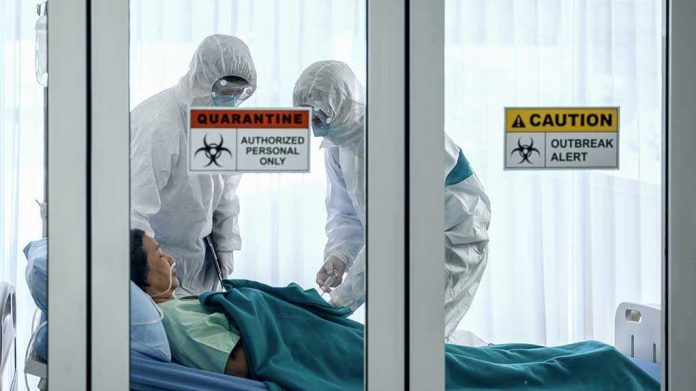
World Health Organization Director General Tedros Adhanom Ghebreyesus has formally determined that the Ebola disease outbreak caused by the Bundibugyo virus in the Democratic Republic of the Congo and Uganda meets the definition of a “public health emergency of international concern” under international health rules, after international spread was documented to Kampala, Uganda’s capital.[2] The determination triggers a higher level of alert and coordination, but the World Health Organization explicitly says this event does not meet the criteria of a pandemic emergency.[2]
World Health Organization guidance says confirmed Ebola cases should be immediately isolated in dedicated treatment centers and barred from any national or international travel until they test negative on two Bundibugyo virus diagnostic tests at least forty-eight hours apart.[2] The agency further recommends that anyone identified as a contact be monitored daily and face restricted domestic travel, with absolutely no international travel for twenty-one days after exposure.[2] These recommendations carry no direct force in the United States, but other governments often mirror them.
What Is Happening On The Ground In Africa
Reporting from international and regional health agencies shows a serious but still localized outbreak in eastern Democratic Republic of the Congo’s Ituri province, centered around mining towns where people travel frequently for work.[1][2] Estimates have shifted quickly as surveillance improves, with reports of hundreds of suspected cases and dozens of deaths—numbers that are still being reconciled across sources.[1][4] The World Health Organization warns that limited access, conflict, and displacement in the region likely mean the true number of infections is higher than what is currently detected.[1][3]
Health officials note that this outbreak involves the Bundibugyo strain of Ebola, which is different from the better-known Zaire strain that hit West Africa in 2014.[2][4] There are approved vaccines for Ebola virus disease generally, but the World Health Organization and allied experts say there are no approved drugs or vaccines specific to Bundibugyo, only a candidate vaccine that has shown partial protection in animal studies.[2][4][5] That reality forces doctors to rely on traditional public health tools: rapid isolation, contact tracing, infection control in hospitals, and safe burials for victims.[2][5] These limitations understandably increase anxiety in affected communities.
Media Alarm Versus World Health Organization’s Own Language
Global outlets have rushed to label this decision a “global health emergency,” a phrase that sounds very close to “global lockdown” for many readers who still remember the worst abuses of the coronavirus response.[1][3][4] Yet the World Health Organization’s own legal language is more precise: this is a Public Health Emergency of International Concern, not a pandemic, and the agency explicitly advises against blanket border closures at this time.[2] That gap between technical language and media shorthand fuels public confusion and mistrust, especially in free societies burned by past alarmist coverage.
World Health Organization documents admit that some early situational awareness has been incomplete, including at least one suspected case that later tested negative.[3] Figures on suspected cases and deaths vary between the World Health Organization, Africa’s regional disease control agency, and broadcasters, reflecting a fast-moving situation where data are updated daily.[1][4] The agency also acknowledges that three weeks passed between the first suspected case and formal confirmation, suggesting health workers initially had a low index of suspicion.[3] Those realities argue for vigilance—but also for caution before accepting every dramatic headline as settled fact.
Why This Matters For American Sovereignty And Freedom
International health alerts can be useful tools to mobilize aid, support African partners, and keep dangerous diseases from spreading further. At the same time, American conservatives remember how coronavirus-era declarations became the pretext for sweeping mandates, church closures, school shutdowns, and attempts to police speech online. The World Health Organization now urges governments to activate national disaster mechanisms and expand screening at borders and major roads, steps that can be appropriate overseas yet must never become automatic triggers for new permanent controls on American citizens.[1][2][3]
World Health Organization (WHO) has determined the Ebola virus disease (EBV) epidemic caused by the Bundibugyo Ebola virus (BDBV) in the Democratic Republic of Congo (DRC) 🇨🇩 and Uganda 🇺🇬 as a Public Health Emergency of International Concern (PHEIC) as defined in the provisions… https://t.co/xFCOfkaB1k
— Vera Ghali, MD (@veraghali) May 17, 2026
Because this Ebola event is not a pandemic and remains confined to central Africa, the United States has a clear interest in helping stop it there while protecting our own sovereignty.[2] The Trump administration can insist that any American response be grounded in transparent data—such as full case lists, laboratory documentation, and clear distinctions between confirmed and suspected deaths—rather than vague models or worst-case rhetoric.[1][2][3] That approach respects both human life abroad and constitutional limits at home, avoiding the kind of open-ended “global emergency” mindset that so often invites mission creep and erosion of individual liberty.
Sources:
[1] Web – WHO Declares Ebola Outbreak in Congo and Uganda a Global …
[2] Web – Epidemic of Ebola Disease caused by Bundibugyo virus in the …
[3] Web – WHO declares Ebola outbreak a global public health emergency
[4] YouTube – WHO declares global health emergency over the Ebola outbreak in …
[5] Web – WHO Declares ‘International Emergency’ Over Ebola in DR Congo …