

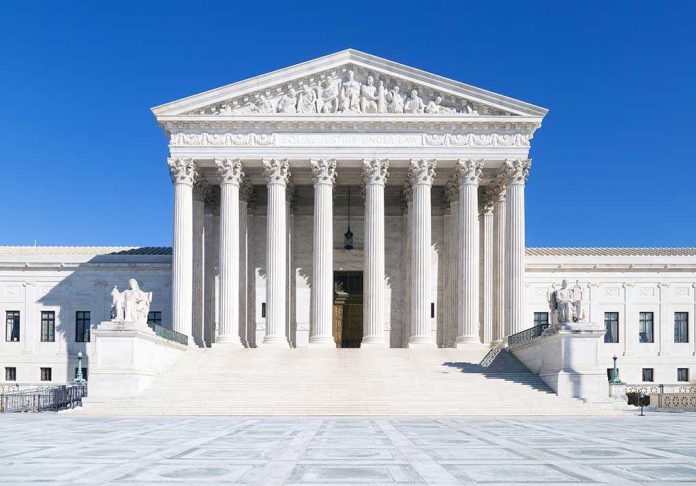
Kamala Harris’s renewed push to “brainstorm” Supreme Court expansion signals a direct attempt to tilt judicial outcomes by adding seats until the left gets its way.
Story Highlights
- Harris has repeatedly said she is “open” to adding justices to the Supreme Court [3].
- Recent remarks urge Democrats to consider court expansion and other structural changes [1].
- Critics warn that packing the Court would politicize the judiciary and erode public trust [7].
- Supporters frame expansion as a remedy for alleged “red state” manipulation in elections [6].
Harris Revives Openness to Adding Supreme Court Seats
Kamala Harris publicly described herself as “open” to adding seats to the Supreme Court during the 2020 cycle and has reiterated that stance in subsequent discussions about judicial reform [3]. Video and reporting capture her encouraging Democrats to consider ideas for structural changes, including expansion, as part of a broader post-2028 strategy conversation [1]. Progressive outlets have framed her position as consistent and deliberate, presenting expansion as a pathway to counter decisions they view as ideologically skewed [2].
Statements attributed to Harris show an effort to normalize court expansion as one of several institutional “reforms,” alongside proposals that would rewire long-standing constitutional guardrails that limit federal dominance in elections and state policy [2]. Her framing positions expansion as restorative rather than radical, but it relies on political dissatisfaction with current rulings rather than on a constitutional requirement or a judicial crisis defined by law or precedent [3]. The push underscores a strategy to reshape outcomes by changing the Court’s size.
Supporters Claim Expansion Counters “Red State Cheating”
Coverage shows allies promoting expansion as a response to alleged “red state” misconduct in elections and districting, casting the Court as complicit unless its composition changes [6]. This narrative asserts that adding justices would neutralize outcomes they believe emerge from partisan manipulation. The argument rests on political judgments, not on evidence of unlawful Court behavior cited in these materials, and it treats an institutional overhaul as a corrective for contested policy disputes rather than proven legal abuses [6].
Proponents emphasize that Congress can set the number of justices by statute and note the Court has not always had nine seats in history, implying expansion is merely another legislative adjustment [2]. That claim is technically accurate about Congress’s authority, but the rationale offered in these sources centers on present-day ideological goals rather than neutral administrative needs. Conflating lawful authority with prudent governance risks transforming a stabilizing institution into a power prize awarded to whichever side can add the most seats fastest.
Critics Warn of Escalation and Eroded Legitimacy
Conservative and institutional critics argue that packing the Court would accelerate a cycle of retaliation that undermines judicial independence and public confidence [7]. They contend that if one party expands the bench to secure short-term wins, the other will counter upon regaining power, pushing the Court into permanent political warfare. Such escalation would reduce the Court’s ability to serve as a constitutional backstop, leaving citizens with fewer protections against sweeping federal or state overreach in future cycles [7].
Kamala Harris proposes Supreme Court expansion and statehood for Puerto Rico, D.C. The move could shift political balance, impacting energy and financial markets. Investors are watching closely.
— Vermouth (@vermoutharc) May 17, 2026
Skeptics also stress that disliking outcomes is not proof of illegitimacy. Lawful decisions remain part of the constitutional order unless overturned through established means. Transforming structure to chase preferred rulings teaches politicians to change referees instead of improving arguments, legislation, or enforcement. For conservatives, that invites long-term dangers to religious liberty, the right to bear arms, election integrity safeguards, and limits on bureaucratic power—areas where a neutral, trusted Court is essential to preserve constitutional rights.
Bottom Line for Constitutional Conservatives
Harris’s recorded openness to Supreme Court expansion and her call to “brainstorm” structural changes keep the idea in active circulation among Democrats [1][3]. Supporters pitch expansion as a fix for perceived election and redistricting abuses, but the sources here do not present specific legal defects requiring immediate restructuring [6]. Conservative leaders responding in the record frame the plan as institutional arson that would politicize the judiciary and corrode trust, warning of tit-for-tat court wars that endanger constitutional guarantees [7].
Sources:
[1] YouTube – Kamala Harris URGES Dems to ‘brainstorm’ whether to EXPAND …
[2] Web – Kamala Harris Has Already Made the Case for Court Expansion
[3] Web – Harris Has Expressed Being “Open” to Supreme Court Expansion
[6] Web – Kamala Harris calls for Supreme Court expansion to take down ‘red …
[7] Web – Kamala Harris calls on Democrats to expand Supreme Court, reform …