

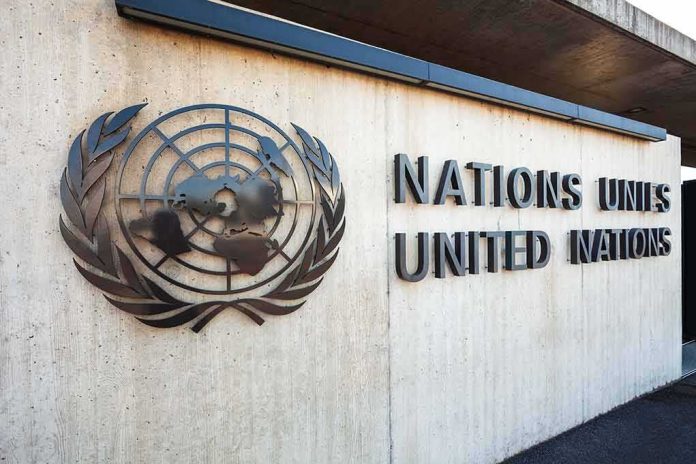
Germany just suffered its first-ever failed bid for a United Nations Security Council seat, and the vote tally tells a harder truth than the headlines.
Story Snapshot
- Austria and Portugal captured the two Western Europe–group seats while Germany fell short of the two-thirds bar [2].
- German officials cited a late candidacy and policy headwinds on Israel and Ukraine as obstacles [2].
- Berlin had framed its campaign as taking more responsibility in global crises, not a prestige play [4].
- The secret ballot leaves motives murky, fueling competing narratives about why Germany lost [2].
What happened in the vote, and why it matters
Austria and Portugal won election to the 2027–2028 non-permanent seats on the United Nations Security Council from the Western Europe and Others group, leaving Germany below the winning threshold. Reporting placed Germany at 104 votes, short of the 129 needed for the two-thirds majority, while Austria and Portugal cleared the bar [2]. This marks the first time Germany has failed to secure a non-permanent seat after previously successful terms, turning a routine ballot into a reputational bruise with real diplomatic consequences [2].
Germany’s Foreign Office had pitched the bid as a commitment to shoulder more responsibility and help address global crises, not as a vanity project [4]. That framing underscores the sting of the outcome: a country that contributes significantly to the United Nations and often casts itself as a stabilizing power could not assemble the votes when it counted. The result does not change Germany’s clout overnight, but it does narrow the platform from which Berlin can shape sanctions debates, peacekeeping mandates, and crisis responses in 2027–2028 [2].
How Berlin explains the defeat
German officials pointed to multiple headwinds: a late candidacy announcement compared with Austria and Portugal; a campaign that, in their telling, “fought to the last minute”; and clear positions on Ukraine and Israel that not all United Nations members share [2]. That is a plausible mix. Early entrants typically bank pledges well in advance in these regional slates, and sharp policy stances can harden opposition in a secret ballot. None of that proves a broad decline narrative; it does show the cost of running a compressed, values-forward campaign [2].
Outside analysts layered on sharper critiques. One expert quoted by Anadolu linked the failure to perceived double standards in German foreign policy, arguing that parts of the Global South saw inconsistency in Berlin’s rhetoric and responses across conflicts [3]. That claim aligns with wider debates about Western credibility but stops short of hard attribution. The ballot is secret, and no member states have publicly documented voting motives. Treat it as a working hypothesis, not a settled verdict [3].
The arithmetic of a crowded slate
Three Western European and Others candidates chased two seats: Germany, Austria, and Portugal. That geometry alone raises the bar for coalition discipline and favors campaigns that lock in early commitments through regional and issue-based caucuses. Germany itself acknowledged that specific structure when announcing its candidacy, placing its bid in direct competition with near neighbors rather than in an uncontested lane [4]. When votes consolidate around two well-prepared campaigns, the late entrant pays a premium at the ballot box [2][4].
Germany lost its UN Security Council bid — 104 votes, beaten by Portugal and Austria.
Now, German Chancellor Merz announces a new bid… for 2035.
His plan this time: Block competing candidates from within the Western European group. https://t.co/pMQnLxHS4g pic.twitter.com/awkmhlU3WJ
— Adam Scott (@chefcascottccc) June 5, 2026
Conservative common sense points to a straightforward takeaway: results reflect preparation, timing, and message coherence more than grand theories of civilizational decay. If Germany wants a seat next time, start earlier, align promises with capacity, and avoid preaching what cannot be delivered. Values do matter; so does retail diplomacy. The United Nations General Assembly rewards the country that keeps its phone calls returned and its quiet assurances kept, especially when everyone votes without their name on the board [2][4].
What to watch next
Berlin will pursue an after-action review, publicly or privately, that tests three questions: Did late entry actually cost decisive pledges; did positions on Israel and Ukraine materially move blocs against Germany; and did Austria and Portugal simply out-organize Berlin in critical regional groupings [2][4]? Answers require primary records that remain scarce: official General Assembly tallies, mission statements after the vote, and internal campaign calendars. Until then, treat grand narratives with caution and the math with respect [2][4].
Sources:
[2] Web – Germany Bids for a Seat on the UN Security Council for 2027–2028
[3] YouTube – For the first time, Germany fails its bid for the UN Security Council
[4] Web – German expert says failure to win UN Security Council seat linked to …