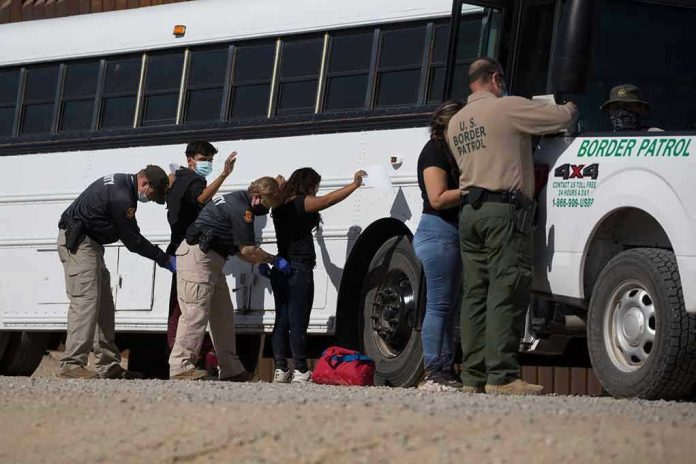
The death of 28‑year‑old Mexican tourist Juan Jairo Coronilla Durán on a Florida highway after an encounter with immigration agents is not just a tragic anomaly; it is a clear window into how routine enforcement tactics can turn an ordinary roadside stop into a fatal event for people who have done nothing more than cross paths with ICE.
Key Points
- A Mexican man, later identified as Juan Jairo Coronilla Durán, was struck and killed by a tractor-trailer while fleeing an ICE and Homeland Security Investigations encounter near St. Augustine, Florida.
- Coronilla Durán was in the United States on a valid tourist visa, visiting family and vacationing, with a return trip planned to Mexico; he was not in the country unlawfully, according to Mexican officials and advocates assisting his widow.
- The incident began at a gas-station stop along State Road 16 when federal agents approached a car with four occupants; all four fled on foot, and Coronilla Durán ran into the highway where he was hit by a semi-truck and died at the scene.
- His death is one of several fatal incidents in a short span involving people fleeing immigration enforcement, intensifying longstanding concerns about ICE tactics, accountability, and the risks embedded in everyday operations.
What Happened in St. Augustine
On a July morning just before 7 a.m., a car with four occupants pulled into the parking lot of a Wawa gas station off State Road 16 in St. Augustine, Florida. Federal immigration agents from Immigration and Customs Enforcement (ICE) and Homeland Security Investigations were conducting an operation in the area and approached the vehicle. At some point during this encounter, all four occupants bolted from the car and ran on foot. One of them, later identified as 28‑year‑old Mexican national Juan Jairo Coronilla Durán, ran out of the parking lot and attempted to cross the multi‑lane state highway.
According to the Florida Highway Patrol, Coronilla Durán ran across State Road 16 and into the path of an oncoming tractor‑trailer. The truck driver was unable to avoid him, struck him, and then stopped and tried to render aid at the scene. Emergency responders arrived, but Coronilla Durán died from his injuries at the roadside. Witnesses later described seeing him lying on the pavement as bystanders and first responders attempted CPR, emphasizing that “he didn’t die alone.”
In the immediate aftermath, the Department of Homeland Security (DHS) issued a terse statement acknowledging that “DHS law enforcement conducted an operation near St. Johns, Florida” and that the Florida Highway Patrol and Homeland Security Investigations were “investigating an incident resulting in the death of a Mexican national.” Notably, federal officials did not publicly name the deceased in the days that followed, even as local organizations and the Mexican government did so.
Who Juan Jairo Coronilla Durán Was — and Why He Was in the U.S.
While U.S. authorities withheld his name, advocates and Mexican officials pieced together the story of the man behind the headlines. Orlando‑based nonprofit Colectivo Árbol, which supports immigrant and farmworker communities, identified the victim as Juan Jairo Coronilla Durán, a 28‑year‑old from San Luis de la Paz in Guanajuato, Mexico. He was married and the father of two young children. Far from being a long‑term undocumented resident, he had traveled to the United States recently and lawfully.
According to Colectivo Árbol’s director, Isaret Jeffers, and to officials from the Guanajuato state government, Coronilla Durán entered the U.S. on a valid tourist visa. He initially flew to Atlanta to visit relatives and friends in Georgia, staying there about three weeks before heading to Florida to enjoy the beaches. His wife, Yezzika (or Yésica) Alamilla López, told reporters that he had been in Florida only a couple of days by the time of the encounter with ICE. Advocacy groups assisting the family add that he had already bought a return ticket and was scheduled to fly home that same week.
This matters because it undercuts any assumption that the fatal encounter arose from a lengthy cat‑and‑mouse game between immigration officers and someone deeply embedded in the shadow economy. Coronilla Durán was the archetype of a short‑term visitor: documented, with a visa, family waiting at home, and plans to leave. The available reporting contains no indication that ICE had a prior deportation order against him or that he was otherwise a known enforcement target; at this stage, public information simply establishes that his path intersected with a broader operation.
Inside the Enforcement Operation: What We Know and What We Don’t
DHS’s description of the St. Augustine incident is strikingly minimal. The agency has confirmed only that “DHS law enforcement conducted an operation” and that state and federal entities are investigating the death. Florida Highway Patrol’s account provides the operational skeleton: ICE and HSI agents were running an enforcement action; a vehicle with four occupants pulled into the Wawa; agents approached; all four fled on foot; and one person ran into the path of a truck on State Road 16.
Several key questions remain unanswered in the public record. It is not yet clear what triggered the initial decision to approach the vehicle, what the agents communicated to the occupants, or whether the agents identified themselves clearly as immigration officers. Nor is it public whether any of the four occupants, including Coronilla Durán, were the specific subjects of an enforcement warrant or were simply stopped as part of a broader sweep. Those details may be captured in internal DHS and FHP investigative files that, historically, emerge slowly if at all.
What is uncontested, however, is the immediate chain of events: an ICE/HSI approach, a flight on foot, a dash into a busy highway, and a fatal collision with a semi‑truck. In that sense, the St. Augustine case fits a now‑familiar pattern where immigration enforcement operations, even without gunfire or physical force by agents, create situational pressures that make sudden, life‑threatening flight more likely.
A Pattern of Deadly Encounters Around Flight and Vehicles
Coronilla Durán’s death was not an isolated tragedy. It was, by several counts, at least the third ICE‑related fatality in roughly a week, and one of multiple incidents in which people fleeing from immigration agents have been killed by vehicles. Civil rights groups such as the ACLU of Florida highlighted that he was the third person in a week to die in connection with ICE actions, underscoring rising alarm about how routine operations can end in death.
Researchers and advocates have documented a broader pattern: when individuals flee immigration agents—whether because they fear deportation, mistrust authorities, or simply panic—encounters can escalate rapidly into vehicular deaths or shootings. A compilation of fatal encounters with Customs and Border Protection (CBP) and ICE includes multiple cases in which people attempting to escape ran across roads and were struck by cars or trucks, or were shot at after being perceived as threats in or near vehicles.
Data obtained through public‑records litigation and investigative reporting shows at least 59 shootings by ICE officers from 2015 to 2021 across 26 states and two U.S. territories, with additional incidents since then. A congressional briefing paper notes that at least 32 people died in ICE custody in 2025—its highest figure since 2004—and that 2026 opened with a cluster of deaths in custody and in public spaces linked to ICE operations. Against this backdrop, a fatality like Coronilla Durán’s is alarming not because it is unimaginable, but because it is disturbingly consistent with known risks in how enforcement is conducted.
Community Response and Demands for Accountability
In the days after the St. Augustine death, local groups moved more quickly than federal agencies to frame what happened. The Jacksonville Immigrant Rights Alliance publicly identified the victim, organized a downtown rally, and called for concrete steps: termination of the 287(g) agreement that allows local deputies to perform immigration functions, an independent investigation into the incident, accountability for the cluster of ICE‑related deaths nationwide, and protection for immigrant‑rights advocates.
Separate vigils and memorials were held in the St. Augustine area, including one organized by a veterans’ group, underscoring that concern over the death cut across typical political lines. Support networks such as Colectivo Árbol focused on immediate support for Coronilla Durán’s widow and children, navigating the logistics and expense of repatriating his body to Guanajuato and helping the family make sense of an avoidable loss. On social media, the case drew international attention once it became clear he had a valid visa and a return flight booked; to many observers, the notion that a lawfully present tourist could die in this way crystallized anxieties about the arbitrariness and danger of present‑day enforcement.
How Lawful Tourists Get Swept Into Enforcement Risk
The most unsettling aspect of the St. Augustine case is that Coronilla Durán was not, as far as the available record shows, the archetypal target of ICE’s interior enforcement. He had not overstayed his visa by years; he had not been arrested for some other crime that put him on ICE’s radar; he was, instead, a short‑term tourist visiting family, stopping for gas on the way to the beach.
Yet his lawful status did not insulate him from the fear and chaos of an enforcement encounter. Many non‑citizens—documented and undocumented alike—experience ICE as opaque and punitive. Stories of raids, detentions, and sudden deportations circulate quickly through immigrant communities, often without the nuance of which categories of people are at highest risk. In that environment, the appearance of armed federal agents at a gas pump can trigger panic regardless of legal status. Advocates familiar with Coronilla Durán’s case have suggested that he may have fled simply out of fear, not because he knew himself to be deportable.
From a policy perspective, this is a critical design flaw: an enforcement model that relies on surprise field operations, heavily armed teams, and the co‑optation of mundane spaces like gas stations and convenience stores will inevitably generate panicked flight. Once an individual runs into a roadway, the line between “enforcement consequence” and “civilian traffic death” becomes morally and operationally thin.
What This Death Reveals About ICE Tactics and Oversight
Coronilla Durán’s case underscores longstanding concerns about transparency and accountability in ICE operations. DHS’s initial public statement—acknowledging only an “operation” and a death, without naming the victim or clarifying the legal basis for the stop—is typical of a system where internal reviews are slow and rarely public, and where independent oversight is limited. Investigations are generally handled by internal DHS components and, in cases like this, by state law enforcement focused on the mechanics of the collision, not the prudence of the operation that set it in motion.
Critics argue that this structure allows ICE to frame deaths as unfortunate byproducts of individual choices—“he ran into traffic”—rather than as foreseeable outcomes of agency tactics. Supporters of robust enforcement, by contrast, tend to emphasize personal responsibility for flight and point out that agents in St. Augustine did not fire a weapon or physically strike Coronilla Durán. Both descriptions are, in their narrow way, accurate. But the broader evidence record around ICE and CBP encounters makes clear that the real question is upstream: what kinds of operations, in what kinds of spaces, with what instructions about pursuit and de‑escalation, are likely to create situations where someone runs for their life into a highway?
Without answers to that question—and without transparent reporting on when, where, and how these deaths occur—cases like Coronilla Durán’s will continue to appear as isolated tragedies rather than as predictable results of institutional design. For communities watching yet another father or mother die in the shadow of an enforcement operation, the pattern already feels unmistakable.
🔴 Mexican tourist on valid visa killed by truck after fleeing ICE encounter in Florida
Juan Jairo Coronilla Durán, 28, died July 14 after running across a busy road in St. Augustine into the path of a semi-trailer during an encounter with ICE and Homeland Security… pic.twitter.com/sUIB162ST6
— NewsTongue (@NewsTongueX) July 21, 2026
What to Watch Going Forward
The investigations by Florida Highway Patrol and Homeland Security Investigations will eventually produce formal findings on the St. Augustine incident, though it is far from guaranteed that those reports will be public in full. The specific facts that emerge—what information agents had before approaching the vehicle, what they communicated, whether they pursued the fleeing occupants, and what guidance they had on disengaging near high‑speed roads—will matter not only for evaluating this case, but for understanding the systemic risks in ICE’s approach.
In the meantime, Coronilla Durán’s death already stands as a case study in the dangers of current enforcement practice. A man with a valid tourist visa, visiting friends and family, stopping for gas on the way to enjoy the Florida coast, encountered immigration agents and ended up dead under a semi‑truck. That sequence is not inevitable; it is the product of choices about where, how, and against whom immigration power is deployed.
Sources:
washingtontimes.com, abcnews.com, english.elpais.com, excelsior.com.mx, news4jax.com, facebook.com, wokv.com, cnn.com, substack.com, ground.news, instagram.com, justice.gov, chicagotribune.com, southernborder.org, aclufl.org, wusf.org, wired.com, thetrace.org, youtube.com