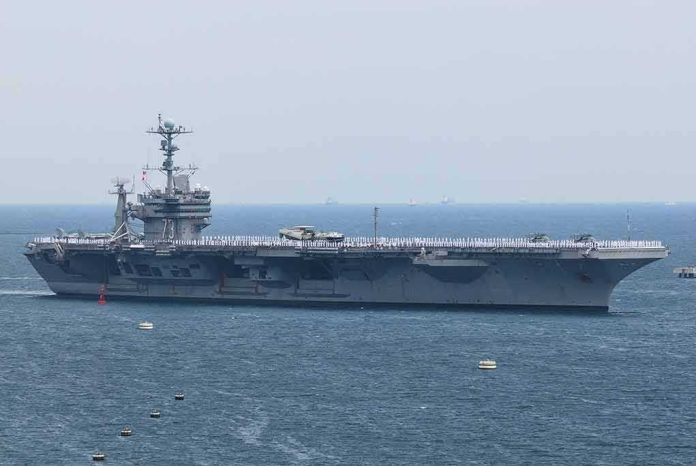
When governments and armed movements say they have an “understanding,” what matters most isn’t the adjective but the behavior that follows; in the case of U.S.–Houthi contacts, the public record points to real communication but imprecise, shifting terms that leave ample room for both sides to claim success without publishing a document.
The Short Version
- President Trump publicly said the Houthis “don’t want to fight with us” and claimed “constant communication,” a line repeated across multiple outlets.
- Parallel reporting and on-record comments from Vice President Vance indicate direct conversations occurred, likely via Omani channels.
- Houthi-linked figures have framed the situation as a ceasefire with the U.S. since 2025 and denied “direct” talks, even as they emphasize not targeting U.S. vessels.
- The mix of public vagueness and private messaging tracks with prior U.S.–Houthi de-escalations: verbal, narrow in scope, and calibrated for political effect.
What the evidence actually supports
The strongest publicly available thread is the President’s own formulation: that the Houthis “called us” and “don’t want to fight with us,” paired with “constant communication” and an understanding not to fight the United States. These statements were reported and re-reported by a range of outlets in the same news window, reflecting consistent quotations rather than a single stray remark. The claim did not stand alone: in contemporaneous coverage, Vice President Vance said the administration had been engaged in direct conversations with the Houthis, an unusually explicit admission given the political sensitivities around engaging a militia long linked to Iran. None of these reports supplied a text, transcript, or official readout; they did, however, align around the proposition that contact was active and consequential to U.S. force protection.
There is limited elaboration on scope. One summary attributed to a senior Houthi official described a commitment not to target U.S. vessels in the Red Sea—narrower than a global “non-fight” pledge—and noted that precise terms were not public. This narrowing matters: a promise not to target U.S. ships is not a blanket renunciation of hostilities against U.S. partners, shipping linked to them, or regional targets. Still, as a practical matter for naval operations, a vessel-specific assurance can be the difference between a spiraling confrontation and a bearable status quo.
Why the wording is so elastic
Diplomacy with armed movements often proceeds without formal instruments—especially when a government wants to preserve deniability, or when recognition confers status the state is unwilling to grant. In the Red Sea theater, that dynamic has recurred: short-of-treaty “understandings,” verbal ceasefires, and mediated messages have functioned as the operating system for de-escalation. In 2025, U.S.–Houthi de-escalation was described as verbal and limited; analysts noted it did not codify every demand Washington had sought and that its boundaries were contested almost immediately. This pattern explains why leaders lean on phrases like “constant communication” and “they don’t want to fight with us”—it signals effect (reduced risk to U.S. assets) without tying policy to a signed accord that can be litigated later.
For Washington, the political upside is straightforward: demonstrate that a mix of pressure and back-channeling is working if U.S. assets are spared. For the Houthis, a narrow pledge can separate the United States from Saudi Arabia, depicting the latter as the primary belligerent while avoiding a fight with the world’s most capable navy. That asymmetric storytelling is not contradiction; it is the coin of proxy conflict.
The counter-claims, weighed
Houthi-linked figures have denied “direct” talks while invoking a standing ceasefire with the United States dating to 2025 and emphasizing that recent escalatory actions were targeted at Saudi shipping, not U.S. vessels. The denial turns on process and optics—“no direct talks or announced talks”—rather than the absence of contact altogether, and can readily coexist with Oman-mediated exchanges, the most common conduit for messages in this file. In practice, “not direct” can still mean substantive dialogue through a trusted intermediary.
Crucially, these same Houthi-facing statements accept a functional separation: they assert no targeting of U.S. vessels. That squares with the administration’s claim at a minimum level—deconfliction around American assets—while rejecting Washington’s framing that the Houthis “agreed not to fight the U.S.” in a broader sense. On balance, the counter-claims do not upend the core: communication occurred and had real operational content. They do, however, caution against assuming a comprehensive or durable peace between adversaries whose interests still collide.
Mechanics: how such understandings are struck
When the parties cannot or will not confer publicly, three channels dominate. First, mediator relays: Oman has long served as a discreet venue for messages between U.S. officials and groups aligned with Iran; analysts and reporters have traced multiple rounds of U.S.–Houthi contacts to Muscat or Omani facilitation in recent years. Second, operational deconfliction: navies and militaries use established patterns and third-party nodes to signal red lines—what ships, routes, and behaviors will trigger responses. Third, political signaling at the top: leaders state—and restate—the outcomes they want observers to infer, solidifying a narrative that shapes behavior at the edges. All three are visible here in some measure.
None of those channels are designed to produce a white paper. They are meant to stem risk in the near term. That modesty is their virtue and their vulnerability; they fray as the larger conflict ecosystem shifts. When regional crises compound—Saudi–Houthi exchanges, Iranian pressure tactics at Hormuz, Israeli–Gaza escalations—the gravitational pull back toward confrontation strengthens, and narrow understandings need constant tending.
Behavior is the proof that counts
Because neither side published terms, the fairest way to test the claim is empirical: did targeting behavior shift? Independent incident datasets and maritime reporting have previously recorded pauses in Houthi attacks on U.S.-flagged or U.S.-operated ships during de-escalation windows, even as pressure on Saudi or Israeli-linked targets persisted. Analysts have described those halts as real but partial, consistent with the verbal, scoped nature of prior understandings. This is the critical lens for any new claim of contact: watch what happens at sea and across the air-defense logs, not just what is said at a microphone.
That approach also protects policy from semantic games. Whether an official calls it a pledge “not to fight the U.S.” or a commitment confined to “not targeting U.S. vessels in the Red Sea,” the operational question is the same: are U.S. ships, bases, and aircraft left alone, and for how long? The broader war framework—Saudi–Houthi exchanges, Iranian guidance, and great-power maritime moves—sets the outer limits of any such quiet bargain.
As Saudi Arabia launches hundreds of airstrikes on Yemen and Trump threatens to “annihilate” Iran, Ottawa is criticizing Ansar Allah. Yet the flagrant imperial double standard passes with nary a mention.
Since breaking a four-year ceasefire by striking the Sanaa International… pic.twitter.com/NR60j3uf6x
— Yves Engler (@EnglerYves) September 21, 2026
What to watch next
Three signposts will separate durable understanding from momentary lull. First, channel clarity: even indirect acknowledgment from Muscat or a U.S. agency readout would harden the record around the mechanism of contact, which is the current gap in public evidence. Second, scope discipline: if statements converge around specific protected categories—U.S.-flagged vessels, U.S. naval platforms, U.S. territory—expect better adherence; ambiguity invites slippage. Third, reciprocity: sustained restraint usually rests on reciprocal limits, whether in targeting, sanctions application, or support to partners. If one side seeks maximalist gains while the other treats the understanding as an on-off switch, breakdown is predictable.
Sources:
realcleardefense.com, english.ahram.org.eg, washingtonexaminer.com, gulfnews.com, news.cgtn.com, outlookindia.com, indiatvnews.com