When the country argues about “kings,” constitutions, and creeping executive power, words on the record matter; on election night, President Trump put two consequential markers down at once—he said he would accept the midterm results and he framed his leverage not as a crown but as the constitutional veto.
At a Glance
- Trump told New York Times reporters he was “absolutely willing to accept” the midterm results and said he expected to work with Democrats.
- In his election-night remarks, he emphasized the presidential veto as his core leverage with an opposition Congress, repeatedly calling it “the ultimate power.”
- The constitutional architecture is clear: Congress legislates, presidents sign or veto, and supermajorities can override; there is no legal pathway to a third term under the Twenty-Second Amendment.
- Rhetoric about dominance and vetoes coexists with firm legal limits; understanding the boundary between hardball politics and monarchical claims requires keeping those limits in view.
What Trump said, and why it was the point that night
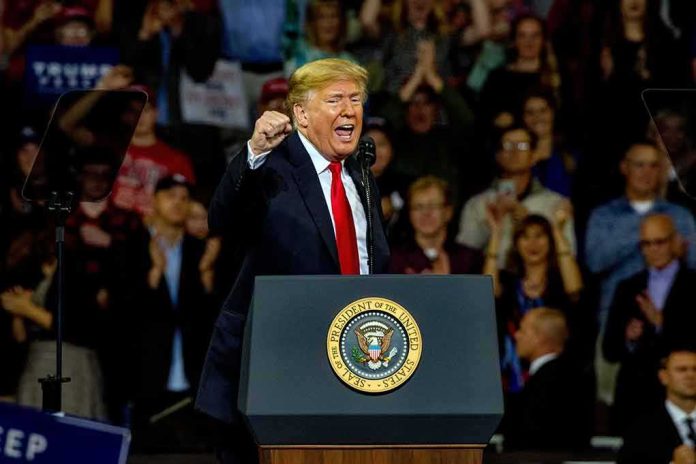
Two discrete exchanges anchor the record. First, in a phone interview with New York Times White House correspondents, Trump said he was “absolutely willing to accept” the election results and that his administration would work with Democrats going forward. The Times framed the call around that question—would he accept the outcome—and reported his affirmative answer on camera and in print. Second, in his election-night remarks, Trump separated his own standing from down-ballot Republican losses—he noted he “wasn’t on the ballot”—and concentrated on the institutional power that still attaches to the presidency: the veto. In that setting, he described it as “the ultimate power,” a phrase he repeated while sketching how he intended to deal with a Democratic Congress.
Those two statements do not dissolve political conflict; they delineate it. Acceptance of results addresses process legitimacy. Emphasis on the veto sets terms for policy bargaining. The president was not claiming new powers; he was declaring he would vigorously use ones the Constitution plainly grants.
How the constitutional machinery actually works
The presidential veto is a defined negative—an executive power to refuse assent to legislation. It is not a decree; it does not rewrite a bill; and it can be overcome if two-thirds of both chambers vote to override. In practice, its force lies less in the occasional formal veto than in how the threat of a veto shapes the bargaining space before a bill ever reaches the Resolute Desk. That is why presidents talk about it in muscular terms. It is also why opposition majorities emphasize hearings, agenda control, and coalition-building aimed at either accommodation or veto-proof margins. In short, the architecture presumes friction.
On term limits, the law is even more categorical. The Twenty-Second Amendment provides that no person shall be elected president more than twice; there is no nonconsecutive loophole that would allow a third election, and scholars across the spectrum treat that bar as dispositive. The amendment was proposed by Congress after Franklin Roosevelt’s four elections and ratified by the states in 1951; it codified what Washington began as a norm into a binding rule.
Rhetoric, norms, and the ever-returning “king” accusation
American politics periodically revives royal metaphors when three threads tangle: personalist rhetoric, sharp-elbowed use of executive tools, and loose talk about succession. That does not make every “king” charge frivolous; it does make precision indispensable. A president boasting about leverage is not the same thing as asserting monarchical prerogative. A veto threat, however emphatic, operates entirely inside the Madisonian design. And with respect to tenure, the legal line is bright—two elections and no more—regardless of swagger or nostalgia for further runs.
This is where Washington’s example and Roosevelt’s exception continue to shape the conversation. Washington’s refusal to run again established a republican norm of rotation that endured for a century and a half. Roosevelt’s third and fourth victories proved that norms can give way to politics. The Twenty-Second Amendment closed that door for good, transforming expectation into law and curbing any future attempt to convert popularity into indefinite incumbency.
What acceptance and veto talk signal for governing with an opposition Congress
An opposition Congress does not render a presidency powerless; it redistributes leverage. The majority in the House and Senate controls floor time, drafting, and investigative forums. The president, in turn, controls the executive branch, the administrative agenda, foreign policy leadership, and the ability to veto statutory changes he rejects. In that balance, two-way bargaining is not a courtesy; it is the only path to durable legislation. When Trump said he would accept the results and expected to work with Democrats, he acknowledged the first constraint. When he underscored the veto, he asserted the second. Both statements are consistent with the design the framers wrote and generations have practiced.
For citizens, the practical implications are concrete. Expect more negotiation at the edges of big-ticket items—appropriations, defense policy, reauthorizations, and tax provisions—because those are the bills that must pass and thus become vehicles for compromise or standoffs. Expect unilateral executive actions to proliferate where statutes leave discretion, followed by court tests. And expect messaging from each side to cast the other as obstructionist. None of that is monarchy; it is the normal friction of separated powers under divided government.
Why getting the record right matters
The health of a constitutional republic depends on two intertwined commitments: losing sides concede, and winning sides wield power within the rules. An on-the-record statement of willingness to accept results shores up the first commitment. A hard-edged but accurate description of the veto reinforces the second by invoking a power that is central, limited, and reversible by supermajorities. Conflating those with claims of kingship confuses rhetoric with law, and it obscures the actual lines of accountability that citizens can use to reward or punish behavior at the next election.
Sources:
tommyxtopher.substack.com, centraloregondaily.com, thedailystar.net, huffpost.com, congress.gov, wlr.law.wisc.edu