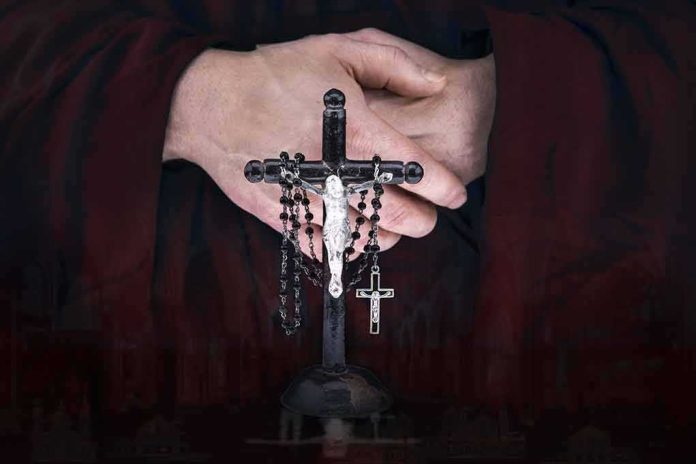
When art reaches for the sacred to tell a story about shame, desire, and identity, it reliably collides with those who hold the sacred as inviolable; Netflix’s The Body sits squarely in that fault line, not as an outlier but as the latest chapter in a long-running contest over what religious imagery is for and who gets to use it.
At a Glance
- The Body pairs Catholic iconography with a queer coming‑of‑age horror framework; its creator frames that mix as satire and personal metaphor, not doctrine.
- Critics, led by a petition campaign, allege blasphemy, citing promotional images, a Halloween‑to‑hell premise, and specific charges such as sexualizing clergy and mocking the Mass.
- Netflix markets the series as a raunchy teen psychodrama with “a dash of Catholic horror,” foregrounding genre play and identity themes rather than religious offense.
- In the United States, legal battles over “sacrilege” in film were settled decades ago; today’s fights play out through platform decisions, petitions, and culture‑war framing rather than censorship law.
What the show is and how its makers explain it
Start with what is on the label. Netflix’s synopsis doesn’t hide the collision it intends: on Halloween night, an all‑girls dance team stumbles into Catholic guilt, “unholy desires,” and ghostly visions after an initiation ritual goes wrong. The platform’s house editorial doubles down on that tonal blend, calling the series a gritty‑camp, raunchy teen psychodrama enlivened by “a dash of Catholic horror” and a playful spin on creator Quinn Shephard’s own teenage nightmares. In interviews, Shephard names her project directly: girlhood as a religious experience, filtered through the religious‑thriller tradition where shame and ecstasy sit side by side; she casts that framework as a fitting metaphor for queer coming‑of‑age, including the deliberately provocative line that realizing she was gay “felt like being possessed by a demon”—a genre conceit, not a doctrinal claim.
Mechanically, that creative choice does two things. It legitimizes overt Catholic aesthetics—not as background set dressing but as meaning‑making devices—and it invites viewers to read scenes of temptation, ritual, and transgression as allegories for identity formation. Whether one embraces or rejects the move depends on what one thinks religious symbols are allowed to do outside worship: instruct, critique, play, or never be touched at all.
The case for offense: specific charges from petitioners
Opponents argue the series crosses a line from allegory into sacrilege. A LifeSiteNews article and an affiliated petition catalogue particulars: promotional art timed to All Saints’ Day that, they say, dresses characters as mock saints—including one posed as an apparent Christ figure with a crown of thorns—and a storyline that, they contend, sexualizes a priest and Catholic schoolgirls, mocks the Mass, and stages a satanic offering of a “holy virgin”. Their critique is not vague discomfort; it itemizes alleged profanations and urges cancellation on that basis.
Two evidentiary cautions apply. First, the identification of a promotional character as Christ is interpretive; Netflix’s own pages show and describe Catholic imagery but do not themselves label a figure as Jesus, and no independent iconographic analysis is cited to settle that point. Second, the petition’s strength is mobilization, not adjudication: its signature count varies by report, and it does not point to a violated platform policy, regulator’s finding, or court order that would compel removal. Those limits do not nullify sincere offense, but they do define what kind of claim is being made—moral suasion aimed at a distributor, not a demonstrable rule breach.
Creative intent and the genre tradition it draws on
Shephard’s stated aim threads through contemporary coming‑of‑age storytelling: to satirize the trauma of growing up queer and repressed, and to map that psychic terrain onto a religious‑horror scaffold familiar from decades of cinema. In practice, that produces tonal hybridity—camp and provocation alongside sincerity about belonging, belief, and the desire to be loved. The demon‑possession metaphor that offends critics functions, in her account, as a way to dramatize an internal rupture rather than to declare homosexuality demonic or Catholic doctrine false; it is a device for conflict, not a catechism.
For viewers versed in the genre, this is recognizable craft. Religious thrillers habitually yoke taboo and transcendence because the symbolism is potent and legible; moving those tropes into a sapphic teen milieu is a change of subject, not of method. That does not make the work harmless—only that its mechanisms are standard tools of the form, here applied to a different lived experience.
Where the real disagreement lies
The substantive dispute is not over whether Catholic imagery is present—it plainly is—but over legitimacy of use. One side sees a satirical, autobiographical exploration of shame and desire in the idiom of horror and camp; the other sees desecration of what is owed reverence, with sexualization of clergy and parody of sacraments beyond the pale. Absent a magisterial judgment or a neutral liturgical analysis tied to specific scenes, “blasphemy” remains a theologically freighted accusation rather than an externally verifiable category in this context; the available public evidence consists of marketing materials, interviews, and advocacy characterizations, not a scene‑by‑scene exegesis against Catholic rubrics.
That evidentiary posture matters because it shapes remedies. If the problem is offense, the tools are audience choice, criticism, and counter‑speech. If the problem is demonstrable harm—say, to minors or to a protected class—then one looks for empirical studies, institutional complaints, or platform‑standard violations. The record surfaced here does not supply such harm evidence; it documents moral objection and calls for deplatforming.
Why this fight recurs—and how it tends to resolve
In the United States, the legal question of whether authorities may suppress a film as “sacrilegious” was answered in the last century: motion pictures are protected expression, and sacrilege as a censor’s category will not stand. Joseph Burstyn, Inc. v. Wilson (1952) is the canonical citation; after Burstyn, the struggle migrated from state censorship to market and cultural arenas—ratings boards, platform policies, advertiser sensitivities, boycotts, and publicity campaigns. In that ecosystem, petitions can influence a distributor’s calculus, but they do not operate as law; platforms weigh brand risk, subscriber sentiment, and creative positioning against backlash dynamics.
Digital mobilizations can set a narrative frame and draw press, but research on hashtag‑driven campaigns suggests the initiating narrative tends to dominate the conversation, while conversion into durable policy change is uneven; distributors respond most when controversies threaten broader reputational coalitions, not when they remain bounded to a single constituency. That pattern implies that The Body’s fate will hinge less on abstract debates over blasphemy and more on whether a wide slice of Netflix’s audience experiences the series as compelling art, objectionable provocation, or something safely ignorable.
How to watch critically—and argue well
Good‑faith viewers can do two things at once: take religious offense seriously as a lived experience for believers, and evaluate the show on the terms its makers propose—an allegory in a familiar horror lexicon about the dissonance of identity, desire, and belief. If one wishes to press the charge of sacrilege, the strongest case will move beyond marketing images to a documented, scene‑specific analysis measured against Catholic liturgy and iconography. If one wishes to defend the work, the strongest case will avoid hand‑waving about satire and instead show where the symbolism builds meaning rather than cheap shock, and why the demon metaphor reads as interior psychology rather than theological smear.
Sources:
lifesitenews.com, lifepetitions.com, teenvogue.com, media.netflix.com, netflix.com, them.us, academic.oup.com