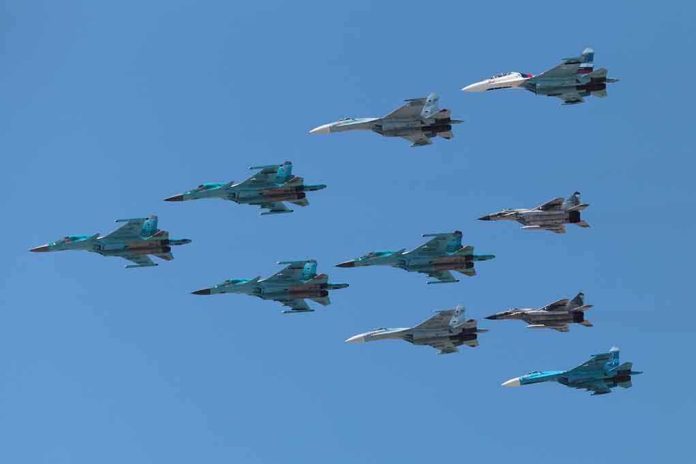
Three Chinese Y-9 reconnaissance aircraft and two Russian Il-20 intelligence planes probed the air corridors around Japan on four consecutive days in late October, forcing Japanese fighters into the sky each time — a sequence that lands squarely inside a pattern Tokyo’s defense establishment now treats as routine, even as the numbers behind it keep climbing.
Key Points
- Japan’s Joint Staff recorded five reconnaissance flights over four days — three Chinese Y-9 missions through the Okinawa–Miyakojima gap and two Russian Il-20 missions off Shimane Prefecture — each met by scrambled JASDF fighters.
- The activity coincided with Keen Sword 27, a Japan-U.S. exercise fielding roughly 45,000 Japanese personnel, 40 vessels, and 260 aircraft from October 19 to 29.
- No Japanese airspace violation was reported; the aircraft operated in or near international airspace, and Japan’s Joint Staff has not characterized the Chinese and Russian flights as coordinated.
- The episode fits a sharply rising baseline: JASDF scrambles hit 442 between April and September — a three-year high, up from 265 a year earlier, with Russian-related intercepts nearly tripling.
- Confirmed territorial airspace violations remain historically rare — just 46 recognized incidents between 1967 and 2023 — underscoring that scrambles signal vigilance, not breach.
What Happened, Day by Day
According to Japan’s Joint Staff, two Chinese Y-9 aircraft crossed the Okinawa–Miyakojima gap on October 20 and 21, tracing a route from the East China Sea into the Pacific toward waters off Amami Oshima before turning back. A third Y-9 mission followed the same corridor, a passage that sits astride one of the few open-water gaps linking the East China Sea to the Pacific and runs close to Taiwan’s northeastern approaches. On October 22 and 23, Russian Il-20 aircraft entered the Sea of Japan from the Russian mainland and flew toward waters off Shimane Prefecture before reversing course. Japan’s Southwestern Air Defense Force scrambled fighters for the Chinese flights; the Northern Air Defense Force and allied units responded to the Russian missions. A separate Ministry of Defense release tied to the exercise’s opening day describes JASDF fighters photographing a BZK-005 drone and a Y-9 that transited the same gap on October 19 — activity that may be additional to, or folded into, the five-flight tally, though the public record does not fully reconcile the two.
The Y-9 and Il-20 are not combat aircraft in the conventional sense; both are turboprop-based platforms built around signals-intelligence and maritime-patrol roles, designed to loiter rather than strike. Their value lies in sensors, not weapons — radar signature collection, electronic-order-of-battle mapping, and imagery of how an adversary’s air-defense network actually responds when tested. That is precisely why the timing matters more than the hardware. Keen Sword 27, which ran from October 19 to 29 and drew in Australian, American, and other allied assets alongside Japan’s own forces, created exactly the kind of dense, high-signal military environment that a reconnaissance mission is built to study.
Reading the Pattern, Not Just the Headline
It is tempting to read “spy flights near Japan” as an escalation story. The more accurate read is that this is the baseline now, and the baseline itself has been rising. Japan’s Ministry of Defense counted 669 scrambles in fiscal 2023, split roughly 479 against Chinese aircraft and 174 against Russian ones. By the first half of fiscal 2025 alone, scrambles reached 442 — a three-year high, up from 265 over the same months the year before — with Russian-related intercepts nearly tripling from 59 to 152 and Chinese-related intercepts climbing from 198 to 285. Set against that trajectory, the five flights recorded during Keen Sword 27 are not an outlier; they are a data point on a curve that has been climbing steadily for years, driven as much by expanded Chinese drone operations — Japan logged eight Chinese drone flights in fiscal 2023 and 23 the following year — as by manned reconnaissance sorties.
What has not changed, and what deserves equal weight, is the rarity of confirmed intrusion. Of the hundreds of scrambles logged annually, Japan’s Ministry of Defense has recognized only 46 actual airspace violations across more than five decades, from 1967 through 2023. Scrambling a fighter is a precautionary, defensive act triggered by an aircraft’s proximity and trajectory near Japan’s air-defense identification zone; it is not an admission that sovereign airspace was crossed. The October 20–23 flights fit that distinction cleanly — close, monitored, photographed, and unaccompanied by any claim of territorial breach.
Why Coordination Is the Open Question
The most consequential unresolved point is whether Beijing and Moscow timed these flights in concert or simply arrived at the same strategic calculus independently. Japan’s Joint Staff has not asserted coordination, and the public record — routes, timing, aircraft types — does not by itself prove joint planning. China’s reconnaissance activity concentrated on the East China Sea and the Okinawa–Miyakojima gap, a corridor it has probed with growing frequency and expanding platforms, from Y-9s to BZK-005 and TB-001 drones. Russia’s Il-20 activity, by contrast, approached from the Sea of Japan toward Shimane — geographically distinct, with no overlapping route. Sequential timing during a major allied exercise is suggestive of parallel interest rather than demonstrated collaboration; treating the two nations’ activity as a single orchestrated operation outruns what the evidence currently supports.
🚨 JAPAN SCRAMBLES FIGHTER JETS AS CHINA & RUSSIA STEP UP SPY FLIGHTS!
Japan intercepted five reconnaissance flights near its territory between October 20–23, involving three Chinese Y-9s and two Russian Il-20s.
The timing? Right in the middle of the massive US–Japan Keen Sword… pic.twitter.com/a2IQEd4YxW
— Xi Znping (@XiZnping) October 27, 2026
The Strategic Logic Behind the Timing
Large allied exercises are, by design, intelligence-rich environments: they concentrate ships, aircraft, radar emissions, and command-and-control traffic in predictable locations for a fixed window. For a reconnaissance platform, that is a target-rich moment — not for weapons, but for data. Observing how Japan’s air-defense network allocates scrambles, which units respond fastest, and how allied forces coordinate under exercise conditions yields information with lasting value well beyond the exercise itself. Keen Sword 27’s scale — tens of thousands of personnel, dozens of vessels, hundreds of aircraft — guaranteed it would draw that kind of attention regardless of whether Beijing and Moscow acted together or simply recognized the same opportunity on their own timelines.
Sources:
19fortyfive.com, news.sbs.co.kr, stripes.com, mod.go.jp, aerotime.aero, straitstimes.com