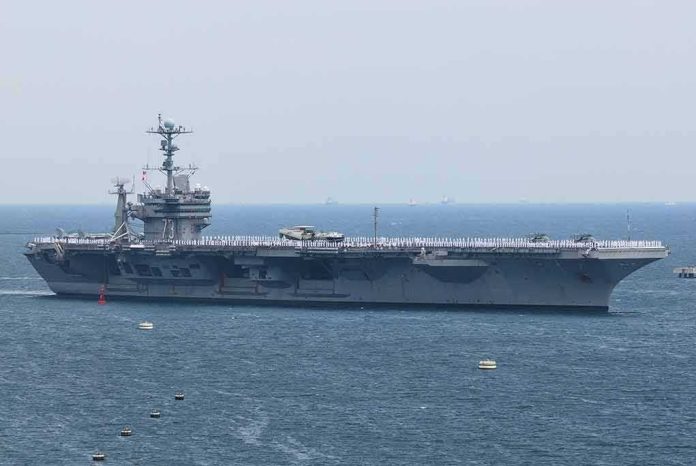
The real story is not that sailors are uniquely fragile; it is that shipboard life concentrates the oldest military stressors—sleep loss, confinement, family separation, noise, and constrained access to care—until ordinary strain can become clinical distress.
Key Points
- Shipboard deployment research consistently shows elevated depressive symptoms, anxiety, and exhaustion across the deployment cycle.
- Family support is not a soft variable; it measurably buffers mental-health deterioration at sea.
- The Navy has long treated onboard counseling and resilience training as necessary mitigations, which is itself an admission that deployment stress is real and recurrent.
- The strongest evidence supports worsening mental strain during long deployments, but not a precise ship-by-ship rate of self-harm without deployment-specific medical records.
Why Long Deployments Hit Hard at Sea
Carrier deployment is a psychological compression chamber. Sailors live inside a system where recovery is rationed, privacy is scarce, and the work rhythm is governed by mission tempo rather than human sleep architecture. The stressors identified in Navy research are not abstract: loud noise, inability to rest when needed, inadequate health care access, and too few people to finish the job rank among the most troublesome conditions sailors report. In the maritime setting, those pressures are not occasional inconveniences. They are the operating environment.
That matters because mental health does not usually break in one dramatic instant. It erodes. Across shipboard studies, the pattern is consistent: depressive screening rates remain high throughout deployment, and minor psychiatric symptoms rise as missions go on. A separate evidence map concluded that shipboard sailors experience behavioral-health burden comparable in some respects to ground-combat populations. That is not a claim that every carrier cruise is combat, but it is a clear statement that the behavioral toll of life at sea can be severe enough to resemble the kind of strain militaries usually associate with high-intensity operations.
What the Navy’s Own Literature Already Admits
The service has not been blind to this. Navy and Navy-affiliated publications have repeatedly framed prolonged deployments as a force-health problem, not merely a morale issue. USNI Proceedings described record-setting deployments as affecting the health of the force and their families, and the Navy has publicly promoted counseling, chaplains, and “warrior toughness” training as part of the answer. That language is revealing. Institutions do not build counseling pipelines around a phantom problem; they do it because operational life predictably produces distress that leaders expect to manage.
There is also hard evidence that some sailors need more than resilience slogans. A force-health report on a six-month aircraft carrier battle-group deployment documented psychiatric medevacs, proving that carrier deployment can generate clinically serious cases rather than merely discomfort. Another Navy deployment study found all phases of deployment carried disturbing anxiety levels, with suicidal ideation reported in predeployment, middeployment, and postdeployment windows. Those are not anecdotal grumbles. They are signs of a system that can push a subset of sailors past the threshold where routine support is no longer enough.
Family Support Is a Protective Factor, Not a Side Issue
One of the most important findings in the research package is also one of the easiest to overlook: family support changes the trajectory of mental health during deployment. In a Naval Medicine study, minor psychiatric symptoms increased midway and near the end of the mission, but sailors with strong family support did not show that increase. That is a major clue about mechanism. The problem is not just shipboard fatigue in the abstract; it is the combination of operational pressure and social isolation. When the social tether weakens, the ship’s stress load weighs more heavily.
This is why “deployment stress” is a more accurate frame than “weak coping.” The literature points to a layered process. Long periods underway intensify stress exposure; limited rest and thin staffing amplify it; poor access to quality mental and physical health care removes friction from deterioration; and family connection can either buffer the damage or, when disrupted, leave sailors more exposed. That is a more disciplined explanation than the crude caricature that some crews simply cannot handle hard work. The evidence supports a structural account.
Where the Evidence Is Strong, and Where It Is Not
The strongest studies in the package are persuasive about symptom burden, but they are less precise about the exact event that triggered the recent public controversy. The shipboard depression-screening study found over half the sample screened positive for risk of depression at all time points. The deployment-cycle deployment research found symptoms increased over time and family support reduced them. The evidence map linked shipboard behavioral health to serious operational stressors. Taken together, those sources make a strong case that long deployments can worsen mental health. They do not, by themselves, quantify how many sailors on one specific carrier experienced crisis in one specific window.
That distinction matters. The available record supports the broader proposition that long carrier deployments are a genuine mental-health hazard; it does not yet provide the clean epidemiology that would let anyone state the exact rate of self-harm risk aboard the USS Abraham Lincoln during the deployment in question. Some public reporting relies heavily on family accounts and vivid anecdotes, which may be credible and important, but they are not the same thing as deck logs, command incident records, or de-identified medical data. A serious reading of the evidence should keep those categories separate.
Why the Navy’s Mitigations Exist
The Navy’s embrace of onboard counseling, post-deployment screening, chaplain access, and resilience education is not cosmetic. It is an institutional response to a predictable problem. The Departure & Separation program placed counselors aboard large-deck ships during the first two to six weeks at sea precisely because that early period is known to be difficult. In other words, the service already recognizes that the transition to deployment is when stress spikes and support is most needed. That is consistent with the broader literature, which repeatedly finds that deployment is not a neutral backdrop but an active contributor to mental strain.
Still, mitigation is not the same as resolution. The existence of support programs proves awareness, not sufficiency. A system can have chaplains, counselors, and screenings and still produce exhaustion, depressive symptoms, and occasional psychiatric evacuations if the underlying operational conditions remain unchanged. The hard question for any long deployment is not whether support exists in theory; it is whether sailors can actually use it when sleep-deprived, overtasked, and far from home. The research suggests that access, timing, and social support determine whether resilience programs are effective or merely symbolic.
Jumping off the Aircraft Carrier: US Navy Sailors are Doing the Unthinkable as Long Deployments are Taking a Mental Health Toll.
Comment:
Sailors jumping overboard & others trying to jump.
Tyrant Trump may face a "Mutiny on the Bounty" crisis.https://t.co/MRzv0ycjU2 #SmartNews— Robert N. Schlesinger (@RobertNSchlesi1) August 12, 2026
What This Means for the Navy’s Future
The enduring lesson is simple: the Navy cannot treat mental health as a matter of individual toughness alone. Shipboard service places unusual strain on the nervous system because it combines deprivation, monotony, hazard, and relentless mission demands. The literature in this package points in the same direction from different angles—high depressive screening rates, rising symptoms over the course of deployment, clinically serious medevacs, and research identifying operational stressors that sailors themselves experience as most damaging. That is a coherent pattern, not a coincidence.
The practical implication is that long-deployment risk has to be managed like any other readiness issue: with staffing, sleep protection, faster access to care, family linkage, and honest measurement of outcomes. Without ship-specific data, the public will keep arguing from anecdotes; without transparent records, the Navy will keep answering a structural problem with generic reassurance. The evidence already shows enough to reject complacency. What it still lacks is the detailed, deployment-level accounting that would tell us exactly how far, and in what ways, one particular cruise pushed its crew past the limits of normal endurance.
Sources:
19fortyfive.com, theguardian.com, academic.oup.com, dvidshub.net, reddit.com, medcoe.army.mil, americanhomefront.wunc.org, tandfonline.com