

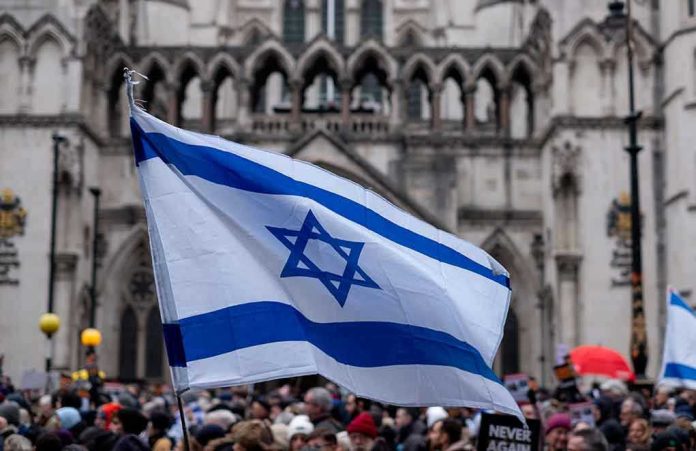
When gunfire erupted outside a Belleville, Ontario synagogue as Yom Kippur services began, the essential facts came into focus quickly: an officer and an armed man exchanged shots near the Sons of Jacob Synagogue, both were hit, congregants inside were uninjured, and the province’s police watchdog assumed the investigation. Those are the fixed points; understanding how such incidents are handled, and why initial narratives coalesce the way they do, requires equal attention to mechanism and process.
At a Glance
- An exchange of gunfire near the Sons of Jacob Synagogue around 7 p.m. left a Belleville officer and a 29-year-old man injured; both were hospitalized.
- Ontario’s Special Investigations Unit (SIU) confirmed the officer and the man were struck by gunfire and took carriage of the police-use-of-force investigation.
- Synagogue leaders said no congregants were injured; worshippers sheltered as shots were heard outside.
- Authorities said there was no ongoing threat, while motive and any targeting determination awaited investigation.
What Happened: The Fixed Record
Belleville police acknowledged an incident near Bleecker and Victoria around 7:10 p.m., reporting an officer “encountered” an individual and that both were injured and taken to hospital. The SIU, which by statute investigates police-involved shootings in Ontario, confirmed an exchange of gunfire near the Sons of Jacob Synagogue around 7 p.m. and that both the officer and the man were struck. Multiple outlets, citing officials, described the officer as in critical or serious but stable condition and the man in life-threatening condition, consistent with two people hit in the exchange. Police identified the man as a 29-year-old from Quinte West; spelling of the first name varied in early reports, but authorities tied the hospitalization to that identified individual.
Inside the synagogue, congregants had begun Yom Kippur services when they heard shots outside. The synagogue’s leadership stated that no one inside was injured, and congregants took cover while police converged on the scene. Authorities asked the public to avoid the area while investigators worked and said there was no continuing threat to public safety once the exchange ended.
How Police-Involved Shootings Are Investigated in Ontario
Ontario created the SIU to investigate incidents involving police where there is serious injury, death, or alleged sexual assault, with a mandate to assess whether criminal charges against officers are warranted. Its jurisdiction triggers when a police firearm is discharged and someone is injured; that happened here, so SIU investigators and forensic specialists were dispatched. Local police retain responsibility for the broader criminal file on the non-police party, but the use-of-force analysis—who fired, under what circumstances, and whether that force met criminal-law thresholds—belongs to the SIU. That division of labour both safeguards independence and constrains what local police can say publicly while the SIU process runs its course.
In practice, the public gets a narrow early snapshot—time, place, injuries, basic roles—followed later by a formal SIU report that synthesizes ballistic evidence, witness statements, and video. That cadence is not a hedge; it is the design of the oversight system, and it is why definitive answers about precise sequence and legal characterization typically arrive weeks or months later.
Place, Time, and Interpretation: Why Houses of Worship Heighten Stakes
Violence proximate to a house of worship is never read in a vacuum. Location and timing act as narrative accelerants; a shooting outside a synagogue as Yom Kippur begins will understandably be interpreted through the lens of communal safety and recent patterns of antisemitic incidents. Officials and community leaders condemned the violence, patrols were stepped up at other places of worship in nearby jurisdictions, and the synagogue president emphasized that worshippers had been present when shots rang out.
At the same time, investigators were explicit that motive and any targeting determination had not yet been established. That dual reality—acute communal concern and methodical evidentiary work—recurs in incidents at or near sacred spaces. The former justifies immediate protective measures; the latter governs accountability and legal classification once the facts are fully assembled.
Names, Conditions, and Early-Report Friction
Early reporting frequently contains frictions that resolve as official documents are issued. In Belleville, the identified 29-year-old’s first name and the spelling of his hometown varied across outlets; these are common transcription variances that later converge on a single spelling in court filings or SIU summaries. Similarly, injury descriptions stabilized around two core facts—an officer in critical or serious but stable condition and a man with life-threatening wounds—across multiple reputable outlets citing authorities on scene or at hospital.
Physical damage descriptions also diverged at first, with reports of bullet strikes to vehicles, nearby structures, and police equipment, and inconsistent mentions of possible synagogue window damage. Such discrepancies are normal when scenes are large, lighting is poor, and angles differ; investigators ultimately settle them through scene mapping and trajectory analysis.
The Oversight Lens: What Will Settle Outstanding Questions
Three evidence streams answer the questions readers care about—who fired first, how many rounds were discharged, and whether the synagogue or its congregants were the intended target. First, forensic ballistics and trajectory work establish firing sequence: cartridge-case locations, strike marks, and recovered projectiles reveal who stood where and when shots were fired. Second, video—body-worn cameras, dash cams, fixed surveillance—anchors timelines to the second and correlates audio muzzle reports with visible actions. Third, formal statements from the officer, nearby officers, and civilian witnesses, locked in by transcripts, reconcile perception with physics. The SIU’s final public narrative typically integrates these layers; until then, police services are constrained in their commentary.
Separate from the SIU’s mandate, local police (or partner agencies) investigate the man’s actions and potential offences, including any hate-motivation element. If prosecutors later allege hate motivation, they do so by adducing evidence of intent—statements, digital traces, planning indicators—not merely location and timing. That evidentiary threshold is higher than public inference but ultimately clearer for it.
Community Security After a High-Profile Incident
In the wake of violence at or near a religious institution, short-term security posture hardens almost automatically: visible patrols, coordination with faith leaders, and adjustments to duty assignments around services or holidays. Nearby police services publicly affirmed increased patrols around places of worship after Belleville, a standard risk-management move that both deters opportunistic threats and reassures communities processing fear and uncertainty. Synagogue officials confirmed that even amid the shock, no congregants were physically harmed, an outcome attributable in part to the incident occurring outside and rapid police response.
Longer-term, communities and police revisit site-specific measures: lighting and camera coverage of exterior approaches, entry procedures during services, and communication drills between congregational volunteers and assigned officers. The goal is not to turn sacred spaces into fortresses, but to tighten the defensive perimeter where risk actually manifests—curb line, sidewalk, and doors—without degrading the openness central to worship.
Belleville synagogue shooting suspect dies in hospital https://t.co/ou8LbTVQGJ pic.twitter.com/o3W8jIW1mg
— National Post (@nationalpost) September 22, 2026
What To Watch For Next
Expect an SIU update sequence: preliminary bulletins confirming roles and injuries, followed by a fulsome report that addresses the officer’s use of force with a coherent timeline and forensic findings. In parallel, watch for police or Crown disclosures on charges, if any, and whether evidence supports a targeting or hate-motivation allegation. Finally, look for coordination notes from regional services about sustained patrol patterns around houses of worship; those operational choices, while not dispositive about motive, signal how agencies are weighting risk across the calendar.
Sources:
pjmedia.com, castanet.net, globalnews.ca, cbc.ca, quintenews.com, jta.org, inquinte.ca