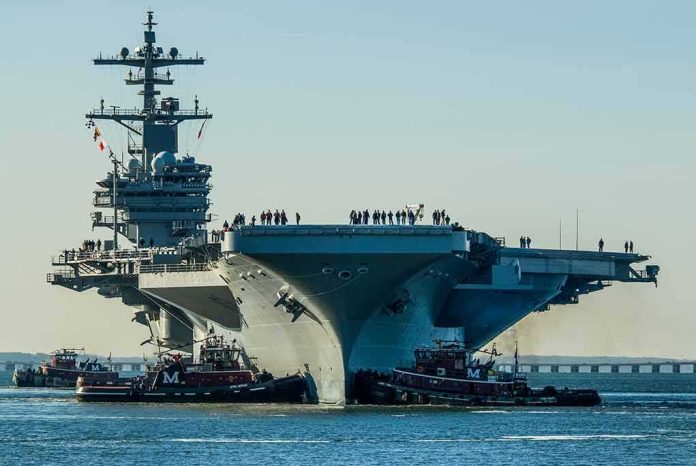
For a Navy that lives on industrial time, not news cycles, the first decisive act in building a new supercarrier is not cutting steel; it is locking in the parts that take years to make. That is what the Navy just did for CVN 82.
The Short Version
- HII received a $336 million undefinitized award to begin purchasing long-lead propulsion plant materials for CVN 82, the fifth Gerald R. Ford–class carrier.
- Long-lead procurement keeps the program on schedule by reserving scarce, slow-to-build components—reactor plant elements, heavy forgings, and specialized systems.
- This is a standard step in U.S. carrier construction: advance buys precede formal construction contracts by several years to reduce schedule and supply-chain risk.
- CVN 82 continues the Ford-class industrial cadence at Newport News Shipbuilding, sustaining the only U.S. yard that builds nuclear carriers.
What the award actually does
The Navy’s $336 million action authorizes Huntington Ingalls Industries’ Newport News Shipbuilding to start acquiring propulsion plant materials for CVN 82, the future Ford-class aircraft carrier. The award is “undefinitized,” a defense contracting term meaning work starts under negotiated ceilings while final terms are settled; it is common for urgent, schedule-protecting purchases. In practice, this unlocks orders for components with the longest manufacturing cycles—reactor plant internals, large-diameter shafts, heavy castings and forgings—so they arrive when the build sequence demands them, rather than becoming critical-path delays.
Because these items typically come from a handful of qualified suppliers and require extensive quality assurance and material traceability, they cannot be bought on short notice. The Navy uses advance procurement to bridge that gap, ensuring materials are in the pipeline years before the first major hull blocks are assembled.
Why carriers require long-lead commitments
A 100,000-ton nuclear-powered carrier is an orchestra of long-cycle parts. Nuclear propulsion introduces exacting metallurgical and fabrication demands. The main reduction gears, for example, are among the most precise and massive in any ship; the reactor plant contains specialized alloys and components that must be produced under nuclear-quality regulations. Even non-nuclear elements—EMALS and AAG foundations, island modules with embedded wiring trunks, aircraft elevators—benefit when structural materials and bespoke equipment are sequenced well ahead of assembly. The point is less about starting “construction” than about preventing a cascade of schedule slips years later by ordering the right items now.
Across surface combatants and submarines, the Navy repeats this pattern because it works. Advanced procurement decouples supplier lead times from the shipyard’s build cadence; it also lets program managers commit limited funds to the bottlenecks that would otherwise determine delivery dates. For nuclear ships—carriers and ballistic-missile submarines—the stakes are higher, the supply base narrower, and the calendar longer, making long-lead purchases indispensable.
Where CVN 82 fits in the Ford-class arc
CVN 82 follows the design lineage of the Gerald R. Ford–class—EMALS catapults, advanced arresting gear, a redesigned island, improved sortie generation concept, and a new power architecture sized for future sensors and weapons. Each successive hull in a class typically sees learning-curve gains: fewer labor hours per ton, earlier risk retirement on troublesome subsystems, and tighter integration of vendor deliveries to the build plan. Long-lead funding is one of the levers that preserves those gains by keeping the industrial rhythm intact between hulls.
Critically, only one yard in the United States builds nuclear carriers. Newport News Shipbuilding’s workforce proficiency and its supplier network are perishable advantages; gaps translate into lost skills and broken vendor lines. Advancing CVN 82’s materials now helps prevent those gaps, smooths the transition from prior Ford-class work, and stabilizes second- and third-tier suppliers whose order books depend on predictable government demand.
Decoding the contracting mechanics
Calling the award “undefinitized” can mislead the casual reader. In defense acquisition, an Undefinitized Contract Action (UCA) authorizes work within a negotiated not-to-exceed value while the government and contractor finalize the full terms and pricing. UCAs are used when schedule urgency or industrial realities demand early start—precisely the case with long-lead propulsion materials. Policy guardrails exist to narrow the timeline to definitization and to balance cash flow against proposal quality; in other words, this is not an improvisation but a well-governed instrument for time-sensitive buys.
For CVN 82, the UCA structure allows immediate placement of orders for nuclear-qualified hardware and other bespoke items, even as the Navy and HII finish pricing the detailed work packages. The alternative—waiting for a fully definitized instrument—would push procurement to the right and risk creating gaps that are much more expensive to close later.
Strategic implications: schedule insurance, not headline spectacle
The significance of this step is pragmatic. It does not signal steel cutting; it signals calendar discipline. Carriers are national assets measured not only by capability but by availability—the number in deployable condition when a crisis arrives. Availability is a function of predictable construction and maintenance flows, which depend on long-term industrial planning as much as on congressional appropriations. By funding long-lead propulsion plant materials for CVN 82 now, the Navy is buying schedule insurance against the two threats that most often undermine major acquisition programs: thin supplier benches and time-compressed production.
The timing also aligns with an enduring requirement: keeping at least two carrier strike groups deployable in each major theater while sustaining the deep maintenance cycles nuclear ships demand. Ford-class carriers, with their electrical margin and deck efficiency, are built to host evolving air wings and power-hungry sensors; ensuring the class continues on cadence is how the Navy translates design promises into operational presence. This award is the unglamorous but essential precursor to that presence.
The US Navy has awarded HII a $336 million contract to begin buying long-lead materials for the planned aircraft carrier CVN 82, starting advance procurement for components needed before full construction gets underway. Click image for more.https://t.co/FN9Z73zARW
— UK Defence Journal (@UKDefJournal) September 19, 2026
What to watch next
From here, watch for two milestones. First, definitization of this advance procurement action, which will set final terms and pricing. Second, the eventual detail design and construction contract for CVN 82, which will define the ship’s production profile and major block build schedule. In parallel, supplier deliveries funded by this award should appear on the program’s material readiness charts—reactor plant elements, forgings, and other hardware arriving to match Newport News’s planned start of structural assembly. If those deliveries hit on time, the award will have done exactly what it was meant to do: keep CVN 82 on the industrial clock.
Sources:
msn.com, naval-technology.com, hii.com