

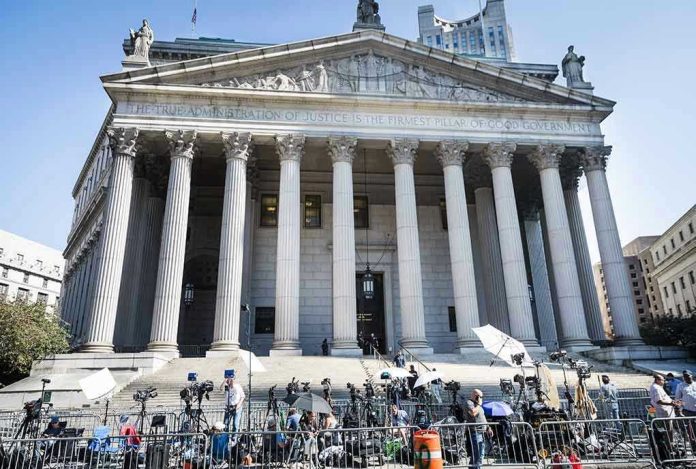
The real story is not that the Supreme Court “shook America” in some single, clean ideological direction; it is that the Court now functions as a high-voltage validator of political conflict, translating cultural fights into binding national rules while leaving the losing side convinced the law itself has been weaponized.
Intro Header
- The strongest evidence in this package supports a real, consequential transgender-athletics ruling: states may bar transgender girls from girls’ and women’s sports under the Court’s June 2026 decision.
- The broader claim that the Court has become a straightforward conservative victory machine is weaker; the package offers commentary and partisan framing, but not a clean docket-wide ledger of “wins.”
- Several of the loudest talking-point claims in the research are under-specified or unverified, including references to campaign finance, immigration, birthright citizenship, and a case called “Trump v. Barbara.”
- The deeper pattern is structural: the Court’s modern 6–3 ideological split makes it an unusually potent force in culture-war disputes, especially where sex, education, federal power, and equal protection overlap.
The Court’s Power Now Comes from Finality, Not Consensus
What makes today’s Supreme Court so politically explosive is not simply that it decides controversial cases; it decides them with the authority to settle the question nationwide, even when the country is nowhere near agreement. The evidence in this package points to that dynamic most clearly in the transgender-athletics cases, where the Court upheld state bans and confirmed that states may maintain girls’ and women’s sports for biological females. That is not a symbolic ruling. It redraws the legal boundary between sex classification and gender identity in one of the most culturally charged areas of public life.
This is why partisan commentators treat SCOTUS as a battleground rather than a court. In a polarized environment, a single opinion can be translated instantly into a broader narrative about presidential power, immigration, affirmative action, campaign finance, or the fate of “common sense.” But that narrative often outruns the actual record. In this research package, the transgender decision is documented; the sweeping claims about a general conservative rout are mostly commentary layered on top of it, not a supported case-by-case accounting.
What the Transgender-Athletics Decision Actually Did
The most concrete legal development here is the Court’s June 30, 2026 ruling in West Virginia v. B.P.J., which, alongside the Idaho case discussed in the reporting, allowed states to exclude transgender athletes from girls’ and women’s teams. News coverage describes the decision as upholding state bans and affecting laws in multiple states beyond the two named cases. Scotusblog’s summary is especially clear: the justices ruled that the laws do not violate federal civil rights law, and Justice Kavanaugh wrote that states may maintain women’s and girls’ sports for biological females.
That matters because the legal logic is narrower than the rhetoric used in political media. The ruling does not announce a general theory that transgender people have no constitutional protections; it addresses the eligibility rules for sex-segregated sports teams and the interaction between Title IX and the Equal Protection Clause. The practical effect, however, is substantial. Once the Court blesses sex-based eligibility as lawful in this context, states acquire a durable template for restricting participation, and advocates on both sides immediately understand that the fight will move to schools, athletic associations, and lower-court implementation rather than ending in the Supreme Court itself.
Why the Broader Conservative-Victory Story Is Less Solid Than the Rhetoric
The research package contains repeated assertions that recent rulings have restored presidential power, validated immigration enforcement, reinstated merit-based hiring, and protected Trump-era campaign-finance policy. Yet those assertions are thinly sourced in the material provided. They appear as paraphrases from partisan broadcasts and speeches, not as named opinions, docket numbers, or complete holdings. That is a serious evidentiary weakness. A Court can certainly issue multiple opinions that align with conservative preferences; it is another thing entirely to prove a generalized trend from a handful of sloganized references.
Equally important, one of the loudest claims in the package is simply unmoored from the record as presented: the supposed case “Trump v. Barbara” on birthright citizenship has no verified Supreme Court citation in the material here. When a political argument depends on a case name that cannot be matched to an identifiable opinion, the proper reading is not ambiguity but unreliability. The surrounding commentary may still be politically useful, but it cannot carry the burden of proof for an evergreen legal analysis.
The Court as an Ideological Amplifier
The neutral context in the research is the most revealing because it captures the real modern pattern: both ideological camps now describe the Court in partisan terms, and both do so because the Court increasingly produces outcomes that map onto national political conflict. That does not mean every decision is partisan in motive or effect. It means the institution now sits at the intersection of law, identity, and power, where legal doctrine is interpreted through political consequence almost immediately.
In that environment, a 6–3 majority becomes more than a numerical fact. It is a signal to political actors that the Court may be receptive to certain kinds of arguments—especially those about federal authority, sex classification, elections, and regulatory power. But the existence of a conservative majority does not by itself prove that recent rulings are overwhelmingly conservative victories. The better reading is more exacting: the Court is most forceful where the legal issue is already structured as a binary conflict, and those are precisely the cases that generate the loudest cultural recoil.
What These Decisions Mean in Practice
The practical consequence of the transgender-athletics ruling is that states now have a firmer constitutional path to maintain sex-segregated women’s and girls’ sports, and lower courts will have to live inside that framework. That makes the decision consequential well beyond the immediate litigants. It influences school policies, athletic eligibility rules, Title IX enforcement, and the strategic choices of advocacy groups that had hoped for a broader federal shield.
But the broader lesson extends further than sports. The Court’s real power in the current era lies in its ability to convert contested social norms into legal boundaries. Supporters call that restoration; critics call it judicial overreach. Both descriptions contain a piece of the truth, but neither is complete. The Court is not simply “shaking America” so much as formalizing the terms of America’s ongoing disputes, often in language that leaves little room for compromise.
Sources:
youtube.com, ballotpedia.org, oyez.org, law.cornell.edu