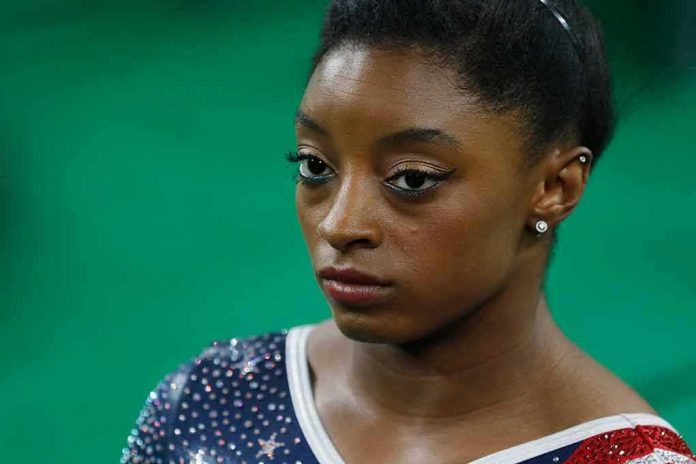
When elite athletes become proxies for a culture war, the personal and the political collapse into each other in ways that illuminate neither — and the Simone Biles–Riley Gaines dispute is a precise case study in exactly that collapse.
Key Points
- Simone Biles called Riley Gaines a “sore loser” and “sick” on social media, then apologized days later for getting personal — while maintaining her broader stance on competitive equity and inclusivity.
- Olympic gymnast MyKayla Skinner publicly defended Gaines and alleged a pattern of bullying by Biles, drawing on her own claimed experience during the Olympic trials.
- Biles proposed a structural solution — a dedicated transgender category across all sports — rather than simply defending the status quo, a nuance largely lost in the coverage.
- The scientific and legal landscape on transgender athlete inclusion remains genuinely contested, with federal executive action, state legislation, and peer-reviewed research all pulling in different directions.
- The dispute’s most revealing feature is not who is right, but how quickly a policy disagreement became a personal conflict — and what that pattern tells us about how these debates actually unfold.
How a Policy Debate Became a Personal Conflict
The immediate trigger was straightforward: Riley Gaines, the former University of Kentucky swimmer who has become the most prominent activist voice for excluding transgender women from female athletic competition, posted about a Minnesota high school softball player she identified as transgender. Simone Biles — the most decorated gymnast in American history, with 11 Olympic medals — responded on X with blunt personal language, calling Gaines a “sore loser” and “sick.” Within days, Gaines had posted no fewer than 15 messages mentioning Biles over a single weekend, and the dispute had migrated from a policy argument into something that looked considerably more like a celebrity feud.
Biles issued a formal apology several days later, acknowledging she had failed to demonstrate “empathy and respect” when criticizing Gaines — but she was careful to separate the apology from any retreat on substance. Her follow-up statement clarified that she was “not advocating for policies that compromise fairness in women’s sports,” and that she had always believed “competitive equity and inclusivity are both essential in sport.” That is a more nuanced position than the initial exchange suggested, and it deserves to be read on its own terms rather than filtered through the heat of the original posts.
MyKayla Skinner’s Intervention and What It Actually Claims
Into this charged environment stepped MyKayla Skinner Harmer, the 2020 Olympic silver medalist in vault, who released a formal statement through One America News and elaborated in a CBN News interview. Skinner’s core claim was pointed: it is “deeply troubling to see Simone Biles publicly label a fellow female athlete a ‘sore loser’ — simply for expressing valid concerns about fairness in women’s sports.” She went further, alleging that Biles had previously directed similar treatment toward her — that she had “experienced the same thing Riley had,” including what she described as belittling, dismissal, and ostracization.
The evidentiary weight of Skinner’s claims requires honest assessment. Her allegation that Biles tweeted dismissively about her — reportedly something to the effect of “not everybody needs a mic and a platform” — during the Olympic trials period is specific enough to be verifiable in principle, but no archived tweet, timestamp, or independent witness has been produced to confirm it. Her broader claim of ostracization rests entirely on her own recollection, without corroborating documentation. That does not make the allegation false; it makes it unverified. Biles, for her part, never directly addressed Skinner’s specific claims, which leaves a conspicuous gap rather than a rebuttal. The absence of a denial is not confirmation, but it is also not nothing.
What Biles Actually Proposed — and Why It Got Lost
The most substantive element of Biles’ original posts was almost entirely buried by the personal dimension of the exchange. In her initial response, Biles suggested a concrete structural solution: a dedicated transgender category in all sports. That proposal — which would sidestep the binary of full inclusion versus exclusion — is not a new idea; it has been floated by various sports administrators and ethicists as a way to honor both competitive fairness and the dignity of transgender athletes. Whether it is practically workable at the high school level, where the numbers of transgender competitors are vanishingly small, is a legitimate question. NCAA President Charlie Baker told Congress in December 2024 that of 520,000 NCAA athletes, he knew of fewer than ten who were transgender — a figure that puts the scale of the actual competitive disruption in stark perspective.
Biles also acknowledged, in her follow-up statement, that “the current system doesn’t adequately balance these important principles, which often leads to frustration and heated exchanges.” That is a candid admission that the status quo is not satisfying anyone, and it represents more common ground with the fairness argument than either side’s supporters would likely acknowledge. The apology she offered was specifically for “getting personal with Riley” and for “singling out children for public scrutiny” — a distinction between her objection to Gaines’ method and her position on the underlying policy.
The Broader Scientific and Legal Landscape
The dispute between these athletes is taking place against a backdrop of genuine institutional flux. A February 2025 executive order directed federal agencies to pressure athletic associations to exclude transgender women from women’s sports. At least 24 states had enacted some form of legislative restriction on transgender student athlete participation as of late 2023, with more following since. The legal landscape is actively shifting, and the SCOTUS reference in coverage of this dispute reflects that courts are now being asked to adjudicate questions that governing bodies have been unable to resolve through policy alone.
The scientific literature is more contested than either side typically acknowledges. A systematic review published in PMC found “no direct and consistent research” to suggest transgender female individuals have an athletic advantage, and concluded that most competitive sport policies are not adequately grounded in evidence-based medicine. Advocacy organizations on both sides cite research selectively; the honest position is that sport-specific physiological data — which varies enormously between, say, weightlifting and distance swimming — is still accumulating, and blanket conclusions in either direction outrun the evidence. What is not contested is that transgender athletes participate in organized sports at dramatically lower rates than the general population, and that the intensity of the public debate is wildly disproportionate to the number of athletes actually involved.
This is a BIG WIN for women's sports.
Riley Gaines and MyKayla Skinner send message to Simone Biles on women's sports debate after SCOTUS ruling https://t.co/daByngXgAV #FoxNews— John Patrick Gamble (@awalkerofrealms) July 1, 2026
The Structural Pattern This Dispute Reveals
Strip away the specific names and this dispute follows a template that has repeated with notable consistency since at least 2021: an activist athlete makes a public claim about a specific transgender competitor; a celebrity athlete with significant platform and sponsorship relationships pushes back; the exchange rapidly personalizes; corporate pressure shapes the celebrity’s subsequent statements; and media coverage shifts from the policy question to the conduct of the participants. The Lia Thomas controversy in 2021–2022, the T’niya Miller backlash in 2023–2024, and now this exchange have all followed essentially the same arc.
What that pattern reveals is a structural failure of the institutions that should be resolving these questions — the NCAA, the U.S. Olympic and Paralympic Committee, and the governing bodies of individual sports. When policy frameworks are absent, ambiguous, or actively contested by federal and state action simultaneously, the vacuum gets filled by social media exchanges between athletes who are not equipped — and should not be expected — to serve as the primary arena for resolving questions of competitive fairness, inclusion, and civil rights. The USOPC has issued no public statement regarding Skinner’s bullying allegations, a silence that itself speaks to institutional reluctance to engage the underlying conflicts within elite gymnastics culture.
What Remains Unresolved
Gaines’ claim that Biles’ tweets were “incinerating her legacy” is hyperbole unsupported by any measurable evidence — no polling shift, no sponsorship loss, no documented reputational harm of that magnitude. Biles remains one of the most admired athletes in the world, and two contentious social media posts have not changed that. Conversely, Biles’ initial personal attack on Gaines was indefensible on its own terms, and her apology acknowledged as much. Skinner’s allegations about her own treatment by Biles are serious enough to warrant institutional inquiry, but they currently rest on personal testimony without corroboration.
The underlying policy question — how governing bodies should balance competitive fairness with the inclusion of transgender athletes — will not be resolved by this dispute, or by the next one. It requires the kind of sport-specific, evidence-grounded policy work that takes years and demands engagement with physiology, ethics, and law simultaneously. What this episode demonstrates, with uncomfortable clarity, is that the current vacuum invites exactly the kind of collision that just occurred: a genuine policy disagreement that becomes a personal conflict, generates enormous heat, and leaves the actual question precisely where it started.
Sources:
foxnews.com, sports.yahoo.com, instagram.com, people.com, nbcnews.com, youtube.com, facebook.com, aclu.org