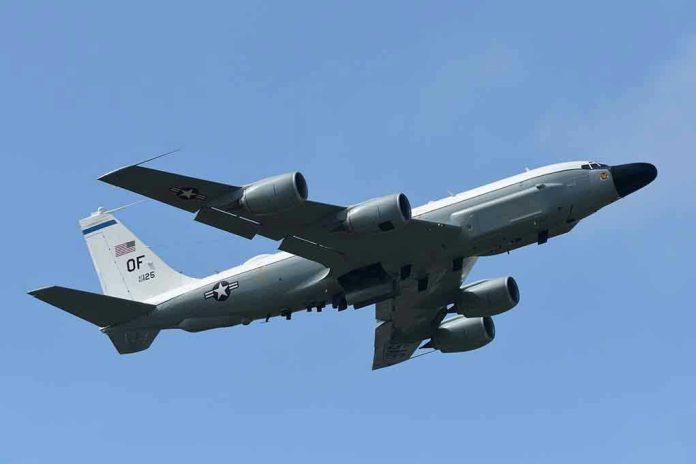
When sensational claims race ahead of facts, routine U.S. surveillance flights near Cuba risk being spun into a manufactured crisis that fuels public distrust and masks what the government will not clearly explain.
Story Snapshot
- Public tracking shows repeated U.S. Navy MQ-4C Triton flights near Cuba in international airspace without territorial incursion [1][2][3].
- Recent sorties followed a Cuban “maximum alert” speech, heightening perceptions of threat without new U.S. clarification [1].
- Open-source reports describe multi-hour intelligence, surveillance, and reconnaissance consistent with maritime monitoring [2][3].
- Attention-grabbing videos speculate about invasion plans but rely on errors or lack primary evidence tied to 2026 [1][2][3].
What Flight Data Shows And What It Does Not
Publicly accessible aircraft tracking recorded a U.S. Navy MQ-4C Triton operating north of Cuba and west of Florida, identified by call signs in recent months that match platforms often used for maritime surveillance [1]. Reporting describes a twelve-hour mission profile typical of long-endurance intelligence, surveillance, and reconnaissance, and notes previous sorties in February and April, suggesting a pattern of presence rather than a single spike [2][3]. None of the cited tracking indicates Cuban airspace entry, pointing instead to international airspace operations [1].
Separate coverage documents multiple MQ-4C flights in short succession, including references to missions on or around February 6, April 17, and April 21, sometimes in coordination with other surveillance aircraft like the RC-135V/W and P-8A Poseidon [2][3]. These accounts frame the activity as part of a sustained surveillance posture rather than a defined countdown to military action. However, the reporting relies on open-source feeds and observer analysis, not declassified mission logs, leaving gaps about objectives and tasking authority [2].
Why Timing Fuels Escalation Narratives
Observers link the April flights to a Cuban presidential speech on April 16 declaring a heightened alert over potential aggression, a juxtaposition that strengthens a storyline of pending conflict without proving intent [1]. Without direct U.S. on-the-record statements specific to these flights, the information vacuum enables competing interpretations. Cuba’s rhetoric elevates perceptions of threat, while U.S. sources emphasize routine surveillance, creating a familiar cycle where timing shapes conclusions more than documented directives [1].
Sensational social videos intensify this cycle by asserting invasion planning and drawing parallels to prior U.S. operations, yet they frequently cite outdated material, conflate timelines, or lean on anonymous claims lacking corroboration in 2026 records [2][3]. These narratives attract attention because they tap widespread frustration about opaque government actions. Still, the available evidence offered by open-source tracking and derived reporting does not document territorial incursions or official escalation steps tied to the highlighted flights [1][2][3].
How To Assess “Surge” Versus “Status Quo”
Determining whether activity amounts to a surge requires a baseline. The current reporting documents at least three to four notable MQ-4C flights within months but does not present historical sortie rates from 2024 to 2025 for side-by-side comparison [1][2][3]. Without those benchmarks or declassified patrol schedules, claims of dramatic escalation remain assertions rather than measured findings. Conversely, labeling everything routine without data can also mislead. Transparency on sortie frequency and mission scope would help citizens judge risk more confidently.
🇺🇸 US Navy | MQ-4C Triton
📡 BLKCAT5 (Hex: AE67F9) departed Mayport NAS (#Jacksonville). In transit to operating areas in the Gulf of América and North of Cuba for long-endurance maritime surveillance (ISR) mission.
#OSINT #MQ4C #USNavy #Triton #MaritimePatrol #Mayport pic.twitter.com/CU9dIqur08— HunterNight (@HHunternight) May 7, 2026
For now, the clearest verifiable points are limited but important: aircraft type and call signs were tracked; long-duration missions occurred in international airspace; other surveillance platforms have been reported operating in the region; and timing coincided with sharpened Cuban warnings [1][2][3]. Each detail fits both a routine maritime monitoring explanation and a darker escalation narrative. The difference lies in evidence not yet public—tasking orders, rules of engagement, or formal statements—rather than in the publicly visible flight tracks themselves.
What This Means For Voters Who Feel Kept In The Dark
Americans across the spectrum see a pattern: government secrecy invites speculation while click-driven media profits from alarm. Conservatives worry about mission creep, costs, and distractions from border security and inflation. Liberals worry about covert pressure campaigns and the danger of miscalculation in a region with fragile economies. Both sides share a concern that officials speak in generalities while withholding details that would allow independent verification.
Basic steps would reduce distrust. The Department of Defense could issue timely statements confirming flight legality, general purpose, and frequency bands without compromising operations. Congress could demand regularized public summaries to establish baselines and audit claims of surges. Until then, citizens should weigh specific, verifiable facts—platform type, location, duration—over hype, and reserve judgment on intent claims that lack primary documentation tied to 2026.
Sources:
[1] U.S. military drone MQ-4C Triton operates in the Gulf of … – CiberCuba
[2] Navy MQ-4C Triton Spies On Cuba In 12-Hour Drone Mission
[3] US Navy uses MQ-4C drone for 12 hour surveillance mission near …