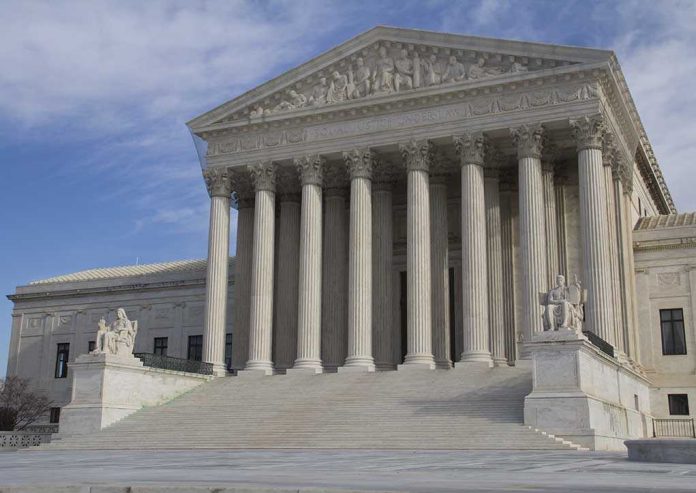
A pair of court rulings — one from the U.S. Supreme Court, one from Virginia’s highest court — have handed Republicans a structural advantage in congressional mapmaking that could help the GOP hold the House in 2026, and critics on both sides of the aisle are asking whether the rules of American elections are being rewritten by judges rather than voters.
Story Highlights
- The U.S. Supreme Court’s ruling in Louisiana v. Callais struck down Louisiana’s second Black-majority congressional district, narrowing Voting Rights Act protections and clearing the way for Republican-drawn maps across multiple Southern states.
- Virginia’s Supreme Court invalidated a voter-approved redistricting referendum on constitutional procedural grounds, preserving a Republican-favoring map and eliminating a Democratic gain.
- Louisiana, Alabama, South Carolina, and Tennessee moved quickly to redraw congressional districts following the rulings, with analysts projecting a net gain of several House seats for Republicans.
- Experts caution that the actual electoral impact remains uncertain, as shifting voter demographics and turnout patterns could offset map-driven advantages.
Two Rulings, One Big Shift
Two separate court decisions in spring 2026 reshaped the congressional map landscape heading into the midterm elections. On April 29, the U.S. Supreme Court’s conservative majority ruled in Louisiana v. Callais that Louisiana’s second Black-majority congressional district violated the Equal Protection Clause, finding the state’s existing map already satisfied the Voting Rights Act (VRA). [3] Days later, Virginia’s Supreme Court struck down a voter-approved redistricting referendum, ruling it violated a constitutional timing requirement. [2] Together, the decisions effectively cleared the legal path for Republican-controlled legislatures to redraw maps on their own terms. [4]
The Virginia ruling drew particular attention because voters had approved the redistricting referendum at the ballot box, only to see it invalidated on a procedural technicality. The court’s 46-page opinion found the referendum violated Virginia’s “intervening election requirement” in Article 12 of the state constitution. [2] The National Republican Congressional Committee had funded legal challenges against the Democratic-drawn maps, and committee chair Richard Hudson publicly celebrated the outcome. [2] For many observers — left and right — having a voter-approved measure overturned by a court raised uncomfortable questions about who actually controls the democratic process.
Southern States Move Fast to Redraw Lines
Within days of the Supreme Court’s Callais decision, Louisiana Governor Jeff Landry suspended the May 16 primary to allow time for redistricting. [1] Alabama, South Carolina, and Tennessee followed with their own map-redrawing efforts. [4] In Tennessee, Republicans had already split Memphis’s majority-Black Democratic district into three Republican-leaning districts, a move that drew protests and comparisons to historical voter suppression. [3] Florida’s redrawn map was projected to net Republicans up to four additional House seats by concentrating minority Democratic voters into fewer districts — a tactic analysts call “packing.” [1]
Louisiana Congressman Troy Carter warned that the Supreme Court ruling could eliminate two Black-majority congressional seats in his state. [3] In Alabama, redistricting threatened the seat representing Montgomery, a city central to the civil rights movement. [3] Critics argue the maps are engineered to dilute minority voting power under the cover of legal compliance — a charge that carries real weight given the documented history of post-Shelby County v. Holder redistricting, which netted Republicans 16 House seats between 2013 and 2020. [6]
Legal Cover, Political Motive — or Both?
The legal picture is genuinely complicated. Courts have found the Republican-drawn maps constitutionally compliant under the standards they applied, and no forensic mapping analysis using neutral compactness or partisan symmetry metrics has been presented to directly rebut those findings. [1] The Supreme Court’s majority reasoning in Callais is now binding precedent that lower courts must follow, narrowing the legal tools available to challengers. [3] Opponents of the maps rely heavily on seat-projection data and timing arguments, rather than the kind of technical mapmaking evidence — GIS shapefiles, partisan bias scores, internal communications — that courts typically require. [1]
You Made Your Ruling. Now Enforce It Yourself.
5/8/26
Virginia voters passed a redistricting referendum last month that would have reduced Republicans to a single congressional seat in the state. Then the Virginia Supreme Court threw it out.https://t.co/4KJKBpi6U1— Sean Morgan (@seanmorgan280) May 10, 2026
That said, the speed and coordination of Republican redistricting efforts across multiple states immediately following the rulings is difficult to dismiss as coincidence. [4] Whether the maps represent legitimate legislative decisions or a coordinated effort to lock in structural electoral advantages before voters can respond is a question the 2026 elections may not fully answer. The Brookings Institution notes that the actual electoral impact remains uncertain, pointing to shifting Hispanic voter preferences toward Republicans as a factor that could confound map-driven projections. [1] What is clear is that the rules governing how congressional districts are drawn — and who gets to draw them — are being rewritten in real time, through courts rather than legislatures, and with consequences that will outlast any single election cycle. [5]
Sources:
[1] Supreme Court decision alters 2026 midterm election outlook
[2] Republicans get massive win in fight for House with Virginia court …
[3] Supreme Court backs GOP in redistricting case, limiting Black voters …
[4] Court rulings shift 2026 redistricting battle toward Republicans
[5] 2025–2026 United States redistricting – Wikipedia
[6] Gerrymandering, the Supreme Court, and the 2026 Midterm Elections