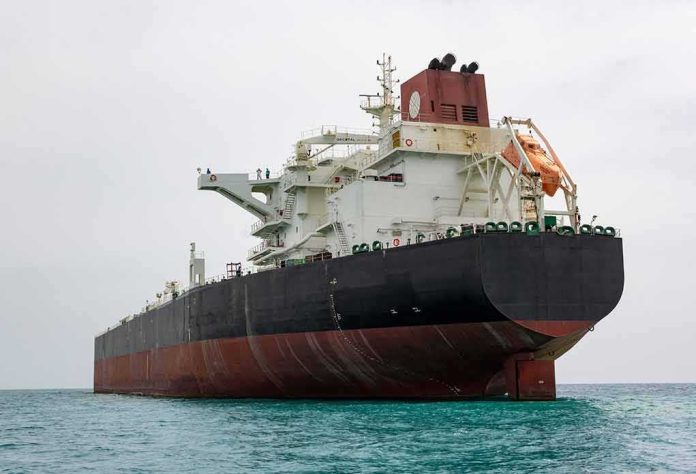
U.S. warplanes fired precision shots to disable three Iranian oil tankers defying a naval blockade in the Gulf of Oman, exposing the raw risks of superpower brinkmanship that erodes global trade stability and fuels fears of wider conflict.[1][2][3]
Story Snapshot
- U.S. Central Command (CENTCOM) forces disabled three Iranian-flagged tankers—M/T Hasna, M/T Sea Star III, and M/T Sevda—after they ignored warnings and headed to Iranian ports.[1][2][3]
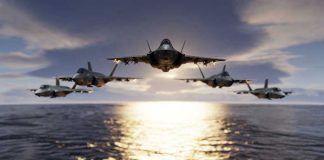
- F/A-18 Super Hornets from USS Abraham Lincoln and USS George H.W. Bush executed the strikes using cannon fire and precision munitions to target rudders and smokestacks without sinking the vessels.[1][2]
- Over 50 vessels redirected and multiple disabled since blockade began, signaling firm U.S. enforcement amid ceasefire tensions.[1]
- Iranian media counters with claims of U.S. aggression, heightening escalation risks in the Strait of Hormuz chokepoint.[6]
- Incidents underscore bipartisan American worries over endless foreign entanglements draining resources from domestic priorities like the economy and border security.
Recent Disabling Actions in Gulf of Oman
U.S. Central Command (CENTCOM) forces disabled M/T Hasna on May 6, 2026, at 9 a.m. Eastern Time in international waters of the Gulf of Oman. The Iranian-flagged unladen oil tanker sailed toward an Iranian port despite multiple warnings. An F/A-18 Super Hornet from USS Abraham Lincoln (CVN 72) fired 20mm cannon rounds into the rudder, halting its progress. The vessel no longer transited to Iran.[1]
On May 8, CENTCOM forces targeted M/T Sea Star III and M/T Sevda, also Iranian-flagged unladen oil tankers approaching an Iranian port. A U.S. Navy F/A-18 Super Hornet from USS George H.W. Bush (CVN 77) fired precision munitions into their smokestacks. Both ships stopped before entering Iran, enforcing the blockade impartially against all nations’ vessels.[2]
Pattern of Enforcement and Prior Incidents
These actions follow a prior disabling of M/V Touska on April 19, 2026. USS Spruance (DDG 111) issued warnings for six hours as the vessel neared Bandar Abbas, Iran. After non-compliance, Spruance fired its 5-inch MK 45 gun into the engine room, disabling propulsion. CENTCOM reports over 50 commercial vessels redirected and multiple disabled to maintain compliance.[3][1]
Admiral Brad Cooper, CENTCOM commander, stated U.S. forces remain committed to full blockade enforcement. Operations target ships entering or departing Iranian ports and coastal areas, amid fragile ceasefire conditions post-conflict.[2]
Escalation Risks and Broader Implications
Iranian state media portrays U.S. strikes as unprovoked aggression on vessels exercising freedom of navigation in international waters. Reports claim Iran fired missiles at U.S. ships near the Strait of Hormuz in response, seizing vessels and framing actions as self-defense. This creates competing narratives risking miscalculation.[6]
These clashes fit a historical pattern of 47 U.S.-Iran maritime incidents since 1984, including warning shots and boardings. The Gulf of Oman and Strait of Hormuz handle 20% of global oil, amplifying economic stakes. Americans across the spectrum—from conservatives decrying overseas spending to liberals fearing endless wars—question if such enforcement diverts focus from domestic crises like inflation and immigration.[1][2]
Frustrations mount as federal priorities seem hijacked by elite foreign policy circles, echoing “deep state” critiques. With Republicans controlling Congress under President Trump’s second term, pressure builds for strategies prioritizing U.S. interests over distant blockades. Unresolved legal questions on blockade validity under international law further fuel skepticism.[9][10]
Sources:
[1] U.S. Disables 2 More Vessels Violating Blockade in Gulf of Oman
[3] U.S. Forces Disable Vessel Attempting to Enter Iranian Port, Violate …
[9] U.S. Naval Blockade of Iran Signals Shift to Maritime Pressure
[10] U.S. to Blockade Ships Entering or Exiting Iranian Ports – centcom