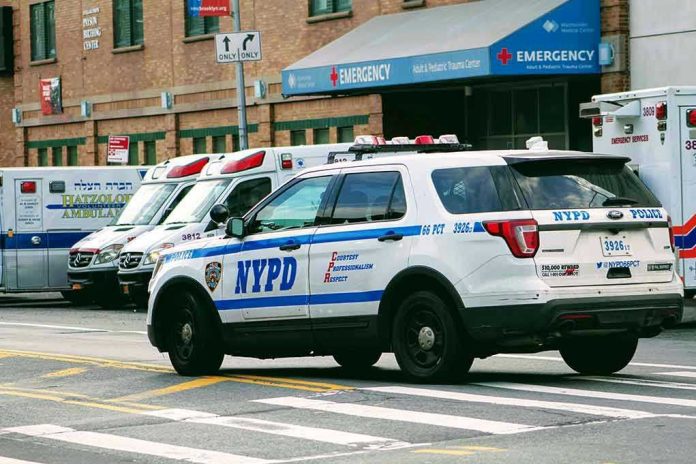
A clear, narrow set of facts anchor this case: a 14-year-old boy was shot in the leg near the intersection of 153rd Street and Jamaica Avenue, just outside Rufus King Park in Queens, shortly before 5 p.m.; he was taken to Jamaica Hospital in stable condition; the gunman, described as dressed in all black, fled on foot; and, as of initial reports, no arrest had been made. Everything else—motive, targeting, and the path to an arrest—remains the work of an ongoing investigation.
At a Glance
- A 14-year-old was shot in the leg near Rufus King Park, at 153rd Street and Jamaica Avenue, shortly before 5 p.m.
- The teen was transported to Jamaica Hospital and reported in stable condition.
- The shooter, described as dressed head-to-to-toe in black, fled the scene on foot.
- No arrest had been made and no motive confirmed at the time of reporting.
The Confirmed Core: Location, Injury, Flight, and Status
Police accounts reported by local outlets align on the essential facts. The shooting occurred near the corner of 153rd Street and Jamaica Avenue, outside Rufus King Park in Jamaica, Queens, shortly before 5 p.m. Officers and EMS responded; the victim, a 14-year-old boy, sustained a gunshot wound to the leg and was transported to Jamaica Hospital, where he was listed in stable condition. The assailant fled on foot and remained at large as the investigation began. Those elements—time window, location, injury description, immediate medical destination and condition, suspect flight, and the absence of an arrest—are consistent across contemporaneous coverage citing the NYPD as the source.
Two witness-adjacent details are worth parsing with care. First, the geography: one report frames the incident near the park; another specifies “outside” the park at 153rd and Jamaica. In urban incident reporting, “near” is often the shorthand the public uses to anchor an event to a known landmark; here, the more precise cross-street pinpoints activity on the street grid rather than within the park’s interior. Second, the suspect description is primarily apparel-based—“head-to-toe black”—which is a starting point for canvassing and video pulls, not a unique identifier. Both are typical features of early-stage briefings; they tell police where to start looking and the public what to watch for, but they do not, on their own, finish the case.
How Investigations Typically Progress From Here
From this foundation, patrol and detectives follow an established playbook. The priority is to stabilize and interview the victim, gather any spontaneous statements, and identify immediate witnesses. Simultaneously, responders secure the scene perimeter and canvass for shell casings, bullet fragments, strike marks, and trajectory indicators. Those physical artifacts—matched to caliber and rifling characteristics—can later be cross-referenced in the NYPD’s ballistics database for links to prior shootings. Parallel to the physical scene work, detectives run a camera sweep: street-facing retail cameras on Jamaica Avenue, traffic cameras, and any municipal park cameras can be time-synced to capture the suspect’s approach and flight path. Retailers often overwrite footage within days; speed matters.
EMS run sheets and hospital trauma intakes document wound location, arrival times, and interventions; in a non-fatal leg wound with a stable presentation, those records help confirm the single most important medical assertion the public cares about: whether the child is expected to recover. On the investigative side, an early apparel description like “all black” is filtered through footage to refine height, gait, distinctive items (logos, shoes, backpack), and, if fortunate, a face. That refinement is what transforms a generic lookout into a BOLO (be on the lookout) bulletin with stills. Absent an arrest on day one, these are the moves that build probable cause.
Why Early Crime Coverage Reads the Way It Does
The information profile in the first 24 hours—injury, location, condition, suspect fled, no arrest—reflects the media’s dependency on police as the primary source for breaking incident data. Decades of research on crime reporting show law-enforcement sources dominate early coverage; they hold the authoritative facts reporters need to publish, especially when court filings, sworn witness statements, and lab results are days or weeks away. That reliance does not mean the basic facts are soft; rather, it explains why motive, targeting, and interpersonal dynamics are usually circumspect until detectives have more than a hunch. In practical terms, the public record at this stage is designed to enable tips, not argue a theory of the case.
One consequence is that some questions linger for a time: Was the teen the intended target? Was there a dispute just before the shot? How many rounds were fired? Those are not evasions so much as disciplined withholding; premature specificity can contaminate witness memory and box an investigation into correcting itself in public. When an arrest is made or charges are filed, the evidentiary picture becomes more granular—number of shots, ballistic match, surveillance pulls, and, where relevant, statements. Until then, the facts that matter most are already in view: a child was wounded, a shooter fled, and police are searching.
Rufus King Park And The Corridor Around It
Rufus King Park is a heavily trafficked civic space adjacent to one of Queens’ busiest commercial corridors. That environment cuts both ways for investigators. On the upside: abundant foot traffic and camera coverage along Jamaica Avenue increase the odds of capturing a suspect’s route or finding bystanders who saw the aftermath. On the downside: density complicates shot localization and introduces witness noise—many people hear, fewer see the muzzle flash, and fewer still can provide reliable, specific identifiers in the seconds after a gunshot. Prior incidents in the broader Jamaica area underscore how rapidly details can evolve in youthful-violence cases and why police lean on video and forensics to corroborate early statements.
It also explains why cross-streets beat landmarks for precision. “Near the park” communicates proximity to a known place but risks conflating inside-the-park incidents with street-corner crimes that happen along its perimeter. Here, the cross-street anchoring provides clarity; this was a street-corner shooting outside the park’s interior footprint.
What To Watch For Next
Three developments would materially change what the public knows. First, a released still image or wanted poster—often produced once detectives have high-confidence footage—can trigger recognition and tips; expect apparel details to harden into identifiable markers. Second, ballistic linkage to prior shootings can reframe the case from a one-off to part of a pattern, raising the odds of a faster identification if the firearm has a history in the borough. Third, a charging instrument or complaint following an arrest will answer the core uncertainties: whether the teen was targeted, what precipitated the shooting, and how many rounds were fired. Until those arrive, the prudent reading of the case is the straightforward one already supported by consistent reporting: a single juvenile victim, a leg wound, a street-corner location near the park, a fleeing suspect in black, and an active search by police.
For members of the public in the area, the most constructive roles are also the most familiar: provide any relevant video from the time window to detectives, respond to tip-line requests if you recognize apparel or gait from released images, and avoid spreading speculative narratives that harden into memory without evidence. For newsroom observers, the discipline is the same—keep the focus on the confirmed core and let the investigation do its work.
A gunman in an all-black outfit remains at large after shooting a 14-year-old boy in the leg near Rufus King Park in Queens.https://t.co/Oha1Uf1xPf pic.twitter.com/75wnJhgZgL
— Next Stamina (@NextStamina) September 7, 2026
Essential Facts, Not Speculation
The story’s backbone is firm precisely where it matters. A 14-year-old boy was shot in the leg near 153rd Street and Jamaica Avenue, outside Rufus King Park, shortly before 5 p.m.; he reached Jamaica Hospital in stable condition; the shooter, dressed in black, escaped on foot; and police had not yet made an arrest or assigned a motive. Those facts are consistent across outlets citing the NYPD. Everything that follows—a refined suspect description, a motive, an arrest—arrives, as it should, with evidence attached.
Sources:
qns.com, nypost.com, fox5ny.com, nydailynews.com, facebook.com, nbcnewyork.com