The constitutional fight over guns at synagogues is ultimately about how far a government can stretch “sensitive place” rules before it collides with two bedrock liberties at once: the right to armed self-defense and the freedom to practice religion in the ordinary manner of one’s faith.
The Short Version
- A federal judge preliminarily blocked Montgomery County’s ban as applied inside one synagogue, finding a likely Second Amendment violation for worshipers there.
- The county’s buffer-zone rule still bars carrying within 100 yards/300 feet of “places of public assembly,” leaving a live dispute over worshipers walking to services.
- The plaintiffs are pursuing that remaining issue on appeal in the Fourth Circuit, pressing both Second Amendment and Free Exercise theories.
- Montgomery County defends the law as a targeted public-safety measure within state-delegated authority to regulate firearms near sensitive locations.
What the court actually did—and why that matters
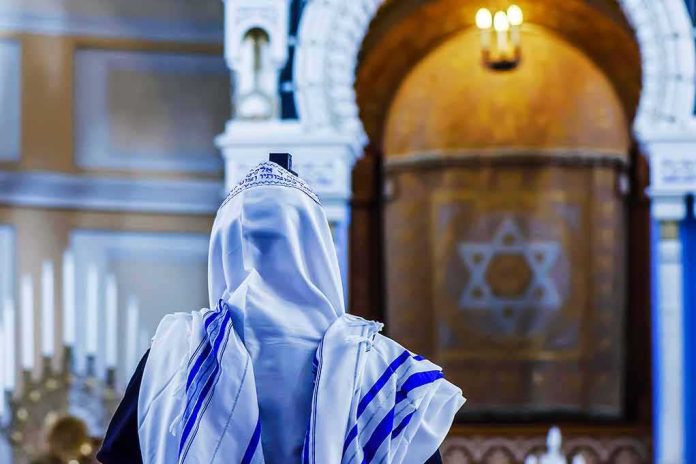
Start with the ruling, not the rhetoric. In September 2026, the U.S. District Court for the District of Maryland granted a preliminary injunction to the Silver Spring Jewish Center (SSJC) and its rabbi, forbidding Montgomery County from enforcing its firearms ban against them inside their house of worship while the case proceeds. The court held the plaintiffs had shown a likelihood of success on their as-applied Second Amendment claim—an early but consequential marker that, as to these worshipers in this setting, the county likely went too far. The order drew a principled line: it preserved the county’s outer buffer around “places of public assembly,” but it would not let the county flatly disable a synagogue’s internal security plan by criminalizing qualified congregants’ carry during services.
That limited win matters because preliminary injunctions require more than sympathy. They require a legal showing of likely merit, irreparable harm, and a favorable balance of equities. Here, the court singled out the practical distinction between licensed security the county exempts and the synagogue’s trained volunteer security team; the county did not persuade the court that the former is inherently safer than the latter in a way the Second Amendment tolerates within a place of worship.
The rule at issue: “places of public assembly” and perimeter bans
Montgomery County’s code prohibits possessing or transporting firearms and ammunition “in or within 100 yards of a place of public assembly,” a defined category that includes schools, parks, libraries, polling places, legislative assemblies, and houses of worship. The Council narrowed earlier drafts by removing venues (like hospitals and long-term care facilities) already covered by state law and added a roadway exception so motorists passing through the buffer are not ensnared. County leaders frame the law as a public-safety measure tailored to protect community institutions; they also note Maryland authorizes charter counties to regulate firearms in or within 100 yards of parks, churches, schools, public buildings, and other assembly places.
Two features make this regime unusually burdensome for religious congregants. First, it is not just an interior ban; it projects a fixed exclusion zone into surrounding public right-of-way. Second, Orthodox Jewish practice often precludes driving on the Sabbath and festivals, which means congregants walk to synagogue; if their routes inevitably pass within the buffer, a carry option that might be lawful for a motorist becomes categorically illegal for a pedestrian. The district court left this “walking problem” intact at the preliminary stage; the plaintiffs took that issue to the Fourth Circuit.
Bruen’s through-line: sensitive places, history, and houses of worship
Since the Supreme Court’s decision in Bruen, courts evaluating modern gun restrictions ask whether the government has shown a historical analogue that is well established and representative of the Founding or Reconstruction tradition, especially for categorical place bans. Some locations—courthouses, polling places, legislative chambers—have a long pedigree as “sensitive.” Houses of worship have a much thinner historical record of categorical disarmament; the scattered 19th-century enactments some states cite are sparse, late-arriving, and often contested as outliers. That is the doctrinal backdrop for why a synagogue’s internal carry policy received a warmer reception than a broad perimeter ban that follows worshipers down the street.
Montgomery County’s defense leans on state delegated authority and a modern public-safety rationale. Those points matter for preemption and local power, and Maryland’s high court has recently addressed the scope of county authority around 100-yard buffer zones. But Bruen’s history-and-tradition test, which binds federal courts on the Second Amendment, sets the burden: the county must justify both the place and the extent of its restriction with historical analogues that fit the modern law’s breadth.
Where the live dispute truly lies: the sidewalk between home and shul
The synagogue’s interior is one question; the public sidewalk is another. The plaintiffs argue the remaining buffer criminalizes the only way many Orthodox congregants can reach services while lawfully armed, effectively conditioning their ability to worship on surrendering a core element of self-defense. That claim fuses the Second Amendment with the Free Exercise Clause: if a rule uniquely burdens religious practice because of the way that faith is practiced—walking rather than driving—it can trigger serious constitutional scrutiny. The Fourth Circuit appeal puts that intersection squarely at issue, with the plaintiffs asking the court to extend relief to the trip to and from worship as well as inside.
Two evidentiary caveats temper the posture. First, the district court’s order is preliminary, not a final merits judgment; it forecasts, but does not settle, the outcome. Second, while the litigation has been discussed against a backdrop of rising antisemitic threats, the record presented publicly so far does not catalog specific incidents directed at SSJC or quantify how many congregants would actually carry if permitted—gaps that matter when courts weigh irreparable harm and tailoring.
The county’s case: safety, tailoring, and delegated authority
Montgomery County’s position is not a free-floating dislike of guns; it is a place-based regulation modeled on the canonical “sensitive places” concept. The Council trimmed its list to avoid overlap with state venues, created a driving exception to prevent incidental criminalization, and defended its scheme as within the state’s express delegation to regulate firearms within 100 yards of assembly sites. County leaders have also pointed to other litigation outcomes upholding aspects of the county’s framework and have publicly characterized adverse rulings elsewhere as consistent with their overarching authority—messaging that underscores a steady, institutional view of the law’s legitimacy. Whether those justifications meet Bruen’s historical test, especially for a roving sidewalk buffer, remains the federal question.
On the facts that drove the synagogue’s partial win, the county was on weaker ground. If licensed private guards may carry in a sanctuary and trained volunteers may not, the county needs evidence that the latter is materially riskier in the specific environment of a house of worship. The district court found that showing wanting at this stage.
What to watch next—and why it matters beyond one congregation
The Fourth Circuit appeal is the hinge. If the court extends the injunction to the walk to and from synagogue, expect a blueprint for future as-applied challenges where perimeter rules collide with religious practice. If it narrows or reverses, counties will have a clearer path to draw broad, site-centered buffers so long as interiors remain regulated as “sensitive” or exempted through licensed security. Either way, this litigation will refine the boundaries of two post-Bruen realities: how far “sensitive place” logic travels beyond walls, and how courts treat faith-specific mobility constraints when evaluating burdens on the right to bear arms.
Sources:
reason.com, supreme.justia.com, courtlistener.com, politomix.com, govinfo.gov, apps.montgomerycountymd.gov, mocoshow.com