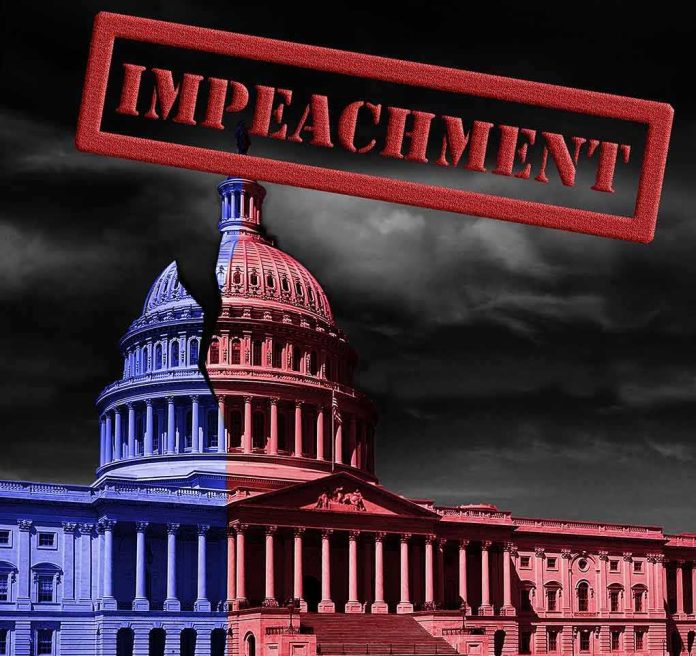
Impeaching a sitting Defense Secretary is not about personalities or even outcomes on the battlefield; it is a stress test of the Constitution’s allocation of war powers and of Congress’s willingness to enforce its limits when an administration treats military initiative as a standing prerogative.
At a Glance
- The case against Secretary Pete Hegseth is built on an eight-article, 34-page impeachment resolution centered on alleged War Powers violations tied to operations against Iran.
- Rep. Thomas Massie used a privileged procedure that forces a House vote within two legislative days, converting a constitutional dispute into a recorded choice for every member.
- The core legal question is whether executive-branch operations entered “hostilities” without authorization and in defiance of a June congressional removal directive, as reported by CBS.
- Hegseth rejects the premise, arguing the operations were lawful and that impeachment weaponizes policy disagreements rather than “high crimes and misdemeanors”.
What is actually being alleged, and why Congress says it matters
Two features make this impeachment bid consequential. First, it is not a press-conference volley; it is a formally filed, multi-article resolution that obliges House action, complete with a theory of law rather than a string of grievances. Second, its first article targets the constitutional heartland: whether the executive introduced U.S. forces into hostilities against Iran without congressional authorization and then sustained those operations despite a June concurrent measure directing removal of U.S. forces from those hostilities. If proven, that scenario would move beyond familiar separation-of-powers sparring into the realm Congress designed the War Powers Resolution to police—preventing prolonged, undeclared war.
According to contemporaneous reporting, Article I asserts that on February 28, 2026, Hegseth directed or caused U.S. forces to be introduced into hostilities against Iran absent statutory authorization, and subsequent articles frame continued action as defiance of withdrawal timelines and a bicameral directive approved in June. The resolution reportedly extends beyond Iran, alleging dismantling of civilian-harm safeguards, maritime killings in counternarcotics contexts, retaliation against a sitting senator, and operations in Venezuela and Yemen—diverse fact patterns offered as cumulative misconduct rather than a single disputed strike.
How the War Powers framework actually works
Since 1973, the War Powers Resolution (WPR) has attempted to reconcile constitutional text with modern military reality. It requires the President to notify Congress within 48 hours when U.S. forces enter hostilities or imminent hostilities and contemplates termination of such deployments within 60 days—extendable to 90 in narrow circumstances—absent express authorization. The statute’s purpose is prophylactic: to prevent the executive from transforming limited actions into sustained conflict without Congress’s assent. In practice, administrations of both parties have read Article II authority broadly, often characterizing operations as below the threshold of “hostilities” or as derivative of existing authorizations, while Congress oscillates between explicit approval, funding signals, and, at times, concurrent directives to wind down activity.
That friction explains why the June measure described by CBS matters. If both chambers directed the removal of U.S. forces from Iran-related hostilities, continuing operations after any applicable WPR clock expired would sharpen the constitutional conflict from ambiguity to open defiance—assuming the operations fit the statute’s “hostilities” definition and were not otherwise authorized. The resolution’s theory, as summarized in reporting, is that Hegseth, as chief civilian at the Pentagon, executed and sustained unlawful hostilities contrary to Congress’s directive and the WPR’s temporal limits.
The counter-case: lawful operations, policy dispute, not impeachable offense
Hegseth has responded directly and categorically: the operations were lawful; no Defense Secretary has been impeached for carrying out lawful military actions; and Congress is dressing a policy disagreement in impeachment clothes. He argues the proper remedy for dispute is legislation, debate, or elections, not the constitutional equivalent of capital punishment for civil officers. The Pentagon has amplified that position, calling the articles baseless and vowing to “take the offensive” against them. Taken together, that defense asserts two things: first, factual-lawful authority for the operations; second, even if critics disagree with strategy or targeting, such disagreements do not constitute “high crimes and misdemeanors.”
As a matter of constitutional practice, that framing will resonate with those who see war powers as an executive competence presumptively validated by ongoing appropriations and inherent defense obligations. It is also strategically shrewd: by characterizing the impeachment as an attack on service members and a propaganda boon to adversaries, the defense tries to transform a legal inquiry into a referendum on patriotism and combat effectiveness—terrain more favorable to a wartime Pentagon chief.
Where the real dispute lives: “hostilities,” authorization, and compliance with a June directive
The decisive questions are neither abstract nor theatrical. They are concrete, testable, and—if Congress pursues them—document-driven. Did U.S. forces engage in “hostilities” as understood by the WPR? Did the administration file the requisite reports and identify a statutory basis? If reliance was on Article II alone, did the facts meet the narrow categories the executive has historically claimed—self-defense against imminent attack, national emergency involving a sudden attack, or limited, time-bound action below the threshold of war? And, if both chambers passed a directive to remove U.S. forces from Iran hostilities in June, under what theory did operations continue thereafter?
Those are not semantic quibbles; they define the difference between hard legal constraint and political guidance. The congressional research literature is plain that WPR disputes occupy a “twilight zone” of concurrent authority, but when Congress squarely asserts a withdrawal directive and the statutory clock runs, the executive’s burden to justify continuation spikes. The impeachment resolution, as described, attempts to meet that burden of persuasion for the legislative branch by alleging specific dates, legal hooks, and continued action notwithstanding a directive. Hegseth’s defense must either collapse the facts (no “hostilities,” different statutory basis) or elevate an alternative legal theory robust enough to withstand the House’s constitutional judgment.
https://twitter.com/RoseSheinerman/status/2120216616013107358
Beyond Iran: why the additional articles may help, and also distract
The remaining articles range from alleged dismantling of civilian-harm mitigation to maritime interdiction deaths, intimidation of a senator, and Venezuela and Yemen operations. Strategically, that breadth invites cumulative judgment: even if a member hesitates on the Iran theory alone, the aggregate might signal unfitness. Legally, however, each claim demands different evidence and statutory predicates—appropriations riders and Title 10 directives for civilian-harm infrastructure; Posse Comitatus–adjacent limits for counternarcotics support; First Amendment and separation-of-powers principles for alleged retaliation. Without public exhibits—orders, targeting packets, approval chains, casualty assessments—the House risks evaluating serious claims through hearsay summaries rather than a documentary record. The strongest ground remains the Iran war-powers theory precisely because the legal rails are clearest there.
Procedural leverage and historical rarity
Massie’s use of a privileged impeachment instrument compresses time and forces clarity: within two legislative days, members must choose whether to table, refer, or proceed—no endless limbo. That accelerant interacts with the rarity of Cabinet impeachments; in 250 years, the House has impeached only two Cabinet officials, most famously Secretary of War William Belknap in 1876. The bar is historically high. Yet rarity is not immunity. The House’s impeachment power is the tool the framers left when an officer’s conduct allegedly subverts constitutional structure rather than merely errs in judgment.
What to watch if you care about the Constitution more than the personalities
Ignore the slogans—watch the documents. A serious adjudication will hinge on the June directive’s final text and votes, the administration’s formal WPR reports, any claimed statutory basis for Iran operations, and internal legal memoranda articulating the executive’s theory of authority. If those documents show an unambiguous removal directive followed by continued hostilities without fresh authorization, the House will be deciding whether that defiance is a removable offense or an acceptable expression of executive prerogative under the WPR’s gray zones. If, instead, the record demonstrates narrow, time-limited operations grounded in a recognized statutory hook or a defensible Article II theory, the impeachment frame collapses into what Hegseth says it is: policy dispute, not constitutional dereliction.
Sources:
npr.org, cbsnews.com, massie.house.gov, chicagotribune.com, washingtonexaminer.com, washingtonpost.com, congress.gov, theatlantic.com