
When infrastructure meets litigation, storms become stress tests—not just of seawalls, but of government credibility. The Thanksgiving flooding at Washington’s East Potomac Park forced that reckoning: was it a genuine inflection point for public safety or a political accelerant poured onto a preexisting redevelopment fight? The answer, so far, sits at the intersection of engineering facts that remain under-documented and a court record that has already called the government’s urgency into question.
At a Glance
- The Thanksgiving storm reportedly submerged parts of East Potomac Park, collapsed sections of the Potomac seawall, and damaged a road—evidence of an acutely changed condition on top of chronic deterioration.
- The Interior Department characterized the course as unsafe and closed, while the administration urged the court to allow redevelopment; yet the public docket did not show a matching emergency motion at the time reporters checked.
- Seawall deterioration and routine tidal inundation predated the storm; agencies had already signaled contractor procurement for seawall work, blurring what the storm newly changed versus what was longstanding.
- A federal judge has found the government’s earlier closure rationale likely pretextual and ordered continued public access during litigation—making safety claims live inside a credibility and process fight, not outside it.
What the storm changed—and what it didn’t
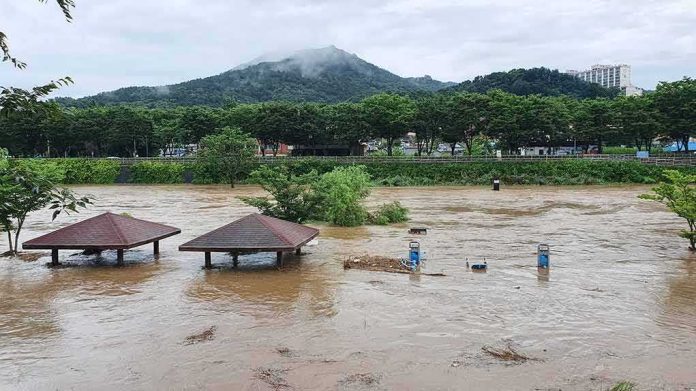
Multiple outlets described significant, visually obvious consequences from the Thanksgiving event: seawall failures, inundated land, and damage to a park road at East Potomac Park. President Trump labeled the course “completely destroyed” and the site “dangerous,” tying the condition to a request that the court greenlight long-disputed redevelopment. Local TV coverage likewise reported flooding and collapsed seawall segments; those accounts constitute contemporaneous, on-the-ground indicators that the hazard profile shifted—at least in places and at least for a time. The administration asserted that the Department of the Interior closed the course on safety grounds in the storm’s aftermath, an action consistent with an acute hazard framing, though reported through presidential statements rather than a published engineering order.
But the baseline matters. Before the storm, the National Park Service had documented a century-old seawall with persistent issues—tidal overtopping, erosion, sidewalk voids, and harmed trees—conditions that put safety and maintenance on the agenda independent of redevelopment. Indeed, Interior signaled it would solicit bids for a seawall contractor days before the flood, reflecting an infrastructure track already in motion. Officials had also acknowledged that large sections of sidewalk were underwater twice daily during normal tides and more frequently during extreme weather, a point that narrows the universe of what counts as “new” damage versus intensified recurrence. The storm may have accelerated failure, but without a post-event structural assessment in the public record, it does not yet redraw that line with engineering precision.
The safety case versus the court’s injunction
Safety claims do not operate in a legal vacuum. Weeks before Thanksgiving, U.S. District Judge Ana Reyes concluded that the administration’s push to close East Potomac appeared pretextual and likely violated federal environmental and administrative law; she ordered the parklands, Ohio Drive, and the golf property to remain open and accessible while litigation proceeds. In her view, an immediate shutdown would irreparably harm daily users and the historic character at stake—findings that place a heavy burden on the government to show bona fide emergency conditions, not merely longstanding deterioration, if it seeks to curtail access or advance irreversible work.
That credibility context shaped how the storm narrative landed. When the President said Interior was asking Judge Reyes to allow redevelopment to proceed because the course was unsafe, reporters looking at the public docket did not find a matching emergency filing; the latest entry they cited predated the claim. This discrepancy is not dispositive of substance—filings can lag public statements—but it widens a trust gap precisely where courts demand rigor in both process and proof.
Mechanics: seawalls, subsurface failure, and what evidence would settle it
On a tidal river, a vertical or sloped seawall resists lateral water pressure, wave energy, and scour; its safety function degrades when joints open, foundation soils erode, or capstones displace. Repeated overtopping pushes water into backfill, piping fines from the subgrade and generating voids beneath pavements and turf. Over time, the failure mode is textbook: differential settlement along the wall, sinkholes at the landside edge, and accelerating loss once storms add wave set-up and surge. In that context, a post-storm shift from chronic nuisance flooding to visible collapse is plausible on first principles. What separates plausibility from proof is documentation: as-built records, pre- and post-storm surveys, condition ratings, calibrated photographs, and stamped inspection memos distinguishing new structural loss from preexisting distress.
The public record here lacks that engineering granularity. We have credible signals that Interior sought seawall contracting before the holiday; we have eyewitness and media descriptions of overtopping, submergence, and collapse; we have an official history of sidewalks going underwater twice daily even absent storms. To translate those facts into a legally durable safety determination—and to justify measures as sweeping as a 15‑month closure or immediate redevelopment—agencies typically produce field inspections, cross-sections, erosion measurements, and alternatives analyses demonstrating why temporary controls (e.g., targeted riprap, jersey barriers, restricted zones) would be inadequate. That is the litmus test that would either substantiate the administration’s urgency or narrow it to focused interim repairs.
History and stakes: public land, public access, and a redevelopment through-line
East Potomac Park is not just a golf property; it is a layered public space used by cyclists, joggers, anglers, and walkers, with the Blue Course tied to early desegregation and protected historic status. That heritage and multiuse identity complicate any redevelopment that concentrates value in a championship configuration if it diminishes affordability or everyday access. Plaintiffs and preservationists have argued exactly that, framing the administration’s plan as a character change and cost barrier for local residents and public users beyond golfers. A separate controversy over the pre-storm removal of more than 400 trees—followed by judicial restrictions—further entwined the project with process critiques, making post-storm safety arguments carry the freight of earlier trust disputes.
That is why the court’s findings on pretext matter beyond rhetoric: when a judge has already questioned the bona fides of an agency timeline, every subsequent emergency claim must be documented to a higher standard. Conversely, if a post-storm engineering record shows progressive structural failure and intolerable residual risk, the same legal framework can accommodate phased closures and targeted emergency work even while larger redevelopment remains contested. The hinge is evidence, not assertion.
Trump cites D.C. golf course flooding to push stalled plan
President Donald Trump cited flooding at East Potomac Golf Links in Washington, D.C., to urge a federal judge to let his golf course redevelopment go forward.
Full story + sources on YouTube: The Tomorrow Desk pic.twitter.com/dLBKuzcdvx
— The Tomorrow Desk (@thetomorrowdesk) November 28, 2026
How to read the road ahead
A durable path forward has three parts. First, separate emergency stabilization from long-horizon redesign. Procure and publish a stamped, post-storm structural assessment of the seawall, subgrade, and circulation routes, with before-and-after comparatives; if hazards are localized, cordon and fix them. If they are systemic, show why narrower controls fail the risk test. Second, realign process with transparency. If Interior sought emergency relief, put the filings—and the delegated authority, closure orders, and photographs—on the record where the public and court can see them. Third, keep the access question analytically distinct from the safety question. Even if redevelopment ultimately proceeds, the law and the public will expect the government to demonstrate that near-term closures are safety-driven and proportionate, not backdoor accelerants to a preferred design.
Sources:
facebook.com, golfweek.usatoday.com, huffpost.com, essentiallysports.com, newsweek.com, ibtimes.co.uk, wjla.com