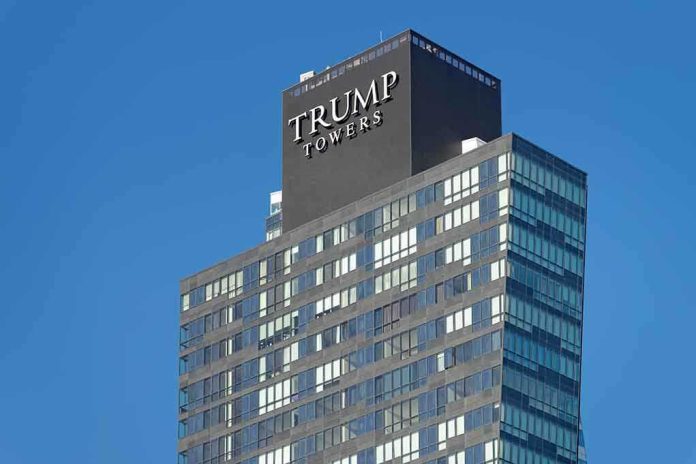
A 70-story Trump-branded tower pitched for Tbilisi promises to be Georgia’s tallest building—and its most combustible business story.
Story Snapshot
- Eric Trump promoted a 70-story “Trump Tower Tbilisi,” billed as Georgia’s tallest if built [1][4][5].
- Design outlets reported Gensler visuals and basic program details, signaling a concrete proposal, not just a rumor [4][5].
- Critics link the plan to a familiar pattern: foreign licensing deals that create political friction and reputational risk [1][2].
- Past Trump-branded projects in Georgia were shelved amid conflict-of-interest concerns, setting the frame for current scrutiny [2].
The pitch: tallest in the country, center-stage in Tbilisi
Eric Trump’s announcement of a roughly 70-story Trump Tower in Tbilisi positioned the project as a future skyline dominator and a symbol of commercial confidence in Georgia’s capital, with language about a city-center site and landmark status [1]. Design-focused reporting amplified those claims, noting that the proposal would be the tallest building in the country if completed and presenting renderings associated with the architecture giant Gensler [4][5]. That pairing—branding plus marquee design—signals a serious commercial aim, not a vague aspiration [4].
The sales logic is clear: plant a globally recognized name atop an eye-catching tower, then convert prestige into pre-sales, premium rents, and political attention. Georgia’s recent urban growth adds momentum, and “tallest in the country” functions as a free marketing accelerant. The Trump Organization’s structure, heavily built on licensing and management fees rather than direct equity in many projects, fits this model well: brand power secures leverage long before opening day [3]. The renderings and height figure give potential buyers a story they can visualize [4][5].
The pattern: branding meets political gravity
Observers connect the Tbilisi plan to a recurrent controversy cycle that has dogged Trump-branded ventures overseas: local developers gain cachet and access by securing the Trump name, while the Trump side gains fees, optionality, and geopolitical baggage [1][2]. Georgia is not new terrain. In the last decade, Trump-branded projects tied to Batumi and Tbilisi advanced, then stalled, as Donald Trump’s political rise and later presidency triggered conflict-of-interest alarms and reputational headwinds for all parties involved [2]. That precedent now shapes reactions to the revived Tbilisi vision.
The heart of the critique does not dispute real-estate fundamentals—prime location, strong skyline identity, and global design credentials can sell. The concern centers on the side effects: whether political figures, regulators, or state-adjacent financiers might perceive a branded tower as a shortcut to influence. Critics argue that even standard licensing deals can create incentives to please the brand’s namesake if he holds or may regain public power. That alignment risk, rather than construction feasibility, drives the sharper questions [2].
The counter: a commercial deal with visible partners
Supporters of the project point to the straightforward commercial narrative: a developer hires a top-flight design firm, pursues an ambitious program, and offers a global brand proven to command pricing premiums. Coverage highlighting Gensler’s involvement and the 70-story target suggests normal development sequencing—concept, renderings, marketing, and capital formation—rather than political gamesmanship [4][5]. On its face, that is a legitimate business pathway, familiar to any city wooing international capital with skyline theater [4].
[Trump Tower in Georgia to be built on land part-owned by son of US sanctions-hit leader | Georgia | The Guardian]
“Links between Trump Organization and Ivanishvili family for Tbilisi skyscraper raise new conflict of interest concerns“ https://t.co/LsH6mGSwZy
— Norio Nakatsuji (@norionakatsuji) May 26, 2026
Caution is warranted when allegations jump ahead of records. Claims about specific land ownership ties or sanction adjacency demand primary documentation; absent that, responsible analysis sticks to verifiable elements: the public announcement, the stated height and program, and the historical pattern of scrutiny that follows Trump-branded projects in politically sensitive settings [1][2][4][5]. From a common-sense, conservative lens, the fairest approach is to demand facts first, judge the deal on disclosed terms, and resist trial by insinuation.
What to watch: disclosure, financing, and execution risk
Three checkpoints will determine whether Trump Tower Tbilisi remains a headline or becomes a habitable address. First, land and ownership transparency: clear, public records reduce rumor velocity and build lender confidence. Second, financing specifics: named lenders and investors with compliance track records calm regulatory nerves and accelerate permitting. Third, execution milestones: signed construction contracts, site mobilization, and presales targets met on schedule convert sizzle into steak. Each step either validates the commercial story or revives the conflict narrative [2][4][5].
Sources:
[1] Web – Trump Organization’s latest 70-storey tower location sparks …
[2] Web – Trump’s Conflicts of Interest in Georgia – Center for American …
[3] Web – The Trump Organization – Wikipedia
[4] Web – Developers shares rendering of Trump Tower Tbilisi by Gensler
[5] Web – Gensler reveals design for Trump Tower skyscraper in Georgia