

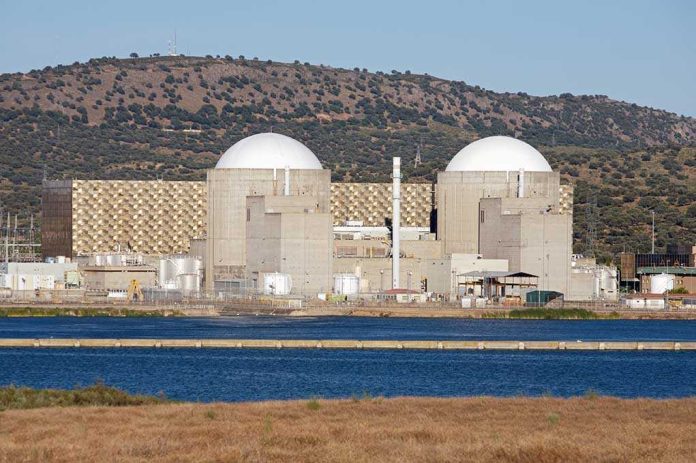
President Trump’s nuclear program is best understood not as a single announcement, but as an attempt to fundamentally reset how fast, how big, and for what purposes the United States builds reactors—linking civilian power, AI infrastructure, and national security to an aggressive industrial agenda.
Key Points
- Four sweeping executive orders form the backbone of a strategy to quadruple U.S. nuclear capacity to roughly 400 GW by 2050 and add 300 GW of new nuclear generation.
- The program couples ambitious deployment targets—10 large reactors under construction by 2030 and 5 GW of uprates—with licensing reform, test-reactor pathways, and federal siting initiatives.
- Nuclear power is explicitly framed as critical infrastructure for AI data centers and military bases, not just as a low-carbon generator for the civilian grid.
- Financing tools, including a $17.5 billion federal loan package for ten AP1000 reactors, aim to turn policy intent into bankable projects, but binding commercial commitments remain limited.
<liIndependent analysis describes the 2050 build-out as technically possible but economically and institutionally improbable without sustained political support, stronger market signals, and significant supply-chain expansion.
The Architecture of Trump’s Nuclear Expansion Strategy
The core of President Trump’s nuclear push is a set of four executive orders issued in May 2025 that collectively attempt to rewire the sector’s regulatory, industrial, and strategic foundations. One order directs a wholesale reform of the Nuclear Regulatory Commission (NRC), with a stated aim of “reestablishing the United States as the global leader in nuclear energy” and facilitating deployment of Generation III+ and IV reactors, small modular reactors, and microreactors. Another order focuses on reinvigorating the nuclear industrial base, including fuel-cycle capabilities, workforce, and manufacturing depth, while a third reassigns and accelerates nuclear test-reactor authority within the Department of Energy (DOE).
Critically, these orders do not stop at aspirational language; they encode specific numeric goals. The administration commits to expand nuclear capacity from roughly 100 GW in 2024 to 400 GW by 2050—a net addition of about 300 GW—and to have ten new large reactors under construction and 5 GW of uprates at existing plants by 2030. Those numbers are central to the strategy’s identity: this is not merely about protecting the existing fleet, but about orchestrating a new wave of large reactors alongside advanced, smaller designs.
Licensing Reform and Test Reactors: Speed as a Strategic Variable
The most contentious element of the Trump program is its insistence that speed—both in licensing and construction—is now a strategic variable, not just an administrative detail. One order instructs the NRC to impose fixed deadlines on license reviews: no more than 18 months for new reactor applications and one year to decide on life-extension for existing units. In the context of a regulatory culture where large projects have often taken many years to clear, this is a sharp break with historical practice.
In parallel, Executive Order 14301 reconfigures how the DOE handles nuclear test reactors, creating a pilot pathway for advanced reactors outside the traditional national laboratory footprint and directing the Energy Secretary to approve at least three reactors with a goal of achieving criticality by July 4, 2026. By shifting part of the testing and early deployment regime away from the NRC and toward DOE, the administration is explicitly trying to sidestep what it views as decades of accumulated procedural drag.
Supporters portray these changes as overdue modernization, arguing that probabilistic risk techniques, advanced materials, and passive safety designs can support faster, yet still robust, licensing. Critics, particularly those concerned with safety culture, see the same changes as a risky experiment—especially given the lack of publicly available, reactor-by-reactor safety analyses for the pilot units. The validity of either view will depend on how individual projects perform and whether accelerated review can be reconciled with the NRC’s statutory mandate over time.
Targets, Financing, and the Gap Between Goals and Deals
No modern nuclear expansion can proceed on intention alone; it requires enormous capital and risk tolerance. Here the Trump administration has tried to fuse its executive targets with a financing architecture calibrated to de-risk large reactors for utilities and vendors. DOE’s loan program office has been tasked explicitly with supporting the goal of ten large reactors and 5 GW of uprates by 2030, and in 2026 the department outlined plans for $17.5 billion in loans to underpin five projects, each with two AP1000 units.
Under the framework described by Energy Secretary Chris Wright and others, each plant would see roughly $3.5 billion in federal loan support, with Westinghouse and participating utilities contributing additional equity to ensure “skin in the game.” This model is intended to compress construction timelines by up to three years and stabilize financing costs, addressing two of the sector’s chronic pain points: schedule risk and capital intensity.
Yet, as independent reporting has emphasized, the existence of loan authorizations and executive orders does not automatically translate into signed contracts, shovel-ready sites, or firm offtake agreements. Journalistic investigations into the touted Westinghouse pipeline have found that, months after headline deals were announced, no U.S. utility had actually ordered an AP1000, and Japanese partners had yet to commit binding funding to the ten-reactor vision. That gap between policy framing and commercial reality is precisely where previous “nuclear renaissances” have stalled, and it remains the Achilles’ heel of the current program.
AI, Data Centers, and Military Bases: New Loads, New Justifications
One distinctive feature of Trump’s nuclear agenda, compared to earlier pushes, is the explicit linkage to AI infrastructure and military basing. The orders task DOE with ensuring that new reactors and uprates support electricity demand from data centers, manufacturing, and “other critical industries,” and call for deploying U.S. reactors to AI facilities and military installations.
In speeches and events, administration officials and private-sector CEOs have gone further, describing advanced reactors tailored to power secure data centers, space-related operations, and undersea systems, as well as microreactors designed for domestic bases by 2028. This framing serves two purposes. First, it broadens the coalition for nuclear beyond utilities and climate advocates to include defense, technology, and industrial actors worried about grid stress and geopolitical resilience. Second, it positions nuclear not just as a cleaner alternative to fossil fuels, but as a way to guarantee 24/7, on-site power to critical infrastructure in an era of escalating cyber and physical threats.
Whether this integration yields actual deployments is, again, a question of projects rather than rhetoric. High-load data centers and sensitive military sites have stringent requirements for security, uptime, and local political acceptance. Advanced reactors may eventually meet those needs, but the evidence base today consists mostly of executive intent, pilot-program language, and early-stage private projects, not mature installations with track records.
Advanced Reactors and the July 4 Milestone
Perhaps the most symbolically important claim in the Trump narrative is that four privately funded advanced reactors achieved criticality by July 4, 2026, surpassing an earlier goal of three and ending a half-century drought in new test-reactor startups at Idaho National Laboratory. At public events, President Trump and industry executives have celebrated this as proof that deregulation and private capital are already delivering hardware, not just plans.
From a sector-history standpoint, a cluster of privately financed advanced reactors going critical in a compressed timeframe would indeed be a milestone; it would mark a break from the era when novel designs existed mainly on paper or in small-scale experiments. However, the publicly available record so far does not include unit-level licensing dockets, safety reports, or independent performance verification for each reactor. Without that documentation, it is difficult to assess whether these units are commercially significant, how their safety envelopes compare to conventional plants, or what kind of economic value they will ultimately deliver.
The reality likely lies between hype and dismissal. The reactors exist and have reached criticality under DOE’s pilot framework; that is a concrete achievement. But it is premature to treat them as decisive evidence that the broader 300 GW build-out is now guaranteed, or that accelerated pathways can be generalized across the entire fleet without careful technical and regulatory scrutiny.
Industrial Base, Fuel Cycle, and Strategic Aims
Beyond capacity numbers, Trump’s orders explicitly target the upstream and downstream pieces of the nuclear system: fuel production, enrichment, and spent fuel management. One directive instructs DOE, in coordination with NRC leadership, to produce a plan within 120 days to expand domestic uranium conversion and enrichment sufficient to meet projected civil and national-security demand. Others call for examining fuel recycling and reprocessing options and improving long-term spent fuel handling, as part of a broader push to restore U.S. leverage in global nuclear supply chains.
Strategically, this is as much about geopolitics as electrons. By strengthening domestic fuel capabilities and offering reactor technology abroad—most notably in the contested civilian nuclear agreement with Saudi Arabia—the administration aims to counter Russian and Chinese influence in reactor exports and fuel services. The Saudi deal, in particular, illustrates the tension embedded in such efforts: its supporters frame it as a tool to constrain Iran and lock a key ally into U.S.-aligned technology, while critics worry about proliferation risks, regional arms-race dynamics, and the political optics of rewarding a country implicated in 9/11 controversies.
The added condition that Saudi Arabia join the Abraham Accords before the agreement fully takes effect underscores how nuclear policy is being fused with broader diplomatic and ideological objectives. That fusion can amplify leverage—but it also makes deals more fragile, as partners balance energy benefits against domestic and regional political constraints.
Feasibility, Risk, and What History Suggests
How should a sober observer weigh this program? The evidence supports two firm conclusions. First, the Trump administration has put more specific, numerically defined nuclear expansion goals on paper than any U.S. administration in decades, and has taken concrete steps—executive orders, loan programs, pilot reactors—to move the system toward those goals. Second, the path from here to 400 GW is constrained by the same fundamentals that have limited nuclear growth since the 1980s: high capital costs, long construction times, complex regulation, and competition from cheaper or more flexible generation.
Independent analysis from news organizations and policy institutes emphasizes that quadrupling capacity by 2050 would require building roughly one hundred times more nuclear capacity in the next quarter-century than in the prior one, and that current project pipelines do not yet reflect that scale. When journalistic investigations ask developers and utilities to point to signed reactor orders or fully financed megaprojects, the answers still largely revolve around loan offers, feasibility studies, and nonbinding expressions of interest.
In that sense, Trump’s nuclear initiative sits squarely within the historical pattern of American nuclear policy: ambitious “renaissance” declarations, partial institutional reforms, some genuine strides in technology and demonstration, and a persistent question about whether markets, regulators, and communities will embrace the tempo and scale politicians seek. The executive orders and early milestones materially shift the starting point for the next decade of nuclear debate. They do not, by themselves, resolve the underlying economics and politics.
What to Watch Going Forward
For readers who care about where this strategy ultimately lands, the most informative signals over the next several years will be concrete, not rhetorical. Key markers include: whether any U.S. utility signs binding contracts for new large reactors under the DOE loan framework; whether the NRC codifies and consistently meets the 18‑month licensing timeline without compromising safety; how the pilot advanced reactors perform in practice and what independent assessments conclude about their risk profiles; and whether the Saudi nuclear agreement, or similar deals, survive political and nonproliferation scrutiny to become durable arrangements.
If those elements converge—projects financed, reactors built on budget, safety preserved, and geopolitical partnerships stabilized—the Trump-era nuclear program will be remembered as the point where U.S. nuclear policy finally broke out of its long stalemate. If they do not, it will join a line of ambitious but unrealized visions that nonetheless shaped the sector’s trajectory by testing the outer limits of what presidents can attempt with executive authority.
Sources:
youtube.com, energy.gov, whitehouse.gov, nuclearinnovationalliance.org, world-nuclear-news.org, utilitydive.com, csis.org, apnews.com, instituteforenergyresearch.org, nytimes.com, presidency.ucsb.edu, skadden.com