

Rhetoric about civilizational renewal is never just about memory; it is a bid to align values with machinery — industry policy, defense spending, supply chains, and alliance discipline — so that cultural confidence and democratic self-government have the hard power to survive great‑power competition.
At a Glance
- Rubio used Athens’ classical stage to argue that Western democratic identity and unapologetic national power are complementary, not contradictory.
- The speech framed a concrete policy bundle — reindustrialization, defense buildup, and tech primacy — as a civilizational project, not a technocratic fix.
- The message fits a long lineage of Western leaders invoking antiquity during strategic stress to rally domestic will and allied cohesion.
- Core claim: recovering confidence and civic purpose is inseparable from restoring material capacity — energy, industry, and military readiness — across the alliance.
What Rubio argued in Athens: identity married to power
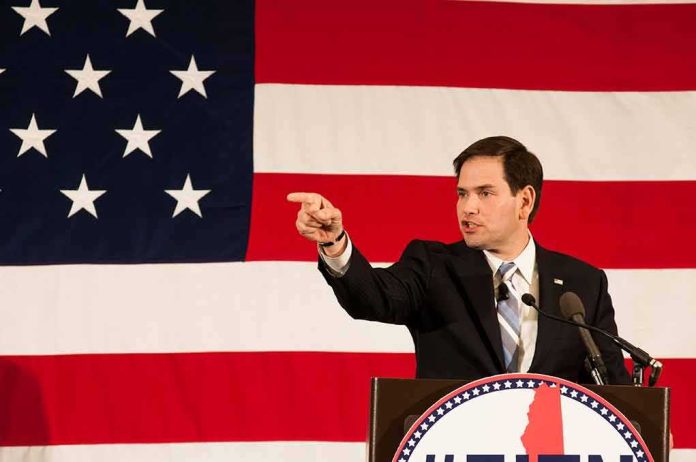
Speaking at the Pnyx with the Acropolis as a deliberate backdrop, Secretary of State Marco Rubio cast ancient Greece as the fountainhead of Western political order and civic character, then yoked that heritage to a prescription for the present. The West, he argued, sits at a crossroads that will determine whether it maintains leadership or slides into atrophy; the way through is the unapologetic pursuit of national power that reinforces, rather than erodes, democratic self‑government and cultural identity. Wire reports captured the speech’s spine: a call to return to civilizational roots and to restore the values that propelled Europe and North America to prominence, now translated into reindustrialization, defense rebuilding, and technological primacy in fields like AI, autonomy, and space.
Rubio’s phrasing — national strength as compatible with liberty and pluralism — is doing double duty. It addresses a domestic audience wary of coercive state power while telling allies that American assertiveness underwrites, rather than eclipses, their sovereignty. It also signals policy continuity: the United States, “under President Trump,” has chosen to reassert national power and expects Europe to shake off strategic complacency by spending more, producing more, and hardening supply chains in ways that serve both national and allied resilience.
The classical stagecraft and why leaders use it
Rubio’s venue choice was not decorative. Western leaders reach for Athens, Rome, and Christendom when they want many disparate problems — war, industrial fragility, migration, technological rivalry, institutional distrust — to be understood as one civilizational challenge that demands a coordinated answer. Speeches from iconic sites have historically preceded concrete asks: more defense outlays, joint industrial baselines, energy corridor build‑outs, and stricter bloc discipline on trade and technology controls. In Athens, the State Department preview and subsequent wire coverage framed exactly that linkage, presenting the address as a rallying cry for renewal that would, in practice, justify a thicker economic‑security agenda across the Atlantic.
This is not mere flourish. Grand narratives change coalition math. When publics accept that the stakes are civilizational, policies that once looked like sectoral tinkering — a semiconductor subsidy here, a munitions multiyear there — become parts of an integrated strategy. Rubio’s catalog of aims points to such integration: onshoring critical manufacturing, expanding energy infrastructure, coordinating immigration enforcement, and tightening alliance technology sharing to outpace rivals that have exploited Western openness and risk aversion.
Mechanism: from rhetoric to capability
How does a speech translate into power? First, by resetting priorities. If the West is at an inflection point, leaders can privilege resilience over short‑term efficiency: secure supply chains over cheapest imports, surge munitions stocks over budgetary neatness, and frontier R&D over incremental upgrades. Second, by aligning institutions. A shared vocabulary about heritage and threat simplifies interagency fights at home and harmonizes standards among allies abroad. Third, by mobilizing capital. Clear strategic direction reduces investor uncertainty in defense, energy, and dual‑use technology; that mobilization is essential to the reindustrialization agenda Rubio emphasized.
The policy menu he invoked is familiar: raise defense spending toward robust readiness, rebuild industrial depth for prolonged contingencies, and seize leadership in next‑generation technologies. Each requires legislative appropriations, regulatory streamlining, and multi‑year contracting — levers that rhetoric alone cannot pull, but which rhetoric can legitimate. As prior alliance cycles show, such moves also depend on anchor allies. Rubio praised Greece’s posture as a model inside NATO — increased spending, energy and maritime coordination, and migration enforcement — a concrete example of how smaller states can plug capacity gaps and geographic seams when strategy is shared.
Where the real debate lives: power, pluralism, and the nation
Rubio’s frame contends with two perennial anxieties. The first is whether an “unapologetic pursuit of national power” erodes liberal norms. His answer, delivered from democracy’s birthplace, is that constitutionalism and national strength are symbiotic: a confident nation can secure borders and factories without betraying liberties. The second is alliance friction — national power, multiplied by many capitals, can pull in divergent directions. Here the remedy is discipline: define common red lines, pool industrial capacity, and treat sovereignty and solidarity as complements, not substitutes. In Athens, that logic emerged as a call for Europe to “awaken from its long slumber,” spend and produce at scale, and match American tempo — not as subordination, but as co‑ownership of deterrence.
Viewed in comparative perspective, the argument tracks the long arc of Western statecraft. Moments of external pressure routinely produce an inward turn to roots and an outward surge in capacity building. The novelty is not the invocation of Athens; it is the twenty‑first‑century toolkit: AI‑enabled kill chains, resilient microelectronics, hypersonic defense, diversified critical minerals, and digitized logistics — all anchored to political communities that must still consent to pay, produce, and serve.
Marco Rubio declares West is "at an inflection point" in Acropolis of Athens speech, warns Europe must "confront dangers" | Video @nypost @WHO @HmpxvT @CDCgov https://t.co/29ydc01NcO
— Ana (@Ana04362608710) October 7, 2026
Implications: what shifts if the Athens thesis prevails
If this thesis shapes policy, expect three durable shifts. First, economics will be securitized across more domains. Supply chains for energy, chips, pharmaceuticals, and rare earths will be reorganized along trusted‑ally corridors, even at a cost to unit prices — an explicit trade of efficiency for resilience that Rubio’s argument treats as prudent statecraft. Second, European capabilities will be pressured upward. Countries that have treated defense as a procurement hobby will face a choice: raise outlays, expand production lines, and integrate command‑and‑control — or accept reduced voice in strategy. Third, alliance technology policy will harden. Export controls, investment screening, and standards setting in frontier tech will be coordinated more tightly to deny adversaries the diffusion benefits they have enjoyed during the West’s “long slumber”.
Domestically, an unapologetic power posture invites corresponding investments in civic muscle. Rubio laced his argument with the classical virtues — ambition, excellence, duty — to suggest that public culture must valorize risk, service, and mastery again. That cultural component matters because industrial revival and military readiness are ultimately human‑capital projects; factories, shipyards, and labs cannot be staffed by abstractions. When leaders marry heritage to capability, they are recruiting the next engineer, welder, machinist, cryptographer, and soldier — the actual sinews of national power.
Bottom line
The Athens address situates Western renewal not as nostalgia but as program: recover confidence and civic purpose, then convert them into energy security, industrial capacity, and credible military power within a disciplined alliance. That is the through‑line from the Pnyx to present policy. The symbolism worked in service of specificity: if the West is to lead, it must once again build — and be seen to build — the material foundations of freedom, at home and with allies who share both heritage and hazard.
Sources:
cbsnews.com, ekathimerini.com, abcnews.com, afp.com, c-span.org, knews.kathimerini.com.cy