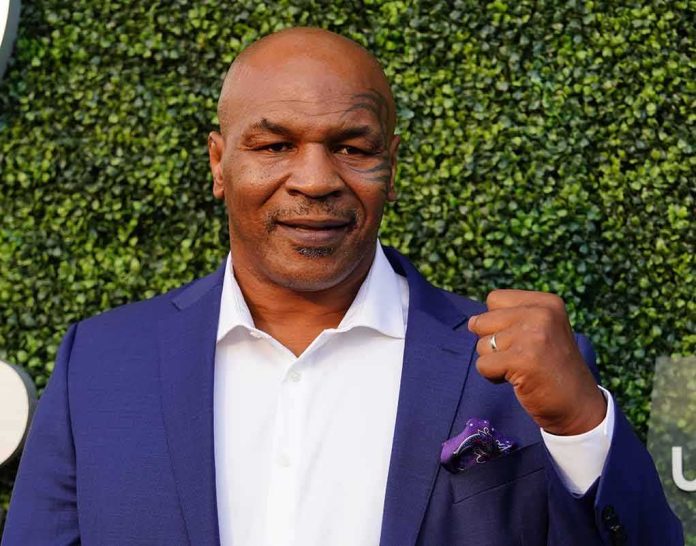
What mattered about Mike Tyson’s brief turn at the White House lectern wasn’t electoral prognostication; it was how a famous face, placed in an official setting on the cusp of a campaign stop, served as a megaphone for a political brand in the thick of a midterm push.
The Short Version
- Mike Tyson told reporters in the White House briefing room that “Trump is going to win” when asked about the midterm elections, before departing with the president for a New York rally.
- The timeline and venue are well-documented: Friday remarks in the West Wing, followed by a Syracuse rally appearance where Trump highlighted Tyson on stage.
- Tyson’s statement was a celebrity political cue, not an evidence-based forecast; no polling or race-specific rationale accompanied the prediction.
- Research on celebrity endorsements shows attention effects are reliable; vote-moving effects are mixed and context-dependent, with rare outsized cases like Oprah Winfrey in 2008.
What happened: a celebrity prediction, delivered from the briefing room, en route to a campaign rally
On a Friday in October 2026, Mike Tyson stepped into the White House briefing room and answered a direct question about how Republicans would fare in the midterms. He replied that he thought Donald Trump would win—wording that varied slightly across outlets but carried the same thrust—then left to travel with the president to a Syracuse rally for GOP candidates. The Associated Press noted Trump publicly introduced Tyson at the White House earlier that day and described a long-standing friendship, underscoring that this was not a stray hallway quote but part of a coordinated political day for the former heavyweight champion alongside the president.
The sequence concluded as expected: at the rally, Trump drew attention to Tyson from the stage, and national outlets framed the event as a midterm push for New York Republicans, including Bruce Blakeman. In short, Tyson provided a newsworthy soundbite in an official setting, then lent his presence as a campaign surrogate—classic choreography for a modern campaign eager to blend governing backdrops with political messaging.
How to understand Tyson’s line: a brand cue, not a model
Tyson’s sentence carried no polling citations, district math, or turnout logic; it was a clean endorsement line delivered from a high-visibility room. The Daily Beast captured the ambiguity many observers flagged: Donald Trump was not on the midterm ballot, so “Trump will win” is best read as shorthand for Republican success broadly or victories by Trump-aligned candidates, not as a literal candidate outcome. The line functioned as affect, not analysis—an easily repeatable declaration that attaches a celebrity’s aura to a political identity.
This is standard operating procedure. Campaigns prize these moments because they generate coverage at minimal cost. The cameras were already trained on the White House; the Syracuse rally was guaranteed press. Dropping a celebrity into the frame creates a fresh hook while reinforcing the organizing story of the day: Trump’s brand, his chosen candidates, and the idea of momentum heading into the vote. It’s not intended to persuade skeptics with cross-tabs; it’s meant to unify allies, delight the already-convinced, and crowd out less favorable narratives.
Mechanism: why campaigns use celebrities, and what they reliably get
Celebrity cues are efficient attention engines. They multiply earned media, create sharable clips, and perform social proof: if this widely known figure is on stage, something important must be happening. Political communication research repeatedly finds that these endorsements can lift awareness, shape perceived viability, and mobilize interest—especially among lightly attached voters—without guaranteeing vote switching at scale. In other words, they tune the volume knob more predictably than they move the needle.
The exceptions prove the rule. The most studied outlier—Oprah Winfrey’s endorsement of Barack Obama in 2008—was estimated to add meaningful votes in a competitive primary and boost contributions and turnout, a function of Oprah’s unmatched cultural reach at that time and the primary’s fluid preferences. Most celebrity moments are smaller: they frame the day, animate the base, and give local candidates a bigger audience. Tyson’s appearance fits that modal pattern.
Context and continuity: Tyson, Trump, and midterm theater
Tyson’s political association with Trump predates 2026. The AP’s same-day note that the two have been friends for a long time clarifies why Tyson was not merely present but integrated into the day’s choreography—introduced at the White House, then featured at the rally. Fox News footage shows the predictable final act: the rally shout-out, the crowd recognition, the loop closed from briefing room to arena. Local and national outlets framed Syracuse as a midterm staging ground for New York Republicans, which gives Tyson’s “Trump will win” its practical meaning: a vote of confidence in the party’s prospects and in candidates running on Trump’s playbook.
Two features of the episode are notable for students of political communication. First, the setting mattered: brief remarks from the briefing room—an institutional symbol of governing—imbued a campaign message with official-seeming gravitas. Second, the timing compressed message discipline: a morning cue in Washington, a primetime reinforcement in New York, and a through-line headline linking the two. That is message architecture as much as it is celebrity cameo.
Mike Tyson is great – not sure why Trump convinced him to give an endorsement but probably wrote him a check
— Journal Court 🇺🇸 🇨🇦 (@journal_court) October 10, 2026
What it does not tell us: forecasting power
Tyson’s statement was a prediction, not a prediction market. There is no evidence in the record that he intended to offer, or possessed, election-model detail; the Daily Beast explicitly observed the absence of any race-specific basis for the claim. For readers tempted to treat celebrity forecasts as tea leaves, the literature is a guardrail: most endorsements adjust salience, identity alignment, and enthusiasm more than they alter vote choice, with effects sharply conditioned by prior attitudes and the endorser’s credibility with the targeted audience.
Still, in political practice, that limited but reliable yield is enough. Campaigns bank attention, project momentum, and create associative memory. In this case, the memory is straightforward: Tyson said Trump would win, from the White House podium, then appeared at a rally where Trump’s candidates were the protagonists. The story worked on its own terms.
Why it matters
Episodes like this illustrate how the modern presidency and campaign culture interleave. The most technically consequential election work happens in field offices, analytics teams, and legal war rooms; the most visible work happens in choreographed moments that yoke celebrity and state symbolism to party goals. Tyson’s brief line traveled far because it was simple, embedded in institutional theater, and immediately echoed in a live rally environment. That is how attention is manufactured in American politics—and why campaigns will keep doing it.
Sources:
thegatewaypundit.com, thehill.com, apnews.com, thedailybeast.com, yahoo.com, foxnews.com, insight.kellogg.northwestern.edu