
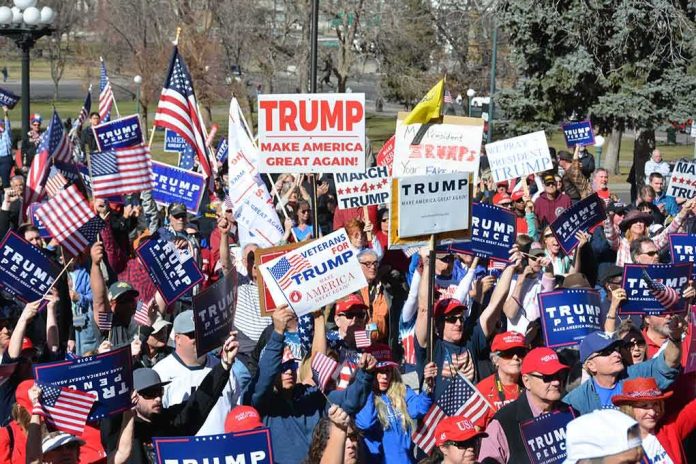
When celebrity enters the choreography of a campaign rally, it is rarely ornamental; it is strategy. Ted Nugent’s pre-speech appearance at President Trump’s Park City, Kansas event was a textbook example—an artist long intertwined with conservative activism stepping onto a political stage to energize a crowd, telegraph cultural alignment, and frame the evening’s themes before the principal arrived.
At a Glance
- Ted Nugent spoke on stage at President Trump’s rally in Park City, just outside Wichita, ahead of Trump’s remarks.
- Local and national outlets independently placed Nugent at the venue and in the speaker sequence before the president.
- The rally’s stated purpose was to boost Sen. Roger Marshall’s reelection, situating Nugent’s appearance inside a broader campaign push.
- Coverage documents Nugent’s fiery pre-show address; reporting does not establish a separate musical performance.
What happened: a documented, on-stage appearance before Trump’s address
The facts are straightforward. Nugent took the stage at the Heartland Credit Union Arena in Park City on the afternoon of the rally and addressed attendees before President Trump spoke. Local television carried that reality plainly—Nugent “speaks at President Trump’s rally”—and regional and national coverage placed him at the venue ahead of the president’s scheduled remarks, which were slated for the early evening window that followed the event’s late-afternoon start. Yahoo’s live report captured his pre-rally presence and movement through the venue; the Wichita Eagle had flagged his expected appearance earlier that day. The location matters for precision: this was Park City, adjacent to Wichita, in a building identified consistently across outlets as the Heartland Credit Union Arena.
One account carried Nugent’s own rhetorical framing—“I’m a radical. I’m extremist,” followed by a list of commitments he characterized as his touchstones—but the substance of the day does not depend on that quotation. What is uncontested is that he delivered a short, high-energy political address to set the tone for a crowd assembled to hear Trump and to rally support for Sen. Roger Marshall’s reelection bid.
How campaigns use musicians: presence, performance, or “opening act”
Campaign events run on cues—lighting, playlists, warm-up speakers, and sometimes star cameos—to build momentum before the principal. In that ecosystem, a musician’s role can be one of four things: an attendee, a speaker, a performer, or an explicit opening act. Coverage of this Kansas rally squarely confirms Nugent as a speaker who appeared before Trump. What it does not establish is a discrete musical set. Headlines and social chatter often collapse those categories; “opens for” gets used as cultural shorthand when a well-known artist takes the stage pre-principal. The more precise description here is that Nugent delivered a pre-speech address, a common slot in modern rally sequencing.
This distinction is not pedantic. A formal opening performance implies a different production commitment and contractual frame than a cameo speech. It also carries distinct symbolic freight: a musical set suggests entertainment value woven into the campaign’s brand, while a speech aligns the artist more directly with the candidate’s message discipline. In Park City, the reporting points to the latter.
Mechanics and timing: where Nugent fit in the run-of-show
Rallies of this scale typically open doors hours before the headliner, fill the bowl with a curated soundtrack, and sequence a roster of state officials, surrogates, and movement figures to keep attention levels high. Kansas Public Radio’s rundown had the rally beginning in the late afternoon, with Trump scheduled roughly 90 minutes later; local and regional reporting placed Nugent on site and on stage ahead of that keynote. That timing places him in the warm-up block that primes the room—structured to unify the crowd, test the audio, and, crucially, give cable hits and live blogs something to cover while the arena fills.
It is also why surrogates with built-in audience familiarity are valuable. Nugent’s decades-long profile—and his comfort working a large, friendly room—lets a campaign trade on recognition without reintroducing a speaker’s bona fides. The audience instantly understands why he is there and what he represents. That is production economy as much as politics.
Why it matters: cultural signaling as campaign infrastructure
Musicians at political events are never just background noise. They are a form of cultural signaling that compresses values, style, and in-group identity into a five-minute hit of recognition. Campaigns have used music—licensed walk-on tracks, unsanctioned playlists, and live cameos—since the republic’s early days to stir emotion and imply affiliation. The modern legal and public-relations terrain around music in politics is dense, but the practical function remains the same: music and musicians help define who a candidate is for, and who is for the candidate.
Because that signaling is powerful, it also reliably attracts dispute. Artists have balked at unauthorized uses of recordings at events; campaigns often retreat to venue blanket licenses or swap tracks to defuse controversy. The core principle that governs most of these fights is simple but counterintuitive: performance-rights organization licenses typically authorize public playback at arenas without direct artist consent, while using a song in an advertisement or implying endorsement is another matter entirely and far more precarious legally and reputationally.
Placing Park City in the broader pattern
Nugent is an outlier in one respect: he is not an unwilling soundtrack provider. He is a willing political actor who has long participated as a surrogate on conservative stages. That makes this event cleaner than the usual dust-up over unsanctioned walk-on music. The Kansas rally leveraged a familiar dynamic—celebrity sets tone; principal delivers message—and attached it to a concrete political objective: boost energy and local coverage for Sen. Marshall while giving the national press a high-contrast visual of movement unity around President Trump.
For readers tracking the media ecosystem rather than the musicology, the interesting piece is how venue geography and headline compression can blur facts. This was a Park City event, frequently described as “near Wichita” or a “Wichita rally” in shorthand. And Nugent “spoke” before Trump; some headlines render that as “opened for.” Neither shortcut is wrong in casual speech, but precision helps if you care about how campaigns actually build and brand these nights.
JUST IN: The Legendary Ted Nugent drops the 🎤 saying “I got a call from President Trump saying 'can you come to Kansas and RAISE SOME HELL”
THIS IS THE MOST EPIC VIDEO 🔥 pic.twitter.com/n5uaaE1nLD
— 🇱🇷🍩JULIE DONUTS Q🍩🇱🇷 (@rejulie_Donutsq) October 20, 2026
What to watch in future rallies
Expect more of this—familiar artists and personalities slotted into pre-keynote windows, with coverage oscillating between political reporting and cultural commentary. The tell that matters is not the label on the appearance but the function it serves: does the cameo unify the room, offer quotable lines that amplify the campaign’s themes, and feed local TV with clean, promotable footage? In Park City, Nugent’s turn did all three, and it did so without tripping the legal tripwires that so often accompany music in politics.
Sources:
thegatewaypundit.com, kwch.com, kansas.com, yahoo.com, kansascity.com, kansaspublicradio.org, politico.com, nytimes.com, nysba.org