

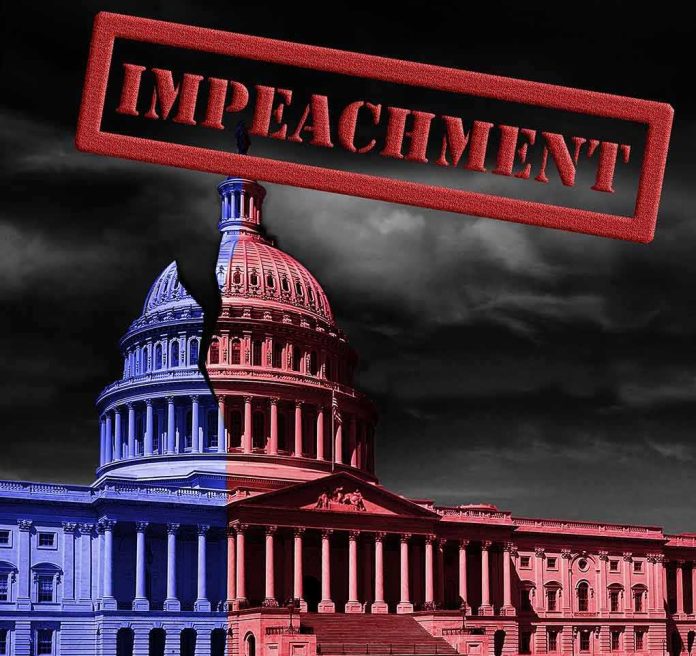
Impeachment is not a referendum on a president’s popularity or an outlet for postelection anger; it is a constitutional instrument with a narrow purpose and steep hurdles, which is why calls to remove a sitting president almost always outpace the legal and political capacity to do it.
At a Glance
- A conservative Detroit columnist urged Republicans to supply the Senate votes to remove President Trump after Democrats pursue impeachment, framing it as accountability, not partisanship.
- House impeachment requires a simple majority to impeach; removal demands two-thirds of senators present to convict—an extraordinary threshold rarely met.
- Democrats introduced a 2026 House impeachment resolution against President Trump, reviving arguments about oath-breaking and constitutional abuses.
- History and scholarship show impeachment efforts correlate strongly with polarization and elite incentives, while Senate convictions remain vanishingly rare.
What’s being proposed and by whom
The spark for the latest impeachment push came not from a liberal firebrand but from Nolan Finley, a conservative columnist at the Detroit News, who argued that Republicans should not shield President Trump from impeachment and, more pointedly, should deliver the Senate votes needed to remove him after the midterm elections. Finley’s case rested on electoral accountability—asserting that Trump cost Republicans Senate seats—and concluded that remaining Republican senators “shouldn’t help the president keep his”. In the House, Democrats channeled parallel arguments into a formal instrument: H.Res. 1486 (119th Congress), which alleged violations of the presidential oath and enumerated “high crimes and misdemeanors,” advancing a familiar article-by-article narrative of constitutional breach.
Together, the column and the resolution set the stage: a moral-political claim that the president’s conduct justifies removal, paired with a procedural pathway that, at least on paper, exists for precisely these moments. But impeachment’s text is simple while its practice is exacting; the gap between voting to impeach and voting to remove is the decisive terrain.
How impeachment actually works—and why the Senate is the mountain
Impeachment is the House’s formal accusation; removal is the Senate’s judgment. The first requires a simple majority of members present. The second demands “the support of a two-thirds majority of the Senators present” on at least one article—an intentionally supermajoritarian bar designed to force bipartisan agreement before reversing a national election. This architecture reflects the Framers’ dual aims: make a remedy available for serious abuses of office, yet insulate the presidency from transient factional passions. The result is a process that looks accessible in the House and nearly forbidding in the Senate.
Modern history bears this out. No American president has ever been convicted in the Senate. Andrew Johnson in 1868 survived by a single vote, Bill Clinton in 1999 by a wide margin, and President Trump twice in 2020 and 2021—each time impeached by the House but acquitted in the Senate, precisely because the two‑thirds requirement converts partisan energy into an arithmetic brick wall without meaningful cross-party defection.
The constitutional and rhetorical case advanced against the president
Proponents of removal typically ground their articles in an oath-centered theory: that the president’s duty to “preserve, protect and defend the Constitution” has been compromised by a pattern of conduct—orders exceeding statutory authority, encroachments on Congress’s war powers, or erosions of First Amendment protections—thus constituting “high Crimes and Misdemeanors,” a term of art that captures grave abuses of public trust rather than only indictable crimes. The 2026 resolution reprises that template, asserting that President Trump violated Article II’s oath clause and therefore meets the constitutional threshold for impeachment.
This theory is not new, and neither is the friction it creates. During earlier Trump impeachments, his counsel countered that impeachable offenses must track established criminal law and that articles untethered to statutory crimes lack legitimacy—a view cataloged in constitutional analyses of those proceedings. The Constitution’s text and practice cut the other way: criminality is not required, but gravity is. The Senate’s supermajority guardrail is intended to force that gravity to be recognized by more than one party.
Politics is not a sideshow here; it is part of the mechanism
Impeachment sits at the intersection of law and politics. The House drafts legalistic articles, but legislators are political actors responding to coalitions, incentives, and shocks. Quantitative scholarship that mapped every presidential impeachment resolution from 1973 to 2019 found that the decision to sponsor tracks ideology and party identity, and that major scandals increase activity; divided government and macroeconomic conditions, by contrast, showed little statistical pull. Elite polarization—leaders and activists sorting into hard camps—raises the odds the House can clear its first hurdle but does little to soften the Senate’s second.
Public opinion moves, but not always in ways that reorder Senate math. Studies of the 2019–2020 impeachment cycle show how partisanship structures attitudes toward the presidency and impeachment outcomes; opposition voters tend to favor removal, incumbents’ supporters the reverse. Even scandal exposure depresses approval unevenly across party lines, which helps explain why the House can act and the Senate can acquit without either side contradicting its base.
What the current push would require to succeed
For removal to occur now, three conditions must converge. First, the House must pass at least one article—a feasible step if the majority is aligned and the case is framed coherently. Second, the Senate must see large-scale defections from the president’s party or a cross-party consensus that the alleged misconduct is intolerable. The arithmetic is unforgiving: two-thirds of senators present must vote to convict; a handful of opposition votes will not suffice. Third, the evidentiary record must be developed and communicated in a way that moves senators beyond partisan shelter—typically through public hearings, documentary proof, and corroborated testimony, not only op-eds and rhetoric.
Finley’s exhortation that Republicans “give Democrats those votes” acknowledges the core obstacle: removal is impossible without a faction of the president’s own party concluding that constitutional fidelity and political self-preservation now point in the same direction. Historically, that alignment has been rare. When it has approached plausibility—Johnson in 1868, Nixon’s crumbling support in 1974 before resignation—the trigger was not a generalized critique of overreach but specific, evidenced acts that shifted intra‑party risk calculus.
The likely trajectory and the cost of confusing remedy with messaging
Impeachment resolutions will continue to appear whenever allegations, polarization, and a narratable constitutional hook align; that is a feature, not a flaw, of a system that allows the people’s representatives to signal and to act. But removal is not a message. It is a constitutional nullification of a national mandate, and the Framers demanded supermajoritarian consent before it happens. Unless and until the case against a sitting president persuades a meaningful bloc of his own party in the Senate, calls for removal will serve primarily as pressure campaigns, fundraising scripts, and party-discipline tools, not as preludes to conviction.
Bottom line
The columnist’s argument captures the accountability impulse that impeachment was designed to honor. The constitutional process he urges, however, is calibrated to be difficult on purpose. The House can impeach on a partisan majority; the Senate cannot remove on one. Any strategy that treats those steps as equivalent misreads the mechanism—and mistakes a loud signal for a legal remedy.
Sources:
redstate.com, govinfo.gov, inquirer.com, townhall.com, congress.gov, constitution.congress.gov, ibtimes.co.uk, docs.house.gov, cambridge.org