

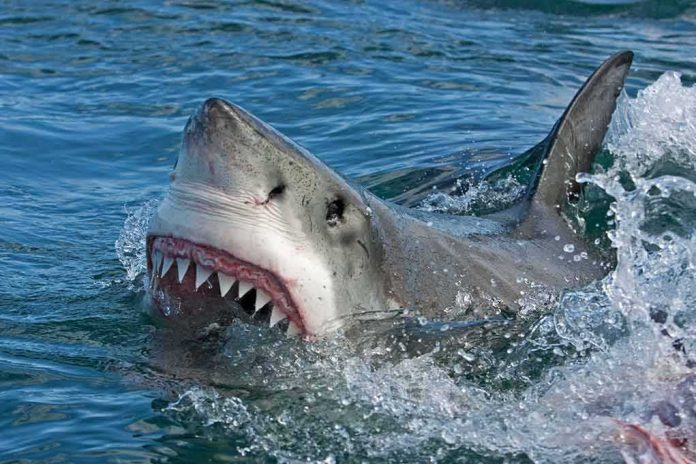
What looks like a frightening near-miss off Half Moon Bay is, in biological terms, a textbook example of a large predator passing close, assessing, and moving on—dramatic to experience, routine for the shark, and a reminder that most shark–human encounters end with nothing more than a story to tell.
At a Glance
- A kayaker off Half Moon Bay captured clear video of a large shark cruising alongside his 12.5-foot kayak.
- The paddler’s first-person account and multiple outlets align: the animal passed very close, no attack occurred, and he was uninjured.
- Reports describe the shark as a great white, with estimated length comparable to or exceeding the kayak.
- Close passes make viral headlines, but bites remain rare; most shark encounters do not escalate.
What Happened Off Half Moon Bay
On a Sunday in late October, a kayak angler off Half Moon Bay felt a splash behind his shoulder, looked back, and saw what he described as a massive fin and shadow overtaking his boat. His camera, mounted on the kayak, recorded the approach from behind and the moment the shark slid along and past the hull. He later said the shark dwarfed his 12.5-foot kayak and that panic set in; the video shows a deliberate pass-by rather than an impact or bite, and he made it back without injury. Multiple outlets ran consistent summaries: large shark, close quartering pass, no attack, no injuries. The footage—unusual for its clarity and angle—anchors the account and explains why the story traveled as widely as it did.
Species and size are always the public’s first questions. Coverage described the animal as a great white, based on the triangular dorsal fin, bulk, coloration, and the body’s tall, rigid sweep through the water—features consistent with a white shark in coastal California. The common size claim—roughly 12 feet—comes from comparing the moving silhouette to the known kayak length. That estimate is plausible for a subadult white shark, which are regularly photographed in Central California’s fall transition zone. While no biologist measured this individual, the video and the paddler’s scale reference explain why most reports converged on the same rough length.
Why White Sharks Show Up Here—And Why Close Passes Happen
Half Moon Bay sits on the edge of a rich upwelling ecosystem. Autumn brings cooler water, concentrated baitfish, and, not far offshore, the so-called “Red Triangle,” where elephant seals and sea lions draw large white sharks each year. Kayaks fish these same lines because predators and prey make for productive angling; overlap follows. White sharks are ram-ventilating, highly visual predators that sample their environment by circling structure, scent plumes, and silhouettes. A low-profile kayak presents a long, narrow shape on the surface, often trailing fish scent and vibrations from tackle. A close abeam pass—fin up, eye near the surface—is consistent with an investigative transit, not a committed predatory strike.
That distinction matters. Bite databases record confirmed bites, not the far larger universe of noncontact investigations. The Half Moon Bay encounter sits squarely in the latter category. For all the visceral punch of the video, it illustrates the base rate reality experienced divers and ocean users know well: sharks pass close far more often than they bite. Research on risk and public perception has repeatedly found that fear is shaped as much by framing—especially video snippets—as by actual hazard levels; viral clips of startling proximity can increase fear and support for punitive shark policies despite low absolute risk.
What the Video Shows—and What It Doesn’t Need to Prove
The camera angle captures three load-bearing facts: the shark’s approach from behind, lateral alignment along the kayak, and a clean departure without a tail slap, bite, or re-approach. The paddler’s narration stitches those images to his sensory experience—splash, fin, “giant eyeball”—details that map well to how a white shark at the surface presents at conversational distance. Size estimates derived from kayak-as-ruler are never precise, but the frame supplies a credible lower bound: an animal at least on the order of the vessel’s length. For the purposes of understanding risk and behavior, that is sufficient: a large apex predator came very close and chose not to escalate.
Media treatment across outlets is notably consistent on the outcome—no strike, no injury—which is where risk assessment begins and ends for the participant. The more breathless “inches away” phrasing is a stylistic flourish applied to a clip that, even in restrained language, is compelling. The Los Angeles Times placed encounters like this within a broader run of close wildlife moments that evoke both awe and fear, a pairing that reliably drives attention while sometimes blurring the difference between threat and spectacle.
The Real Risk Picture
The ocean is not a controlled environment, but it is not an indiscriminate gauntlet either. Even as overall human–shark interactions have grown with coastal recreation, individual risk remains low. Comparative risk work and expert syntheses consistently put the odds of serious shark injury far below those of other beach hazards, including surf and currents. Experimental and observational studies on media effects further show that negative, attack-framed videos and headlines elevate fear and support for lethal management, whereas balanced or natural-history framing increases tolerance and conservation support—important because public sentiment shapes policy after headline-grabbing clips circulate.
For paddlers and anglers, pragmatic adjustments reduce the already small risk further: avoid active pinniped haul-outs, sidestep murky bait-ball conditions at dawn and dusk, keep fish secured and blood in the water to a minimum, and maintain situational awareness when birds and surface activity spike. None of these precautions sterilize a wild environment; they simply align a day’s plan with how predators use a coastline.
Kayaker comes within inches of 12-foot great white shark in terrifying encounter https://t.co/XeTtItl5Xw
— J S (@BlueSeasSailing) November 9, 2026
Why This Clip Resonates—and How to Watch It Well
Two elements make the Half Moon Bay video unusually sticky. First, perspective: a kayak-level camera puts the viewer inches above the waterline, compressing distance and amplifying the dorsal fin’s presence. Second, narrative completeness: the clip shows approach, pass, and exit without a cut, granting it an authenticity that audiences—and editors—trust. That combination is why a straightforward non-event in safety terms becomes a major event in attention terms. The lesson for viewers is not to dismiss the awe; it is to pair awe with context. A white shark did what white sharks often do: patrol a food-rich edge, investigate a novel silhouette briefly, and continue on. The kayaker did what experienced ocean users do: stayed upright, kept paddling, got home, and told the story.
Sources:
nypost.com, snntv.com, people.com, latimes.com, heavyglobal.com, ktla.com, nbcbayarea.com, jfeed.com, onlinelibrary.wiley.com