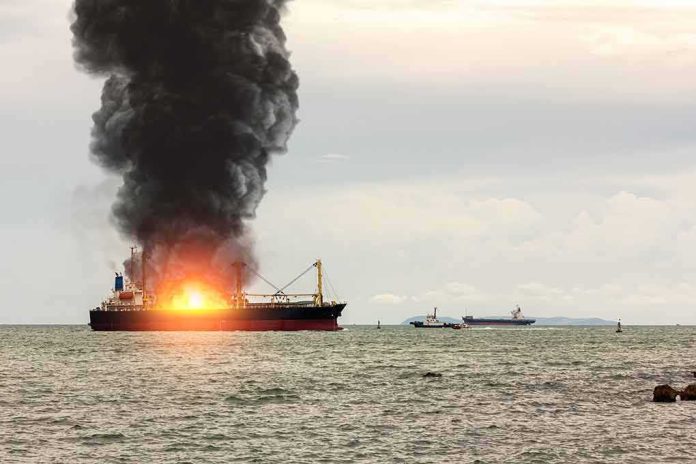
The significance of this strike campaign is not simply that the United States is hitting Iran; it is that Washington has moved from striking clearly military assets to hammering the transport and utility systems that make Iranian coercion in the Strait of Hormuz possible, and that shift changes both the military logic and the political risk of the war.
Key Points
- U.S. Central Command says the latest wave targeted surveillance sites, military logistics infrastructure, underground weapons storage, and maritime capabilities.
- Published reporting says bridges, port infrastructure, and at least one desalination facility were among the damaged sites.
- The campaign fits a broader Hormuz pattern: pressure on shipping, retaliation for maritime attacks, and escalating strikes on dual-use infrastructure.
- The strategic aim is straightforward: reduce Iran’s ability to threaten commercial traffic and regional partners, but the practical effect is to widen the war’s footprint.
What the United States Says It Is Trying to Do
The U.S. description of the campaign is consistent across multiple briefings and reports: the strikes are meant to degrade Iran’s ability to threaten shipping, military movement, and maritime surveillance in and around the Strait of Hormuz. CENTCOM’s own language on the latest wave is specific, naming “surveillance sites, military logistics infrastructure, underground weapons storage, and maritime capabilities,” which is not the vocabulary of a narrow punitive raid; it is the language of systematic attrition against a state’s operational architecture.
That matters because logistics infrastructure is not glamorous, but it is decisive. Bridges, roads, port towers, storage sites, radar, and surveillance nodes are the connective tissue of force projection. If you break the connectors, you slow the movement of weapons, fuel, crews, and information. In a contest centered on Hormuz, where a small number of chokepoints shape global shipping risk, degrading the support network can be as important as destroying launchers or boats.
Why Bridges, Ports, and Water Sites Became Targets
The current reporting shows an unmistakable broadening of target selection. NBC reported airstrikes on bridges and critical infrastructure in southern Iran, while the Los Angeles Times described attacks on bridges, energy infrastructure, and a key port tower, with U.S. and Iranian reporting both pointing to the Bandar Abbas and Hormozgan corridor as a focal point. Axios and other outlets also reported earlier strikes on railway bridges, underscoring that transport links have become a deliberate object of attack rather than collateral damage.
The water-facility reporting is the most consequential because it marks the point where military and civilian spheres begin to overlap in a dangerous way. Earlier this month, reporting from The New York Times, CNN, and other outlets described precision strikes that appeared to damage water-storage tanks in southern Iran, leaving residents without access to water; Iranian officials framed those attacks as deliberate hits on civilian infrastructure. More recent reporting says a desalination plant was hit, with roughly 10,000 people affected. Even if the U.S. frames such sites as dual-use or adjacent to military assets, the humanitarian consequences are immediate and measurable.
The Strategic Pattern Behind the Hormuz Campaign
This is not an isolated episode; it is the latest turn in a recurring Hormuz cycle. Since 2019, U.S.-Iran escalation around the strait has followed a familiar sequence: maritime attacks, U.S. retaliation, claims that strikes are limited to military targets, then widening damage to infrastructure that sits closer and closer to civilian life. The pattern is visible again here. U.S. strikes have been justified as protection for commercial shipping and regional partners, while Iran’s response has included attacks on Gulf infrastructure, which in turn gives Washington more justification to keep widening the target set.
That dynamic produces a dangerous asymmetry. The U.S. can frame each strike as defensive and discrete; Iran, meanwhile, can present itself as resisting blockade or coercion. But the geography of Hormuz makes the war self-expanding. Once a campaign is organized around keeping sea lanes open, every bridge, coastal radar site, port tower, storage bunker, and energy node starts to look like a node in the same system. That is why the fighting migrates from ships to land infrastructure so quickly.
U-S forces conducted their seventh consecutive night of airstrikes on Iranian targets overnight.
U-S Central Command said they hit surveillance sites, military logistics infrastructure, underground weapons storage, and maritime capabilities.
U-S forces employed fighter aircraft,… pic.twitter.com/Ef81ObgPEo— Worldwide News Network (@WorldwideNNX) July 18, 2026
How Credibly Can the Strikes Be Described as Military-Only?
On the record available here, the strongest official U.S. claim is that the campaign is aimed at military and transport systems tied to Iran’s ability to threaten shipping, not at civilian life as such. But the reporting does not permit a clean military-civilian divide. Bridges in Iran’s south are often dual-use by definition, serving both civilian traffic and military movement; port-adjacent towers, road links, and utility systems can support commerce and the armed forces at the same time.
That is the central analytical problem of this war. Once the target set includes dual-use infrastructure, the distinction between military necessity and civilian harm becomes operationally blurry, even when the stated purpose is limited. The best evidence here supports two conclusions at once: the U.S. is trying to suppress Iran’s ability to project force through Hormuz, and it is doing so through strikes that predictably spread into infrastructure ordinary people depend on. Those are not contradictory facts; they are the defining feature of the campaign.
What This Means Going Forward
The most important implication is that the war is no longer just about retaliation for maritime attacks. It is about whether the United States can compel behavioral change by making the cost of escalation visible in physical infrastructure. That strategy can work tactically; it can damage command-and-control, slow resupply, and narrow Iran’s options. But it also hardens Iranian resolve, raises the odds of asymmetric retaliation, and normalizes strikes on systems that keep water, power, and transport functioning.
The second implication is political rather than military. As the strike list expands, every new target invites a new argument over proportionality, intent, and legality. That argument will not be settled by slogans about “military targets” alone, because the evidence shows a campaign that is already moving through the gray zone of dual-use infrastructure. In wars like this, the gray zone is not a side issue. It is the battlefield.
Sources:
military.com, nbcnews.com, newsweek.com, npr.org, axios.com, youtube.com, cnycentral.com, wbaltv.com, nytimes.com, bbc.co.uk, pbs.org