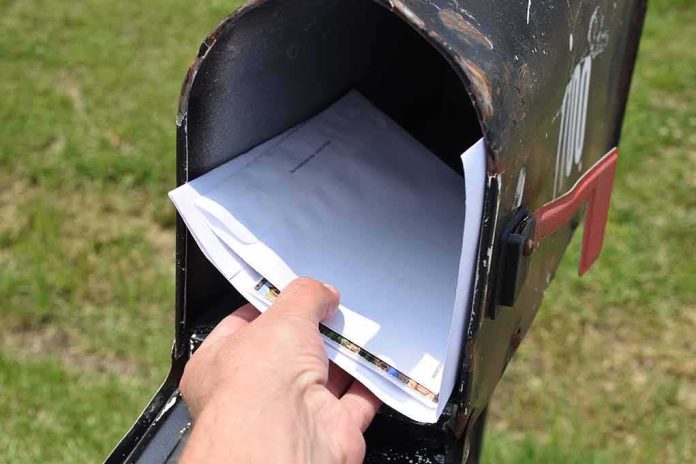
The fight over the U.S. Postal Service’s new mail‑in ballot rule is not just about barcode technology or voter lists; it is a test of whether a federal delivery agency can be turned into a gatekeeper for who may participate in American elections.
Key Points
- A DC Circuit panel has temporarily lifted a lower‑court block, allowing USPS to move forward with a Trump‑backed election‑mail rule while litigation continues.
- The proposed rule would require states to submit detailed voter lists and assign unique Intelligent Mail barcodes tied to individual voters on every federal mail‑ballot envelope.
- Supporters frame the change as a “win for election integrity,” arguing it will help law enforcement and prevent noncitizen voting, despite little evidence of such fraud.
- Opponents—from civil rights groups to bipartisan state election officials—warn it is unconstitutional federal overreach that could disenfranchise large numbers of eligible voters.
- The rule fits a broader pattern of executive attempts to centralize election control through administrative mechanisms, a strategy courts have repeatedly resisted.
What the Appeals Court Just Allowed USPS to Do
The immediate development is procedural but consequential. A three‑judge panel of the DC Circuit Court of Appeals has issued a stay of a lower‑court order that had blocked USPS from advancing its proposed election‑mail rule. The district court, applying a 2021 NAACP settlement that required the Postal Service to prioritize ballot delivery, had concluded the new restrictions would likely violate that agreement and ordered USPS to halt implementation. The appeals court did not decide the underlying merits; instead, it found the Postal Service had met the standard for a stay pending appeal, meaning the agency may continue developing the rule while the case proceeds. First Assistant U.S. Attorney Bill Essayli celebrated the decision as “a win for election integrity,” capturing how supporters see the ruling: not as a technical procedural step, but as validation of a broader crackdown on mail‑in voting.
Practically, the stay keeps the Trump administration’s March executive order—“Ensuring Citizenship Verification and Integrity in Federal Elections”—alive. That order instructs the Department of Homeland Security, Social Security Administration, and USPS to build state‑by‑state lists of verified citizens eligible to vote, and to withhold mail ballots from those not on the lists. The proposed USPS rule, published in late May and early June, is the mechanism by which that directive would reach voters’ mailboxes.
The Core of the Rule: Voter Lists and Serialized Barcodes
At the heart of the proposal are two linked requirements: data and identifiers. First, every state would be required to submit to USPS a “Mail‑In and Absentee Participation List” for each federal election—essentially, a roster of all voters approved to receive a mail‑in or absentee ballot. These lists must arrive at least 30 days before ballots are mailed, though subsequent updates are permitted as the election approaches. The lists would include each voter’s name, address, and a unique ballot envelope identifier. Under the executive order, USPS “shall not transmit” mail ballots from any voter not enrolled on this list.
Second, every ballot envelope for federal elections would carry a uniquely serialized Intelligent Mail barcode (IMb) that is explicitly tied to an individual voter. USPS has used IMb technology for years as an internal tracking tool; the agency’s own voluntary election‑mail toolkit urged election officials to use barcodes and standardized envelope designs to improve visibility and reduce delays. The new rule would convert those voluntary recommendations into binding obligations and, more significantly, require states to provide the data linking each barcode to an identifiable voter.
In its Federal Register notice, USPS asserts these serialized barcodes “will assist in ensuring compliance with federal regulations and support law enforcement activities.” A multistate comment letter, quoting the notice, notes that “[u]niquely serialized IMbs facilitate the tracking of individual pieces of Ballot Mail to and from individual voters as the barcodes are scanned on the Postal Service’s mail processing equipment,” generating detailed scan data as ballots move through the system. Supporters treat this granularity as a feature: in their view, being able to trace a ballot to a person strengthens the system. Critics see it as precisely the problem.
Supporters’ Case: Election Integrity and Noncitizen Voting
The Trump administration and its allies present the rule as a long‑overdue modernization of mail‑in voting security. Essayli’s “win for election integrity” formulation is echoed in social media campaigns describing the appeals court stay as a “massive election integrity win” and a “big court victory” for Trump’s effort to tighten mail voting. The administration argues that limiting ballots to voters on federally curated lists and tracking each envelope with a unique barcode will reduce fraud, especially by noncitizens.
Homeland Security Secretary Mark Wayne Mullen and other officials have said the central aim is to stop noncitizen voting, which they acknowledge is “exceedingly rare and already illegal” but still present enough, in their view, to warrant federal intervention. In public messaging, Trump has described mail‑in voting fraud as “legendary” and “horrible,” insisting that by “the nature of it, it’s going to be corrupt” absent stronger controls. The Maryland example—where one voter reported receiving multiple party ballots in a single election—has been cited as a cautionary tale, despite state officials noting each envelope carried a unique code preventing multiple votes from being counted.
USPS itself frames the barcode requirement not just as an integrity measure but as a law‑enforcement tool. The agency’s notice explains that linking IMbs to individual voters “will facilitate law enforcement efforts” by allowing investigators to pinpoint specific ballot envelopes in the mail stream. Supporters argue this traceability could help identify tampering, illegal ballot harvesting, or multiple voting, and—less concretely—restore confidence in a system that has come under intense scrutiny, particularly in states like California where mail‑in ballots predominate.
Evidence Gaps in the Integrity Argument
What the record does not contain is as important as what it does. Neither the Federal Register notice nor public statements from USPS or the administration provide concrete data showing that serialized barcodes and pre‑screened voter lists have reduced fraud in any pilot or prior implementation. There are no published audit results, case studies, or law‑enforcement reports demonstrating that such measures would have prevented known instances of ballot tampering or illegal voting. The rule’s integrity claims rest largely on assertion rather than empirical evidence.
The noncitizen voting rationale is similarly underdeveloped. Government Executive reporting notes that administration officials invoke noncitizen voting as a threat but concede it “occurs very rarely.” They have not provided underlying statistics, enforcement records, or studies quantifying such cases in federal elections, nor have they shown why existing state‑level controls—registration verification, citizenship attestations, and post‑election audits—are insufficient. Experts like David Becker, who has worked closely with state election administrators, emphasize that current mail‑in systems have multiple security layers, including ID checks at registration and signature verification on return, and that these systems have functioned reliably for more than 150 years.
Even on the operational side, USPS has not documented existing infrastructure capable of vetting ballot mailings against voter eligibility lists at scale. Historically, the Postal Service has insisted it does not judge who may vote; it delivers properly prepared mail and leaves eligibility determinations to election officials. The proposed rule would reverse that stance, assigning USPS a gatekeeping role with no public evidence of dedicated systems, staffing, or testing to support it.
Opposition: Constitutional Limits and Risk of Disenfranchisement
Opposition to the rule is unusually broad and deeply rooted in constitutional arguments. Twenty‑three Democratic‑led states plus the District of Columbia have sued to block Trump’s executive order that underpins the USPS proposal, arguing that the president lacks authority to dictate who may receive mail‑in ballots. A federal judge in Boston agreed with that view in a related case, holding that “The Constitution does not grant the President any specific powers over elections” and halting the order’s attempt to create a national voter list.
Judge Emmet Sullivan’s Washington, DC ruling—later stayed by the appeals court—took a different path to the same conclusion, finding that USPS’s proposed rule would breach its 2021 settlement with the NAACP by delaying or denying ballot delivery. Civil rights organizations and voting‑rights advocates characterize the rule as an unconstitutional federal overreach, a “poison pill” designed to increase federal oversight of elections and undermine state control.
Congressional opposition is equally stark. All Senate Democrats and two independents signed a letter urging Postmaster General David Steiner to withdraw the rule, warning that it would impose “significant operational burdens on election mail processing systems” and compel states to participate in “an unconstitutional federal data collection program” by turning over voter‑level information linked to IMbs. The letter emphasizes that USPS would gain the ability to pinpoint ballots sent to or returned by specific voters, a capability the Postal Service has never before claimed as part of its mission.
Perhaps most telling, some of the harshest criticism comes from bipartisan state election officials. In Wisconsin, Republican Elections Commission Chair Don Millis and Democratic Commissioner Ann Jacobs jointly urged Steiner to drop the rule, calling it likely to “disenfranchise a significant swath of Wisconsin voters.” Millis, a Republican, remarked that some in the Trump administration “just think mail‑in ballots are bad,” suggesting the measure is driven more by hostility to the modality than by demonstrated security needs. Officials in Michigan and Maine have made similar arguments, stressing that states run elections, not the federal government, and warning the rule would create chaos and privacy risks by forcing disclosure of detailed voter rolls to Washington.
Mechanism of Disenfranchisement: Where Ballots Could Be Stopped
To understand why state officials speak in terms of disenfranchisement, it helps to trace how the rule would operate in practice. Under the proposal, every mailing of ballots would be presented to USPS for acceptance and checked against the state’s participation list at that point. If the ballots are addressed to recipients not on the list, or if the envelopes fail to meet barcode and design requirements, USPS would “not accept or deliver” them. In other words, a voter’s eligibility error, a data mismatch, or a format misprint would not simply create a registration question for local officials to resolve; it would physically prevent the ballot from entering the mail stream.
Brookings analysts argue this marks a sharp departure from the Postal Service’s traditional role. Instead of serving as a neutral conduit that transports ballots prepared by election offices, USPS would act as a compliance checkpoint, deciding which ballots it will carry based on federal criteria and data. In states with tight election calendars and already strained postal operations—as Wisconsin’s “unusually long” mail delays have shown, even without these new requirements—adding a federal approval layer could mean some voters never receive ballots in time to return them.
The risk is particularly high for jurisdictions with limited technical capacity. Smaller counties may struggle to generate and manage unique barcodes for every absentee voter, retool envelope designs, and upload accurate lists on compressed timelines. Any failure in that chain results not merely in slower mail, but in ballots that are never delivered.
Historical Pattern: Executive Attempts to Centralize Election Control
The USPS rule is not an isolated incident; it fits a recurring pattern of executive branch efforts to centralize election administration through federal agencies. Over the past several years, the Trump administration has pursued multiple “election integrity” initiatives that sought to override state control without congressional authorization—most notably the SAVE database proposal, proof‑of‑citizenship mandates, and now the USPS voter‑list and barcode rule.
Courts have repeatedly blocked or limited these attempts. Previous executive orders that tried to impose federal voter ID and citizenship verification requirements were struck down by at least three federal courts. Judge Talwani’s Boston ruling and Judge Sullivan’s NAACP enforcement decision continue that trend, underscoring a judicial consensus that the Constitution vests control over election rules in state legislatures and Congress, not the president or administrative agencies. The appeals court’s stay does not reverse that constitutional logic; it simply pauses one enforcement mechanism while appellate judges examine whether the NAACP settlement applies.
Brookings has described the current executive order as pushing USPS to do “the one thing it has always insisted it does not do: judge who may vote by mail, and refuse to carry the ballots of those who don’t comply.” Whether courts ultimately permit this transformation will shape not only the future of mail‑in voting but also the boundaries of presidential power over elections.
What Comes Next: Legal, Operational, and Democratic Stakes
Looking ahead, three tracks matter. Legally, the underlying lawsuits from states, voting‑rights groups, and the NAACP are still being litigated in district and appellate courts. The DC Circuit’s stay suggests at least some judges view the NAACP settlement issue as distinct from the executive order’s constitutionality, but other courts have already held that the president cannot commandeer USPS to decide who receives ballots. A Supreme Court review is possible if conflicting rulings persist.
Operationally, USPS must still complete formal rulemaking, including Postal Regulatory Commission review and public comment, before the proposal can take effect nationwide. That process gives states, local election officials, and the public further opportunity to document practical risks—delays, data errors, privacy concerns—and build a record that courts and regulators can weigh against the administration’s integrity claims.
Democratically, the stakes are real. Mail‑in voting is no longer a niche option; in states like California, Oregon, Colorado, and increasingly in swing states, it is central to participation. Turning USPS into a gatekeeper that can refuse ballots based on federal data requirements reorients the balance of power between states and Washington, and between voters and the institutions that carry their votes. Supporters call that reorientation necessary to secure elections. Opponents argue it compromises a century‑and‑a‑half of reliable, state‑run mail voting for a problem that remains unproven at scale.
For readers trying to assess where they stand, the key questions are straightforward: Is there persuasive evidence that noncitizen or fraudulent mail‑in voting is significant enough to warrant federal gatekeeping through USPS? Are the safeguards in the proposed rule robust enough to prevent eligible voters from being wrongly excluded when data or barcodes fail? And, perhaps most fundamentally, who should decide the rules of voting—state legislatures and Congress, as the Constitution has long been read, or the president acting through administrative agencies? The answers will determine whether this “win for election integrity” becomes a durable feature of American elections or another short‑lived attempt to reshape them from above.
All states must submit voter lists and serialized ballot barcodes before the USPS will mail federal ballots for the upcoming midterm elections. https://t.co/NJTBBlS0IB
— Paul Gadot (@gadot_paul) July 19, 2026
Sources:
nypost.com, lynnwoodtimes.com, reuters.com, govexec.com, krishnamoorthi.house.gov, cyberscoop.com, protectdemocracy.org, content.govdelivery.com, youtube.com, facebook.com, njlm.org, democracydocket.com, jsonline.com, wpr.org, npr.org, brookings.edu, verdict.news, campaignlegal.org, cnn.com, attorneygeneral.gov, newsweek.com