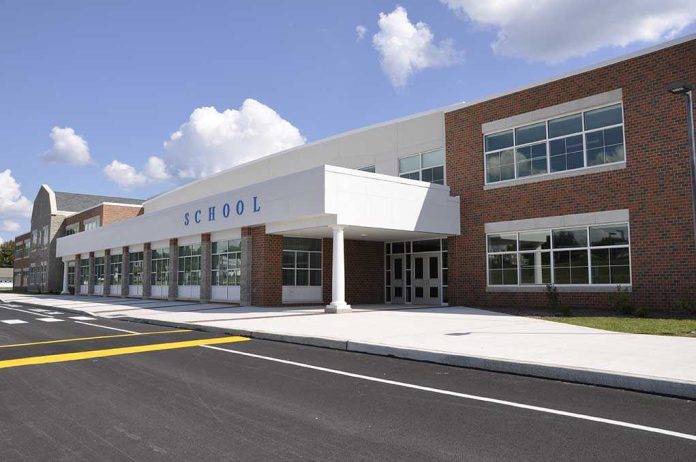
One parent’s split-second pursuit inside a Bend, Oregon elementary school turned a mass-casualty attack into a stopped attack; the basic sequence is clear, corroborated by police and multiple major outlets, and it explains why officials and families described his actions as lifesaving.
At a Glance
- Police say a community member saw the gunman enter Silver Rail Elementary, pursued him into the building, and fatally shot him.
- Multiple outlets identified the parent as 36-year-old Kaylub Giamanco; his mother publicly affirmed his role.
- The attack had already killed three children and a teacher before the intervention.
- Officials and families credited the bystander’s action with preventing further killings.
What Happened Inside Silver Rail Elementary
The through-line of the case is not in dispute. Bend Police Chief Mike Krantz told reporters that the suspect “was shot by a community member who had seen the suspect enter the school and pursued him into the school and engaged him.” That declaration fixes the spine of the narrative: an armed civilian witnessed the threat, closed distance, and ended it before police arrived. This is the rare circumstance in which lay intervention intersects with the core doctrine of active-shooter response—immediate engagement to stop further harm—executed by someone who was neither law enforcement nor security.
Contemporaneous reporting from the Associated Press identified that civilian as 36-year-old Kaylub Giamanco, a father whose two daughters attended Silver Rail. AP reported that Giamanco saw the attacker, retrieved a.40-caliber handgun, followed the shooter into the school, and fired the killing shot; his mother, Kenda Freeman, read a statement identifying him and describing the aftermath for the family. The same reporting detailed the attack’s toll—three children aged 5, 8, and 11 and a teacher were killed—and described the shooter’s forced entry by firing through locked doors, a detail that underscores how quickly the school’s physical barriers were overcome.
The Intervening Parent: Identity and Action
Large outlets converged swiftly on name and role. NBC News, CBS News, ABC News, AP, and AFP each reported that Giamanco was the parent who pursued and fatally shot the attacker, aligning on the central sequence even as peripheral details continued to be gathered. NBC’s parallel piece cited officials and families calling the act heroic and crediting it with saving lives; that language traces directly to the practical reality of these attacks, where seconds carry outsized weight and ending the shooter’s mobility often determines the casualty count.
Two facts matter most here. First, the intervention terminated the attack. Second, it occurred while the shooter was still attempting to move and kill inside a school. Those facts, taken together, justify the public characterization of heroism from a policy standpoint as well as a human one. While only later forensic reconstruction can estimate what would have happened absent the bystander’s shot, the combination of ongoing threat and rapid incapacitation is precisely the circumstance in which professionals infer “lives saved,” because every new interval of unopposed gunfire tends to generate victims.
The Timeline and Tactics That Stopped the Killing
The reports agree on a tactical arc: forced entry by gunfire against locked doors; movement into the school; engagement by a pursuing civilian near or in a classroom serving students with special needs; and the fatal shot that ended the attack. Giamanco’s choice set matches what active-shooter training demands of first-arriving officers—move to the sound of gunfire, close with the threat, and stop it. The fact that a parent executed that sequence, rather than a uniformed responder, is unusual but not without precedent in the broader data on civilian interventions. By the time police assemble a team and clear the first corners, the casualty clock is often already running; here, a parent was physically present and acted in the gap before official response could reset the conditions.
The gravity of the intervention is sharpened by what preceded it: children and a teacher killed despite locked access points. That detail carries two implications. First, hardening measures like locked doors and single points of entry can help, but will not reliably stop a determined shooter with a firearm capable of breaching barriers. Second, once an attacker is mobile inside a school, the only durable solution is incapacitation—by police if present, by a capable civilian if not. Those are uncomfortable truths; they are also the realities that guide contemporary response doctrine.
How This Fits (and Does Not Fit) the Larger Pattern
Civilian interventions are a documented, if uncommon, part of active-shooter events. The FBI’s multiyear analyses note that some incidents end through action by people who are not police or security personnel, and in some cases those interventions come with civilian casualties as well. The same body of work shows most attacks end through the shooter’s own actions—flight, suicide, or surrender—rather than by outside force. So while this Bend case is consistent with the historical possibility of civilian stoppage, it is not emblematic of a typical outcome; it is an outlier in degree of difficulty and consequence, which is precisely why it drew national attention.
There is predictable debate in the research community over frequency counts and definitions—what qualifies as an “active shooter,” how to categorize attempts versus successful stops, and where to place incidents that occur in “gun-free” or restricted zones. That methodological churn does not alter the specific case in Bend: a civilian confronted and killed a shooter moving inside an elementary school. From a policy lens, that single fact has two policy-relevant lessons. First, response time is destiny in these events. Second, layered defenses must assume breach and plan for immediate interdiction—by whoever can reach the threat first.
2 AM Top-of-the-Hour News
Lighting candles for the victims in Bend, Oregon, Friday night, Three boys and a 25 year old teacher killed Thursday when a 16 year old former student showed up at Silver Rail Elementary School with a shotgun and 44 rounds of ammunition and opened fire.… pic.twitter.com/PQT0VdbmKX
— Worldwide News Network (@WorldwideNNX) October 17, 2026
The Human Aftermath for the Intervenor and the Community
Public narratives often end with the last shot, but the people who intervene live with the residue. Giamanco’s mother, Kenda Freeman, spoke openly about her son’s trauma in the days after the attack—an unsurprising consequence for anyone who uses lethal force, especially inside a school filled with children. Those long tails matter to communities because they signal the downstream needs after the cameras leave: family support, professional counseling, and civic rituals of acknowledgment that help the intervenor and the school community metabolize what happened without mythologizing it into something painless. Her statement also underlines a quieter reality: heroism solves the tactical problem; it doesn’t spare the human cost.
Why Officials Called It Lifesaving
In the aftermath, officials and families used a consistent vocabulary—heroic, saved lives—because the observed facts justify it. A shooter who breached locked doors, killed students and a teacher, and continued moving inside a school retains the capacity to kill more. Ending that trajectory mid-attack is not symbolic; it is causal. That is why NBC’s reporting emphasized officials’ belief that more loss was averted and why national coverage, including wire services and networks, used the same frame. The description does not rely on speculative tallies of hypothetical victims; it rests on the practical logic of interrupting ongoing lethal action.
What This Means Going Forward
No single event should be stretched into an all-purpose policy script, but this case clarifies the stakes of seconds. Schools will continue to refine layered security—controlled access, communication, drills that prioritize rapid lockdown without paralyzing daily life. Law enforcement will continue to train for immediate solo or small-team entries rather than perimeter setups. And communities will grapple with the fact that, on the outer edge of preparedness, the first effective actor may be a parent, teacher, custodian, or passerby. That possibility argues for sober public education on recognition of threat, movement to safety, and, for those lawfully armed and trained, a clear understanding of when and how to intervene without compounding risk.
Sources:
lifesitenews.com, nbcnews.com, apnews.com, cbsnews.com, abcnews.com, registerguard.com