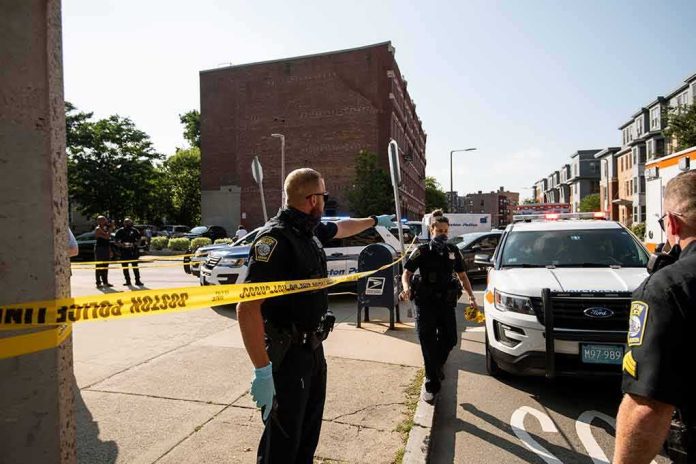
Domestic-violence calls are among the most perilous moments in American policing, and Columbia’s loss underscores why: routine patrol work can pivot in minutes from a welfare check to a gunfight, with consequences that radiate through a department, a family, and a city.
The Short Version
- Two Columbia police officers were shot after responding to a domestic-dispute call; one—Officer Christopher DeLong, 29—died.
- The suspect also died at the scene near Southeast Park on Hazelwood Road; police said there was no ongoing public threat.
- The second officer was hospitalized in stable condition and expected to recover.
- South Carolina’s State Law Enforcement Division (SLED) took the lead on the investigation, as state law prescribes.
What Happened: A domestic-dispute call that led to a deadly encounter
Columbia police first engaged this incident as a domestic-dispute response. According to on-record briefings, officers initially went to a residence tied to a reported domestic disturbance, then later encountered the suspect near Southeast Park off Hazelwood Road by Garners Ferry Road. An exchange of gunfire followed. Two officers were struck; one, identified by multiple outlets as Officer Christopher DeLong, a two-year member of the department, succumbed to his injuries. The other was reported to be in stable condition. The suspect died at the scene. Columbia’s police chief, W.H. “Skip” Holbrook, delivered the announcement and the department emphasized there was no ongoing threat to the public as investigators secured the area and closed the park for processing.
Core facts coalesced quickly across independent reports and live briefings: two officers shot, one killed; suspect deceased; scene confined to the Southeast Park corridor; state agents assuming investigative control. Those are the pillars of the public record to date. While some outlets differed on the precise address sequence—residence first, then the park; or a simplified narrative centered at the park—each traced the same arc from a domestic call to a fatal officer-involved shooting.
Why this category of call turns lethal so quickly
Domestic disturbances routinely sit at the nexus of volatility, access to weapons, and split-second decision-making. Large-sample research analyzing police shootings nationally shows domestic incidents compose a significant share of fatal encounters; an American Journal of Public Health study attributes roughly 15.7% of police shooting incidents to domestic incidents over a multi-year period, and a COPS Office review of officer fatalities highlights domestic-dispute calls as a disproportionate slice of deadly calls for service. That pattern maps onto what played out in Columbia: an initial domestic-dispute response that, even after the first call cleared, re-emerged as a suspect contact and then gunfire.
Mechanically, these calls pose layers of risk: history between the parties, restraining orders or pending charges, offender flight, and the inherently dynamic environment of a residence or public space where officers have limited control over distance, cover, or bystanders. Officers must decide how to approach, whether to wait for backup, and how to balance investigative steps with officer-safety tactics. Columbia’s sequence—an initial response where the suspect was not present, followed later by an officer spotting a person matching the description near Southeast Park and calling for backup—tracks with standard patrol practice: clear the address, broadcast suspect descriptors, remain alert on the beat for a re-contact. It takes only a few seconds of noncompliance or a weapon presentation for that routine to rupture into a gunfight.
Scene, response, and immediate aftermath
Witness accounts and local coverage describe a fast, concentrated law enforcement presence after the shooting at Southeast Park, with streets cordoned and the park closed to the public as investigators worked. The Columbia Police Department publicly reassured residents that there was no continuing threat—critical both for public safety and to limit the rumor cycle that can spin up around an active scene. The Richland County Coroner’s Office and SLED coordinated the post-incident sequence: hospital transfer, next-of-kin notifications, and the forensic handoff that begins the formal reconstruction of a shooting. SLED’s lead role is not discretionary courtesy; it is the architecture South Carolina uses to cabin conflicts of interest and centralize investigative expertise in officer-involved shootings.
Chief Holbrook’s statements were direct—heartbroken, unimaginable loss—and formed the backbone of early, authoritative details. The public record across wire copy, local television, and regional outlets aligns on the essentials: DeLong, 29, two years on the force; another officer wounded and stable; the suspect deceased; and the locus near Hazelwood Road by Garners Ferry Road.
Who investigates and how: the SLED process and evidentiary building blocks
Once a suspect and officers have exchanged gunfire, the analytic center of gravity shifts from patrol to state-level investigative routine. SLED typically leads scene processing—mapping cartridge casings, documenting bullet trajectories, and collecting body-worn camera footage. Investigators will synchronize CAD (computer-aided dispatch) timestamps, radio traffic, and 911 audio with camera timelines to reconstruct when the contact began, when commands were issued, when shots were fired, and from what distances and angles. Medical records, autopsy findings, and ballistics complete the causal puzzle, distinguishing which rounds struck whom and whether the suspect’s fatal injury was officer-inflicted or otherwise. South Carolina practice, mirrored in other jurisdictions, uses this state-led review both to inform prosecutorial decisions and to support administrative use-of-force evaluations within the department.
In Columbia’s case, press-briefing details supplied the preliminary timeline; the durable record will come from SLED’s investigative packet. That includes body-worn camera video, which has become the decisive artifact in many modern reconstructions because it captures not only the suspect’s actions but the officers’ verbal commands and tactical choices second-by-second. The public will likely encounter those findings in stages: first, a high-level conclusion on lawfulness; later, a more granular release of reports and selected video after criminal reviews conclude.
The fallen officer and the surviving partner
Multiple outlets identified the fallen officer as Christopher DeLong, 29, a two-year Columbia Police Department member. His death triggered the rites that departments and communities know too well: line-of-duty honors, a procession from the hospital to the coroner’s office, and support mobilized for his family. The second officer, unnamed in some early reports, was described as in stable condition and expected to recover—language that, while reassuring, usually reflects the triage window before surgeons and trauma teams can fully characterize injuries. Departments typically defer to hospitals and families for more specific updates in the days that follow.
The suspect also died at the scene, and some reports referenced a prior criminal history. As with any shooting, the ultimate public record on the suspect’s identity, prior charges, and legal status will be anchored to court dockets and investigative summaries once released by authorities. For the purposes of understanding the Columbia event, the essential fact pattern does not turn on those biographical details so much as on the tactical exchange itself: a suspect contact following a domestic-dispute response became an armed confrontation that killed a young officer and wounded another.
Law enforcement agencies across the Midlands are reacting to the death of Columbia Police Officer Christopher DeLong, who was killed in a shooting on Saturday.https://t.co/vetYq5dUzN
— WACH FOX (@wachfox) August 30, 2026
What this means for policy, training, and the public
Domestic-dispute responses demand rigor before officers arrive, not only after shots are fired. Agencies that have driven down risk tend to emphasize pre-contact intelligence (restraining orders, known weapons, prior calls at the address), deliberate staging for backup, and communication discipline: a clear plan of approach, roles, and contingency triggers. Training that rehearses the transition from consensual contact to high-threat encounter—especially in public spaces where distance and cover are limited—can blunt the most lethal failure points. The Columbia case aligns with nationally observed risk contours in this call type, and it will inevitably be studied through that lens by SLED, prosecutors, and the department itself.
For the public, two truths can be held at once. First, the core facts here are not in dispute: one officer killed, another injured, suspect deceased, investigation led by SLED, and no ongoing threat to the community. Second, the detailed reconstruction takes time; when it arrives, it should be read closely for lessons that can inform policy and save lives on both sides of the badge. When the initial call is a domestic dispute, experience and data both say the margin for error is thin.
Sources:
townhall.com, wistv.com, usnews.com, abcnews4.com, youtube.com, columbiapd.net, fitsnews.com, english.news.cn, scstatehouse.gov, ajph.aphapublications.org