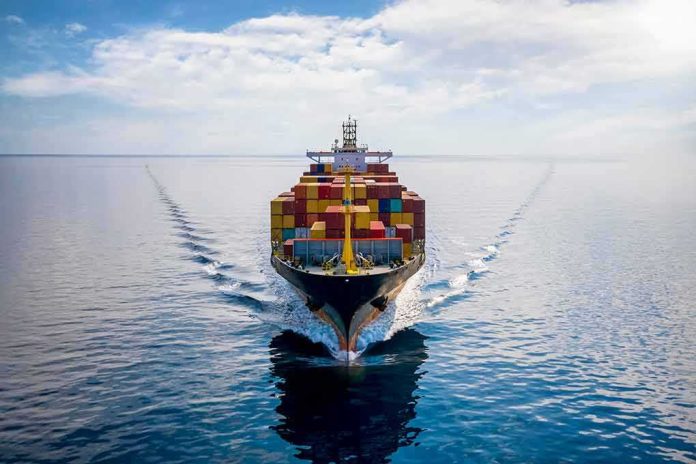
When a tanker catches fire in the Strait of Hormuz, the first casualty is usually the truth — not because anyone is lying outright, but because the chokepoint’s geography and politics guarantee that every party with a camera, a radio, or a warship has a reason to tell the story its own way.
Key Points
- Iran’s Revolutionary Guard Corps (IRGC) said three oil tankers struck naval mines and caught fire while using what it called an unauthorized southern route through the Strait of Hormuz on October 29–30, 2026.
- U.S. Central Command publicly disputed the mine narrative, stating the Strait’s primary transit route remained free of mines.
- UK Maritime Trade Operations (UKMTO) separately confirmed real incidents nearby — including a tanker fire caused by explosive devices attached to a hull by a small boat, and another vessel struck by an unidentified projectile — but did not confirm Iran’s three-tanker, mine-strike account.
- No independent source has yet verified the vessels’ names, flags, or exact locations, leaving the core of Iran’s claim unresolved even as evidence of some hostile maritime activity is solid.
- The episode echoes the 1980s “Tanker War,” when Iran’s use of mines against Gulf shipping forced a sustained U.S. naval response — a precedent that shapes how every modern claim here gets read.
What Actually Happened, and What Remains Unconfirmed
Strip away the competing narratives and a narrower set of facts holds up. Something happened in the waters near the Strait of Hormuz in late October 2026: at least one tanker caught fire after explosive devices were attached to its hull by a small boat, and a separate vessel was struck by an unidentified projectile, according to UKMTO, the UK’s maritime security monitoring body. Those are independently reported, specific, and consistent with the kind of covert small-boat attack the region has seen before. What is not independently confirmed is Iran’s broader claim — voiced by the IRGC Navy through state media — that three tankers struck naval mines after disabling their radar and navigation systems and ignoring Iranian warnings on an “unauthorized” southern route.
The distinction matters more than it might first appear. A moored or drifting naval mine and a limpet charge bolted to a hull by divers or a skiff are different weapons entirely, with different signatures, different legal implications, and different strategic messages. UKMTO’s account of a small boat attaching explosives above the waterline describes the latter, not the former. If the IRGC’s mine narrative and UKMTO’s limpet-charge account refer to the same vessel, the mechanisms described simply don’t match — a gap no outlet in the available record has reconciled.
The Direct Contradiction from U.S. Central Command
This is where the story moves from “unverified” to genuinely contested. U.S. Central Command did not merely withhold confirmation — it issued an affirmative denial, stating that Iranian media claims of vessels striking sea mines were false and that the Strait’s primary transit route remained free of mines. That is a named, on-record rebuttal from a credible military authority, not vague skepticism. It does not prove no mine existed anywhere in the Strait; Iran’s claim specifically concerns a secondary “unauthorized” route, and CENTCOM’s statement addresses the primary one. But it establishes a direct evidentiary conflict that cannot be waved away as routine fog of war.
Earlier IRGC claims add weight to the skeptical reading. A maritime-security advisory noted that when the IRGC Navy claimed on October 17 that two supertankers had struck mines, “there is no substantiation to these claims”. A pattern of assertive, detail-rich Iranian announcements that subsequent investigation fails to substantiate is now established over multiple incidents, not just this one. The Associated Press likewise could not identify the supertanker Iran referenced or verify crew details in its own reporting on the episode, leaving the account resting almost entirely on Tehran’s own state media.
Why Iran’s Account Isn’t Simply Dismissible
None of this means the Iranian account is fabricated outrage. Iran has a documented, decades-old mine-warfare doctrine, and it has used exactly this kind of ambiguity before. An industry assessment of the May 2019 attacks on tankers off Fujairah concluded that limpet mines were “highly likely” used against two Saudi tankers, a Norwegian vessel, and a UAE-flagged ship, and that a state actor was the probable culprit — without ever naming Iran outright. That earlier episode shows how Tehran, or forces aligned with it, have historically preferred deniable, small-boat-delivered explosives over conventional mine warfare precisely because they generate confusion rather than clear casus belli. The current reporting — a mix of mine claims, limpet-style attacks, and an unattributed projectile strike — fits that same playbook of layered ambiguity rather than a single clean narrative.
NEW: UKMTO reports another strike on shipping transiting the Strait of Hormuz. An exiting oil tanker has struck by a projectile, no word on crew status.
This contributes to the recent uptick in shipping attacks. pic.twitter.com/vtGi51O6pq
— Faytuks Network (@FaytuksNetwork) October 30, 2026
The Tanker War Precedent
None of this is without historical grounding. During the 1980–88 Iran-Iraq War, Iran laid mines throughout the Persian Gulf as part of what became known as the Tanker War, a campaign that directly drew in the U.S. Navy. In 1987 the reflagged tanker Bridgeton struck an Iranian moored contact mine that tore into its hull, and in April 1988 the mine-damaged frigate USS Samuel B. Roberts prompted Operation Praying Mantis, the U.S. military’s largest surface naval engagement since World War II. That history explains why any mention of Iranian mines in the Strait triggers immediate, heightened scrutiny from Washington and why CENTCOM moved so quickly to issue a public denial this time. Mines are not an abstract threat in this waterway; they are a weapon Iran has used before, with consequences that escalated into direct state-on-state combat.
What It Means Going Forward
For now, the honest accounting is this: hostile or unexplained incidents involving tankers near the Strait of Hormuz are real and independently documented, but the specific claim that three vessels struck naval mines on an “unauthorized” route remains an Iranian assertion that the United States has directly disputed and that no outside party has corroborated. Readers, insurers, and shippers navigating this waterway should treat Iranian mine claims as a recurring feature of regional signaling — sometimes grounded in real attacks, often amplified for strategic effect — until vessel identities, forensic residue, or seabed surveys settle the mechanism. In a chokepoint that carries roughly a fifth of the world’s seaborne oil, that unresolved gap between claim and verification is not a footnote; it is the central fact shippers and policymakers have to operate around.
Sources:
argusmedia.com, gulfnews.com, iranintl.com, english.alarabiya.net, yahoo.com, 247wallst.com, ukmto.org