

When a White House accuses a major network of “refusing to cover EVEN one second” of a presidential event, but the network can point to its own digital stream and article about the same ceremony, what you are really seeing is not a simple dispute over airtime but a deeper struggle over who gets to define what counts as legitimate coverage—and whose narrative about victims, truth, and bias will stick.
At a Glance
- The Angel Families ceremony was a formal White House event honoring Americans killed by illegal immigrants, with Trump signing a proclamation establishing “National Angel Family Day.”
- The White House blasted CNN for not airing the event live on its main TV channel, claiming the network “refused to cover EVEN one second” due to left-wing political bias.
- Reporting indicates CNN did provide digital coverage—streaming the event online with analysis and publishing an article—while prioritizing other breaking news on television, undermining the “zero coverage” claim.
- This fight sits inside a broader pattern: the Trump White House regularly attacks CNN’s editorial decisions, frames them as contempt for victims or national security, and uses access as leverage in its ongoing war with critical media.
What Actually Happened at the Angel Families Ceremony
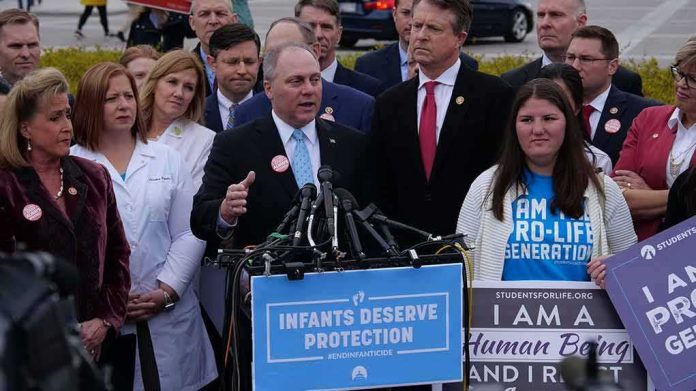
The starting point is the event itself. According to the official White House release, President Trump hosted a formal ceremony at the White House honoring “Angel Families”—relatives of Americans killed by people in the country illegally. The release describes Trump delivering remarks and signing a presidential proclamation designating February 22 as “National Angel Family Day,” elevating these families into a recurring symbolic role in his immigration agenda. Parents of murdered Americans spoke from the podium, recounting the loss of their children and framing illegal immigration in terms of preventable violent crime. Conservative media and the administration treated the event as a moral centerpiece of Trump’s border and crime policy, emphasizing the emotional testimony as evidence of a national crisis.
On that substance, there is no dispute: the ceremony was real, official, and integral to the White House’s message about illegal immigration. The controversy is about how CNN chose to cover it—and how the White House chose to describe that choice.
The White House’s Charge: “EVEN One Second” and “Total Disgrace”
White House Press Secretary Karoline Leavitt led the charge. In a widely shared X post amplified by the official White House account, she wrote that “@CNN is a total disgrace. President Trump hosted a powerful event honoring Angel Families… but CNN refused to cover EVEN one second of it.” She went further, claiming, “That’s because CNN doesn’t care about the victims of illegal alien crime. They pretend to be a news organization, but they refuse to cover anything that doesn’t fit the Left’s narrative.”
Steven Cheung, Trump’s communications director, echoed the line, calling CNN and MS NOW’s decision “sickening and appalling” and asserting that it showed “no regard for the victims and their families.” Fox-linked coverage and commentary reinforced the message: Fox carried the event live, while a Bill O’Reilly segment highlighted that “CNN didn’t mention it” on the main channel, framing that absence as proof of bias and failure.
This is a carefully constructed accusation. It fuses three claims: that there was no coverage at all (“EVEN one second”), that the omission was driven by political ideology (“Left’s narrative”), and that the result demonstrates contempt for grieving families (“don’t care about the victims”). Each of those claims has to be assessed separately against the evidence.
What CNN Actually Did: Digital Coverage, Competing News, and Framing
Side B in this dispute—the counter-evidence—does not come from secret memos but from public reporting about CNN’s own explanation. Yahoo News, summarizing the network’s position, reports that CNN did not carry the Angel Families ceremony live on its primary television channel but did stream the event digitally on its website with real-time analysis, and also published an article about the gathering. That alone invalidates the literal claim that CNN “refused to cover EVEN one second” of the event in any form. The network chose a different platform and format, not total silence.
Why the difference between TV and online? CNN stated that it was devoting its main channel at that time to breaking coverage of a historic blizzard affecting the northeastern United States. In other words, this was an editorial prioritization decision: a live, fast-moving weather emergency over a preplanned political ceremony, with the latter handled via digital coverage and later reporting. That kind of triage is standard practice in cable news, which constantly allocates scarce live airtime among multiple simultaneous events.
The content of CNN’s article reinforces that this was not a case of dismissal. The piece reportedly contextualized the Angel Families framing by noting that “there is no data linking immigrants to higher crime rates,” a point widely supported in criminological research. That is straightforward journalistic engagement: cover the event, quote the participants, and then situate their claims within the broader empirical record. It is precisely the sort of coverage a newsroom might produce when it believes a president is using emotionally powerful stories to advance a contested policy narrative.
Where the Evidence Cuts Against the White House Narrative
The most serious weakness in the White House’s case is the insistence on “zero coverage” in the face of evidence of non-television coverage. Once you acknowledge that CNN streamed the event online and wrote about it, the allegation that the network “ignored victims” in any comprehensive sense cannot be sustained as a factual statement; it becomes an argument about hierarchy—television versus digital—and tone, not presence versus absence.
Leavitt’s further claim that CNN’s choice proves the network “doesn’t care about the victims” is interpretive rather than evidentiary. There is no on-record statement from CNN executives suggesting indifference to grieving families, nor documentation that personal contempt guided the decision. The only concrete rationale we have from CNN is the blizzard coverage and a longstanding internal concern about airing Trump live when he is likely to make false statements about elections or immigration without real-time fact-checking. A prior on-air explanation by CNN’s John King, in a different context, spelled that logic out: the network would monitor Trump’s speech, fact-check claims and newly declassified material, and then report with context instead of broadcasting his remarks unfiltered.
That history matters. It shows an institutional pattern of caution with live Trump addresses on topics where he has a record of falsehoods, but it also shows that the network still covers those events, just not in the form the White House prefers. When CNN cuts away from a misleading Trump speech after 18 minutes and shifts to fact-checking, or declines to carry an address live while promising “analysis and commentary,” it is marking a boundary between dissemination and scrutiny. The Angel Families episode fits that pattern: cover digitally, analyze, contextualize, but do not dedicate uninterrupted televised airtime at the expense of other breaking news.
The CNN Side: Skepticism About Framing, Not Denial of Grief
Critics of CNN have singled out specific language to portray the network as contemptuous. The New York Post and conservative outlets pounced on CNN political analyst Seung Min Kim’s use of the phrase “so-called angel moms” in discussing the ceremony. That formulation was widely denounced as dismissive, and it unquestionably sounds cold to many ears. But it also reflects a familiar journalistic habit: putting contested labels in quotation marks or using “so-called” when a term carries heavy political freight and is not a neutral descriptor.
The Angel Families label is explicitly strategic. It was adopted by immigration restrictionist activists and embraced by Trump’s political operation to frame particular tragedies as emblematic of a broader supposed threat from illegal immigration. Journalists may legitimately question whether that framing matches the larger crime data, even while acknowledging the real pain of those families. The “so-called” construction, in that sense, is directed at the rhetoric, not the reality of the deaths.
Whether that distinction lands with viewers is another matter. To many, the difference between challenging a label and challenging a person’s status as a victim collapses emotionally. That collapse is what the White House has seized on, repeatedly, to argue that CNN and similar outlets show “contempt” for victims of illegal immigrant crime. But again, the evidence shows skepticism about a political narrative, not evidence of newsroom hostility toward bereaved parents as such.
A Wider Pattern: Weaponizing Access and Accusations of “Failure to Report”
This fight is not happening in isolation. It fits a years-long pattern in which Trump’s White House uses public rebukes, access control, and the language of “failure to report” to punish and delegitimize outlets that do not carry its preferred messages in the preferred manner.
In earlier episodes, the administration has accused CNN and MSNBC of refusing “to devote a single second of airtime” to stories it wanted amplified, such as an attack on an ICE facility in Texas or emotional appeals from families of victims of migrant crime. It has labeled CNN a “sh*tty outlet” over Iran coverage, condemned the network for airing four straight minutes of Iranian state TV when the White House believed that helped an adversary, and repeatedly asserted that the press “only want to make the president look bad… especially CNN.”
These rhetorical attacks have been paired with structural moves. The White House has barred CNN and other major outlets from press gaggles, taken control of the White House press pool from the Correspondents’ Association to decide which reporters accompany the president, and defended its ability to revoke press passes in litigation by arguing that “no journalist has a First Amendment right to enter the White House.” Media rights advocates view these moves as part of a broader project: turn editorial disagreements into grounds for access punishment, thereby pressuring outlets that rely on the White House beat.
Against that backdrop, the Angel Families controversy looks less like a one-off outrage and more like another entry in an established playbook. When CNN’s coverage diverges from the White House’s preferred script—whether by not airing an event live, fact-checking claims about Iran, or contextualizing immigration rhetoric—the administration responds by accusing the network of “lying,” “failing,” or lacking compassion for victims, often through Leavitt’s and Cheung’s public interventions.
What We Know—and What We Still Don’t—About Motive
The hardest question is motive: did CNN’s decision not to air the Angel Families event live on its main channel stem primarily from partisan hostility to Trump’s immigration agenda, or from routine editorial triage combined with a policy of caution around Trump’s misleading statements? The evidence at hand does not fully resolve that question.
On the one hand, CNN has articulated specific, non-ideological reasons in other cases for declining live carriage: the need to vet newly declassified material, a documented pattern of false claims on elections, and competing breaking news priorities. Those rationales are consistent with standard journalistic practice. On the other hand, CNN has not produced granular internal documentation—broadcast logs, editor memos, deposition-level testimony—showing how the Angel Families decision was made in real time. Without that, any claim about psychological or ideological motive remains partly inferential.
What the evidence does show clearly is this: the White House’s strongest factual claim, that CNN “refused to cover EVEN one second” of the event, is inaccurate once you consider the documented digital coverage; its most inflammatory interpretive claim, that CNN “doesn’t care about the victims,” is not supported by direct evidence of intent.
Why This Matters Beyond One Ceremony
For a thoughtful observer, the deeper stakes are not about whether CNN should have aired one more speech. They are about the boundary between two kinds of power. On one side, a president’s ability to frame events and invoke victims to support contentious policy choices; on the other, a major news organization’s authority to decide how, where, and with what context those choices are presented to the public.
When the White House insists that anything less than live, uninterrupted television coverage is equivalent to “ignoring” victims, it is trying to redefine editorial independence as moral failure. When CNN confines some Trump events to digital streams and articles, then layers them with data-driven skepticism, it is asserting that the press’s responsibility is not to mirror presidential staging but to interrogate it. That clash is not going away. It will recur wherever grief and politics meet—on immigration, crime, war, and beyond.
Understanding the Angel Families dispute through evidence rather than slogans clarifies the terrain. The White House did host a powerful ceremony and has every right to argue its significance. CNN did cover it, though not in the way the administration wanted, and has articulated defensible journalistic reasons for limiting live carriage. What neither side can legitimately claim, on the record we have, is sole custody of compassion or truth. The relationship between presidents and the press has always been adversarial at its healthiest; in the Trump era, that adversarial stance has simply become louder, more personalized, and more weaponized.
Assessing Future Conflicts Over “Failure to Cover”
Looking forward, the Angel Families episode offers a template for how to read similar fights. When a White House alleges “failure to report,” the first questions should be: was there coverage in some form, even if not live television; what competing news claims were in play; and how has the outlet handled comparable events from other administrations? On the media side, networks that choose to limit live Trump coverage while still reporting analytically would do well to be maximally transparent about their criteria, publish clearer broadcast rationales, and ensure that victims’ voices, when invoked by politicians, are not lost inside broader fact-checking.
The public, meanwhile, benefits from resisting binary stories. A network can be skeptical of a president’s narrative and still take victims seriously. An administration can legitimately criticize coverage without sliding into punitive access tactics. The evidence around the Angel Families ceremony shows both the possibility of that balance and how quickly it can be abandoned when political advantage beckons.
Sources:
foxnews.com, yahoo.com, x.com, youtube.com, nypost.com, cnn.com, ground.news, townhall.com, deadline.com, nationaltoday.com, npr.org, whitehouse.gov, edition.cnn.com, dw.com