

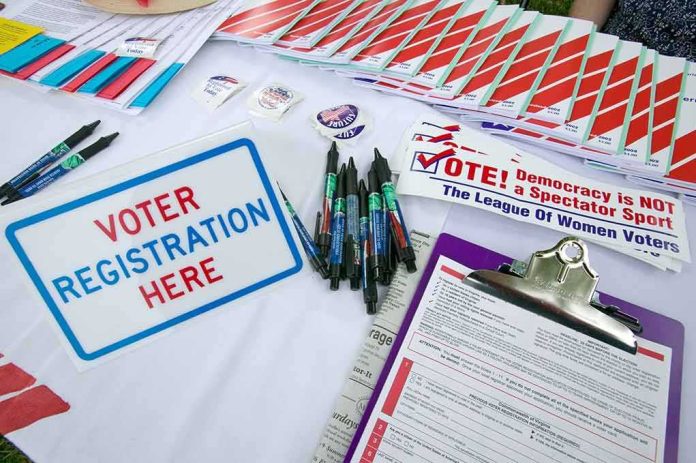
The integrity debate this fall is not about whether to vote; it’s about which guardrails Americans want around voting — and whether new federal proof-of-citizenship and voter ID mandates solve a meaningful risk without sidelining lawful voters.
The Short Version
- House-passed proposals would require documentary proof of U.S. citizenship to register for federal elections and government ID to vote; sponsors frame this as restoring trust and uniform rules.
- Independent research finds noncitizen voting and in-person voter fraud are exceedingly rare relative to total ballots cast, raising proportionality questions about sweeping federal mandates.
- The core policy trade-off is preventive security versus access friction: stronger front-end verification may block rare ineligible attempts, but it can also sideline eligible citizens who lack ready documents.
- Congress clearly has constitutional authority to set rules for federal elections; the live questions are operational — what counts as proof, how states implement, who bears the burden, and at what scale of benefit.
What the bills actually do — and why sponsors say they matter
Two anchor measures — the SAVE America Act and related election-administration packages — would knit federal elections to hard proof of citizenship at registration and government-issued photo ID at the polls. The text is granular, not rhetorical: it defines eligible documents (e.g., passports, certain military and state or tribal IDs) and, crucially, allows REAL ID–compliant identification that indicates U.S. citizenship to serve as proof. The design is straightforward: tighten the front door of the voter file and authenticate at the polling place. Proponents argue this uniform baseline “makes it easy to vote and hard to cheat,” contending that harmonized standards and paper-based audibility are the fastest route to public confidence.
As federal election policy, this is not a novel constitutional stretch. Article I’s Elections Clause empowers Congress to set the “Times, Places and Manner” of federal elections; Congress has long dictated registration and list-maintenance frameworks. The bills fit squarely in that lane, substituting nationwide minimums for today’s state-to-state heterogeneity — a point their supporters emphasize as a trust dividend in close national contests.
The risk baseline: how rare is the problem these rules target?
The burden of proof in any integrity reform rests on incidence and consequence. On that ledger, independent analyses have been consistent: proven in-person voter fraud and documented noncitizen voting are exceptionally rare relative to the hundreds of millions of ballots cast. The Brennan Center’s syntheses place observed fraud rates at fractions of a hundredth of a percent and conclude that such conduct does not occur on a scale capable of “rigging” an election without detection. NPR’s review reached the same bottom line: cases exist, but not at volumes that have altered modern statewide outcomes. These findings do not say “zero”; they say “vanishingly small.” For reformers, prevention at the registration stage still has value. For skeptics, the numbers fail a proportionality test.
This is the crux. If the empirics show near-zero incidence, sweeping paperwork prerequisites may produce larger, more certain effects on eligible voters than on bad actors. If, however, administrators value a defense-in-depth posture in which front-end documentary checks harden systems against low-probability, high-salience risks, then uniform verification can be defended as an insurance premium — especially in jurisdictions with porous data-sharing or inconsistent list maintenance.
The access side of the ledger: who bears the paperwork cost?
Proof-of-citizenship requirements hinge not on citizenship per se, but on the ability to produce accepted documents on the timeline and in the manner election offices specify. Research repeatedly warns that a meaningful slice of eligible voters does not keep passports or certified birth records at hand, and that obtaining replacements can be slow, costly, or both. An NPR analysis estimated that tens of millions of eligible Americans report they cannot easily display proof of citizenship — a friction that lands hardest on the elderly, the rurally situated, and citizens born outside hospital systems that digitized vital records late. Policies can mitigate that friction — fee waivers, on-site document verification, secure digital proofs — but the operational details matter more than slogans. Paper rules without service design become access barriers in practice.
Arizona’s first-generation proof-of-citizenship experience is often cited as cautionary: a large share of new registrants were initially rejected for missing documentation, not because they were ineligible, but because the acquisition and submission workflow was brittle. Critics argue this is not a security feature; it is an administrative bottleneck whose predictable victims are lawful voters with thinner document trails. Sponsors counter that better state-federal data links and acceptance of REAL ID citizenship flags materially lower that burden. The current bills’ reliance on enumerated, standardized documents suggests drafters took those lessons, but whether states can execute at scale, speed, and equity is the open question.
Mechanics and feasibility: REAL ID, databases, and error rates
REAL ID is attractive policy plumbing because it embeds document vetting in DMV workflows; if a license or ID is marked as issued upon documentary proof of citizenship, election offices can, in theory, use that attestation on registration. But the “in theory” hides engineering. State DMVs vary in how they record citizenship status, how reliably those flags reflect original documents, and how readily they share fields with election agencies under privacy law. False negatives — citizens whose DMV record lacks or miscodes the flag — are the predictable failure mode. False positives are rarer but riskier. Any federal mandate that leans on REAL ID fields must budget for reconciliation work: upgrading interagency interfaces, training staff to cure errors quickly, and publishing service-level metrics so voters know how long a fix takes. Without that, integrity rules become latency rules.
At the polls, photo ID similarly trades a simple check for back-end pressure. States that already require ID have learned to manage provisional balloting and post-election cures, but those processes require throughput capacity. If the federal baseline expands ID checks nationwide, jurisdictions with large transient or student populations will need surge plans to avoid cure backlogs chilling participation. None of this is intractable, but it is logistics, not rhetoric.
Where the genuine disagreement lies — and how to evaluate it
Strip away the slogans and you get a clean policy question with two honest answers. One: uniform proof-of-citizenship and voter ID rules are prudent, low-cost defenses that will rarely be outcome-determinative but will narrow avenues for ineligible participation and, by visibly tightening controls, shore up trust. Two: because the measurable incidence of the targeted misconduct is tiny, the larger, more certain effect of strict documentation regimes is to keep some eligible citizens from registering or having their ballot count, while adding administrative cost for symbolic gain. The evidence record today better supports the rarity claim than the vulnerability claim; that is not ideological, it is quantitative. But rarity does not make prevention irrational — it makes calibration essential.
Practical guidance for voters and administrators
For voters, the answer to the headline question — should Americans deny elections this November? — is no. Participate. If your state’s rules tighten, front-load your document gathering now: confirm your registration status, request any vital-records copies early, and know your polling-place ID options. For administrators and lawmakers, the productive path is not maximalism but precision: adopt clear, enumerated proofs; accept multiple documentary routes; offer free, rapid-issue IDs; integrate DMV and election databases with auditable logs; and publish cure timelines and success rates so the public can see that access and integrity are both being honored. That is how you harden a system without hardening hearts.
Sources:
thegatewaypundit.com, congress.gov, dailysignal.com, brennancenter.org