

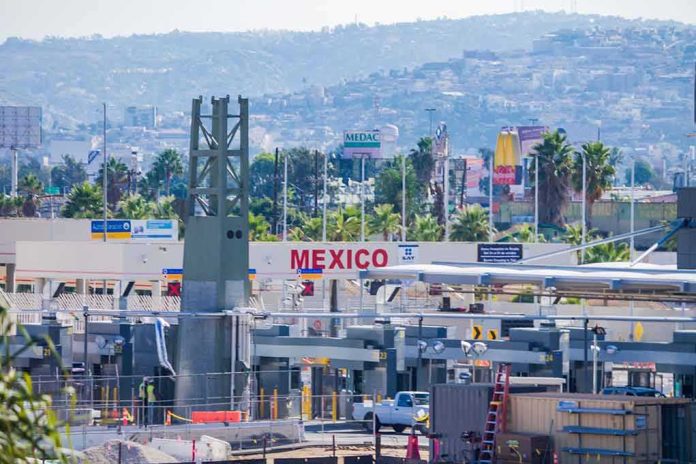
When the United States suspends its own movements in a foreign city, the real message is not theater but risk management: Washington only pulls those levers when internal threat intelligence suggests a credible, time-bound danger to people or facilities. That is precisely what happened in Mexicali.
At a Glance
- U.S. officials briefly halted government activities and official travel in Mexicali after receiving threat information about a potential armed attack.
- The U.S. Embassy’s alert framed the risk as specific and short-duration; guidance to citizens focused on avoiding government buildings and sheltering in place if violence erupted.
- This response fits a well-established State Department playbook: temporary, preventive restrictions keyed to localized intelligence rather than broad, open-ended warnings.
- The region’s baseline risk remains elevated under the State Department’s Mexico advisory architecture, independent of one-day suspensions.
What triggered the suspension and what it signaled
On the evening of August 25, the U.S. Mission in Mexico issued a formal security alert stating that, due to threat information, U.S. government activities in, and official travel to, Mexicali were suspended for that day. The notice did not publish classified details; it did, however, do what these alerts are designed to do—translate intelligence into concrete, short-run protective steps for U.S. personnel and citizens. The Embassy advised Americans to avoid government buildings and be prepared to shelter if violence materialized. For risk professionals, that pairing—a same-day operational pause for official travelers and precise behavioral guidance for the public—is the tell that authorities were treating the threat as both localized and actionable, but not indefinite in scope.
Media summaries filled in what the official text left implicit: reporting attributed the potential target set to law enforcement facilities and described the threat context as a possible armed attack. While those secondary descriptions are inevitably less authoritative than the Embassy’s own phrasing, they reflect the same core reality—the U.S. government took concrete, defensive steps because of a specific potential for violence in the city at a particular time window.
How the diplomatic security playbook works
The State Department manages overseas risk on two tracks. One is strategic and map-based: a country-level advisory (numbered 1 through 4), often layered with state- or region-specific guidance. The other is tactical: time-bound alerts and temporary operating restrictions that respond to live intelligence, sometimes with only hours of lead time. Mexicali fell squarely into the second track. The Embassy used narrow, reversible measures—suspending official movements for a day, paring back in-person activity—to lower exposure while Mexican and U.S. partners assessed the threat picture. That is standard practice: pause movement, harden posture, and advise the public, all while avoiding disclosure of sources and methods behind the threat stream.
This mechanism is not a referendum on the city’s long-term viability or on bilateral relations; it is a brake pedal applied when indicators cross a risk threshold. When those indicators recede, operations resume. Separate from these alerts, Baja California’s baseline advisory posture has, at times, required added restrictions for official travelers—reflecting enduring crime dynamics in border corridors. The key is to understand the alert for what it is: a surgical control, not a standing verdict.
The local security ecosystem that shapes these calls
Border cities like Mexicali sit at the seam of two enforcement regimes and multiple criminal markets. Intelligence-driven seizures, interdictions, and arrests periodically shift the balance among organized groups, and in those moments the risk of retaliatory violence against security institutions can rise. Public-facing travel pages catalog the structural drivers—organized crime, armed confrontations, kidnapping risk—without tying them to specific days or facilities; alerts bridge that gap when concrete threat intelligence appears. In practice, that means an American traveler might see two signals at once: a general advisory urging increased caution in the state or nearby regions, and a punctual alert instructing them to avoid certain areas or behaviors for a defined period.
For U.S. personnel, duty-of-care standards are stricter. Movement restrictions that bind embassy and consulate staff often exceed what is asked of private travelers, both because the U.S. government is a visible target and because its risk tolerance for official duty travel is institutionally lower. Suspending official travel for a day, as occurred here, is a low-friction way to take risk out of the system while partner agencies work their sources and assess whether hostile intent is crystallizing into capability and timing.
What citizens were told to do—and why that matters
The Mexicali alert’s language asked Americans to avoid government buildings and to prepare to shelter in place if an incident unfolded—more specific than a generic “exercise caution” and less disruptive than a blanket curfew. That calibration matters. It tells you the concern vector (institutional facilities rather than random street crime), the expected hazard (armed attack rather than theft), and the recommended countermeasure (distance and cover rather than evacuation). For private travel, that is practical intelligence: defer nonessential visits to government facilities, keep situational awareness high around official compounds, and have a communication plan to check in with family if security operations disrupt movement.
For those living or working in cross-border rhythms—Calexico by day, Mexicali by night—the advice also underscored what does not change: ports of entry typically remain open unless host-nation authorities or CBP restrict flows for specific reasons. The suspension applied to U.S. government movements, not to the public at large. In short, the warning aimed to keep people clear of the likely target set while minimizing broader disruption.
U.S. ISSUES SECURITY ALERT IN MEXICALI; REPORTS POINT TO THREAT LINKED TO “LOS RUSOS”
The U.S. government issued a security alert for Mexicali after the U.S. Consulate General in Tijuana received information regarding a threat against security facilities and government buildings… pic.twitter.com/Q6ok9gOxSX
— THE INFO STREAM (@_theinfostream) August 25, 2026
How to read the next alert you see
Three questions help decode future security alerts without succumbing to alarmism. First, scope: Is the instruction narrow and temporary (avoid X on date Y), or broad and open-ended? Narrow and temporary usually indicates intelligence about place and timing rather than a generalized surge in ambient risk. Second, posture: Are officials curbing their own movements? When Washington limits official travel, it is elevating force protection based on a defined threshold being met. Third, congruence: How does the alert align with the standing advisory architecture? If the baseline is already “exercise increased caution” and the alert names a potential threat to a specific category of sites, the practical lesson is to modify routes and routines, not to abandon the region entirely.
That is the disciplined way to treat these notices: as time-sensitive risk controls sharpened by intelligence, not as verdicts on a city’s future. The Mexicali suspension was brief by design, precise in its guidance, and consistent with the State Department’s long-running method for managing uncertainty along complex frontiers. As long as transnational criminal dynamics and enforcement pressure continue to interact along the border, alerts of this kind will surface—punctuating, not rewriting, the map.
Sources:
facebook.com, mx.usembassy.gov, yahoo.com, washingtonpost.com, nypost.com, deeparrival.com, infobae.com