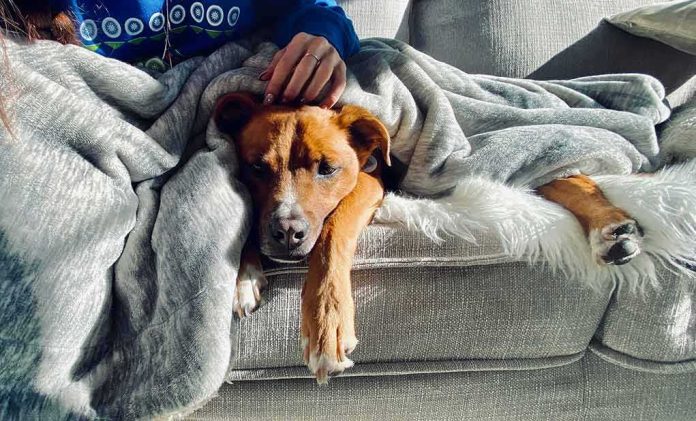
A dog’s improbable survival after an avalanche is not just a feel-good tale; it is a case study in how consumer tech, organized volunteers, and disciplined search tactics can bend the odds in terrain where time, cold, and distance usually decide outcomes.
At a Glance
- A 4-year-old poodle–husky mix, LouLou, survived roughly 50 hours in Alaska’s Chugach backcountry after an avalanche separated her from two mountaineers.
- AirTag pings from the mountain narrowed the search area; drones, a helicopter, and ground teams converged to locate her alive.
- The incident underscores both the utility and hard limits of AirTag-style “Find My” tracking in sparse, mountainous environments.
- The rescue fits a known pattern: survival hinged on rapid coordination, the right tools, and a dog’s resilience, not a single piece of technology.
What happened on the mountain
The storyline is stark and consistent across outlets: on October 10, two experienced mountaineers and LouLou were traversing a ridge in Chugach State Park, near Eklutna Lake, when an avalanche swept the men roughly 500 feet downslope and separated them from the dog. The men were rescued with injuries; LouLou disappeared into deep, unstable snow and subalpine terrain. Searchers—family, community volunteers, and aerial assets—spent the next two-plus days chasing thin signals and circumstantial clues until, about 50 hours later, LouLou was found alive and essentially uninjured and brought home. Multiple reports place the timing, location, and sequence of rescue consistently, anchoring a clear narrative even as minor details (like the dog’s precise breed mix) vary by outlet.
Two elements proved decisive: persistence on the ground, and a small but meaningful stream of digital breadcrumbs from LouLou’s Apple AirTag. Those pings—sporadic due to scarce nearby devices—didn’t give a walk-up GPS fix, but they bounded the search problem to a handful of drainages and lee slopes that teams could then interrogate with eyes, optics, and rotor wash. In mountain rescue, narrowing the haystack is half the game; in this case, it turned a vanishingly large search grid into a tractable one.
How AirTags actually help in the backcountry—when they do
An AirTag is not a satellite tracker. It is a passive Bluetooth beacon that relies on Apple’s distributed “Find My” network—nearby iPhones and other Apple devices opportunistically relay a cryptographically anonymous location update to the owner. In cities, that network is dense; in a snow-choked valley with few phones passing by, updates can be rare or absent, and accuracy can degrade from meters to broad swaths of map tiles. Precision Finding—the close-range, directional feature some users associate with AirTags—only works when you are already near the tag with a compatible iPhone. In remote mountains, expect intermittent, coarse updates at best; that is exactly how LouLou’s search unfolded.
Still, intermittent does not mean useless. For a backcountry search leader, a stale ping can constrain a search sector, suggest wind drift or avalanche runout patterns to examine, or cue a helicopter pass over specific aspects. The practical lesson is not to over-index on the device, but to fuse it with terrain analysis, last known point, and movement hypotheses. AirTags can be a decent adjunct in the mountains, but they are not substitutes for PLBs, inReach/Spot messengers, or avalanche beacons—each of which uses very different signaling physics and networks designed for emergencies.
Avalanche survival and canine resilience
Avalanche medicine is blunt about the clock. For people who are fully buried, survivability usually collapses within minutes as hypoxia sets in; even partial burial with airway compromise can be rapidly fatal. This is why avalanche transceivers, shovels, probes, and trained companions matter—organized response is racing a physiologic timer, not solving a leisurely puzzle. Dogs present a different profile: they can avoid complete burial by outpacing the flow or “swimming” to the surface; if unburied or only partially entrained, their risk pivots from asphyxia to exposure, injury, and predation. The window then measures in hours to days, not minutes, if they can find shelter and remain mobile.
In human rescue, trained avalanche dogs are a force multiplier, able to clear large areas fast—but even there, dog-finds do not automatically improve survival over probe-line searches when transport time and burial depth dominate outcomes. The point translates here: dogs are terrific at finding, but survival hinges on mechanisms upstream of discovery—airway, trauma load, time to first shovel full of snow. LouLou appears to have escaped the worst mechanism of death (complete burial) and then survived the cold through a combination of undercoat insulation, behavior (minimizing convective heat loss), and perhaps luck in wind and snow conditions.
What made this rescue work
Look closely and the magic dissolves into method. There was an immediate mobilization by people who knew the route and the hazard profile of the slope. There was an aerial search capable of surveying multiple avalanche paths quickly—rotorcraft are invaluable for reading crown lines, debris fans, and tree blows from above. There were drones and observers pressing into pockets that a helicopter cannot safely linger over. And critically, there was just enough digital telemetry to keep the search honest, anchoring hunches to coordinates, however imprecise. This is the modern pattern for wilderness success: pair local knowledge and disciplined ICS-style coordination with just enough technology to illuminate the next best move.
It is tempting to credit a single hero—dog, device, or pilot. The better reading is systems thinking: redundancy across modalities. Tech fails in canyons; rotorcraft get weathered off; batteries die in cold; volunteers tire. When one strand weakens, another carries the load. LouLou benefited from that braid.
Guidance for backcountry dog owners
If you travel in avalanche terrain with a dog, plan for both the avalanche problem and the separation problem. For the avalanche problem, keep your dog within immediate voice or leash control when crossing suspect slopes; a dog can trigger a slide as easily as a person. For the separation problem, stack tools: a visible collar tag, an AirTag (useful if other devices pass nearby), and a true satellite device on the human for SOS and two-way messaging. Practice recall under stress, and carry a compact canine first-aid kit tailored for lacerations and hypothermia. Above all, apply terrain discipline—safe travel protocols (one at a time across avalanche paths, predetermined islands of safety) protect both species equally.
What this story is—and is not
LouLou’s rescue is not evidence that consumer trackers can replace dedicated emergency gear, nor that avalanche burial is survivable over days for humans. It is a testament to realistic expectations, persistent search, and a dog’s capacity to endure cold when not fully buried. The technology helped define a problem space; human judgment and aerial access turned that into a living animal on the ground. In the mountains, that division of labor is about as good as it gets.
solana:7BMb4jNt2tQG81jX7W22H2h2UyL4SW9QJgz25HRhpump 200K
2N8c4pXu6T2oBxE8ZDBYb3QgwMkyTe673HiBaYSNpumpOn October 10, LouLou followed two climbers into Chugach State Park in Alaska. During the trip, they were caught in an avalanche. The two climbers were swept about 500 feet down… https://t.co/KPRpRzCDRC pic.twitter.com/hqeQA3tqk9
— Azzie (@Motier_crypto) October 13, 2026
Why it will keep happening
Stories like this recur because the ingredients recur: adventurous people take well-judged risks in complex terrain; weather and snowpack do what they do; animals act like animals; and our tools, for all their sophistication, still obey physics and battery chemistry. What changes is our ability to coordinate—neighbors with drones, pilots with local knowledge, rescuers who understand both the mountain and the network map on a phone screen. As that coordination improves, the search funnels narrow faster. Sometimes, as in Chugach, that’s enough to pull a living creature back through a window that would otherwise slam shut.
Sources:
facebook.com, people.com, lastampa.it, tag24.de, ilfattoquotidiano.it, pcmag.com, hotairtag.com, hubble.com, seattletimes.com, greenlight.com