Presidential appearances at global sporting events are never just cameos; they are stagecraft that reshapes the day’s logistics, images, and audience memory. President Trump’s brief turn as honorary chairman at the 2026 Presidents Cup at Medinah was exactly that—ceremony layered atop competition—folding the rhythms of elite golf into the choreography of Air Force One, motorcades, crowd reactions, and a trophy-day script the PGA Tour has refined for decades.
At a Glance
- President Trump served as honorary chairman of the 2026 Presidents Cup at Medinah Country Club near Chicago, a ceremonial role rooted in event tradition.
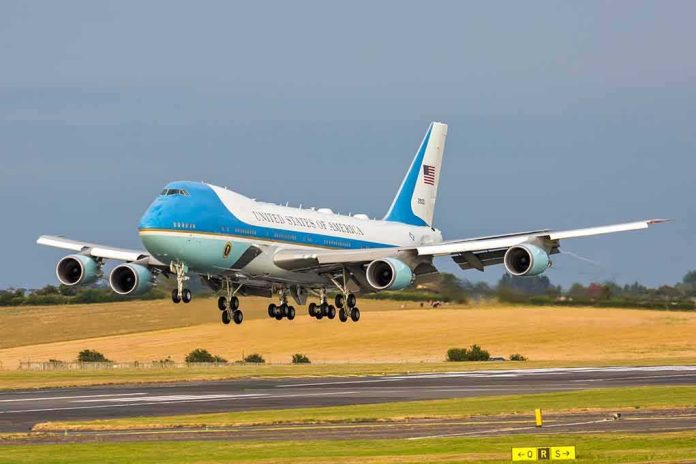
- Air Force One overflew the course before Trump’s appearance, a visual centerpiece that set the tone for the final day’s spectacle.
- The tournament ran September 22–27, 2026, continuing the Cup’s longstanding pairing of championship golf with presidential pageantry.
- As with other presidential drop-ins, Trump’s visit brought heavy security, protests outside the venue, and heightened broadcast attention.
What happened at Medinah—and why it fit the Presidents Cup playbook
The Presidents Cup is designed to carry a head-of-state sheen: it is a biennial, team-format exhibition that leans into ceremony as much as scoreboards. In 2026, the PGA Tour again enlisted a sitting U.S. president as honorary chairman, announcing in late August that President Trump had accepted the role for Medinah’s staging of the event. The tournament itself anchored the Chicago golf calendar from September 22–27 on Medinah’s Course No. 3, a storied major-championship venue built to host exactly this scale of spectacle.
The president’s arrival followed a familiar cadence. On Sunday, Air Force One executed a flyover visible and audible to galleries ringed around the opening holes; local broadcasts and national feeds quickly folded the footage into their pre-telecast montages. The aircraft’s pass had the intended effect: it signaled presence, reinforced the ceremonial stakes of the final day’s singles matches, and delivered a made-for-TV visual that outlives the leaderboard in public memory. From there, the motorcade moved to the club and Trump greeted the crowd and players in a compact sequence integrated into the day’s competitive timetable.
The honorary chairman role: symbolism over strategy
Honorary chairmanship at the Presidents Cup is not governance of the team; it is presentation. The role confers no influence over pairings, captain’s selections, or competitive tactics. It amounts to a dignitary’s blessing over the proceedings—handshakes on the first tee, words at the podium, and a cameo during the trophy ceremony. Presidents have repeatedly filled that lane, and Trump has now done so twice, having previously held the same title at the 2017 edition, when the event concluded with an on-air presentation featuring the commander-in-chief. That continuity matters: it places 2026 firmly inside an existing tradition rather than treating the moment as an outlier.
For the PGA Tour and the Presidents Cup brand, the calculation is straightforward. A presidential imprimatur expands reach and elevates the broadcast narrative; it also imposes costs. Venues must absorb a surge of credentialing, perimeter control, and timing discipline. The Secret Service, local law enforcement, and tournament operations converge into a single choreography—one that safeguards the protectee and players without derailing the match play unfolding inside the ropes.
Security, protests, and the logistics tax of presidential theater
Large sporting venues are already complex systems: ticketed ingress, merchandise and concessions, broadcast compound, practice ranges, and player transport. Add a presidential visit and the system tightens. At Medinah, security increased visibly; staging areas and access points were modified; and crowds experienced the stop-and-go flow that comes with motorcades and protective sweeps. Outside the gates, protesters and supporters staged their own performances—megaphones, banners, and counter-chants that have become the ambient soundtrack of political figures at sports venues. None of this is novel; it’s the base rate whenever a president attends a marquee event. But each instance has its own flavor—here, the flyover, the Chicago market, and the Sunday timing gave the day a distinctive profile.
Event organizers learn to plan for three overlapping clocks. The television clock must be reliable down to the minute; match starts and trophy lifts are broadcast inventory. The competition clock must accommodate warm-ups, rules officiating, and the inherent variability of match play. And the security clock—insistent, sometimes unforgiving—adds holds and windows that ripple across volunteer assignments, shuttle routes, and fan entry. When it works, the audience experiences the spectacle and the golf as seamless. That is the measure of success.
What the cameras chose—and what the audience remembers
On television and social feeds, punctuation marks matter more than paragraphs. The image of Air Force One carving across Medinah’s skyline is a punctuation mark; so is the presidential stroll to the first tee and the crowd’s reaction, whether cheers, boos, or a messy mix of both. Narrative editors know these beats travel farther than a tidy up-and-down on the 14th. For the tournament, this can be both asset and distraction: the Cup sells team golf and patriotism; the broadcast attention a president brings can amplify that theme—or subsume it if the spectacle overwhelms the sport. In 2026, the sequence held: the flyover drew roars, the appearance was brief, and the matches proceeded inside their broadcast window.
There is a tactical reason the honorary chairman’s remarks are short. Long speeches are friction against a television product calibrated to shots, not soliloquies. It is better to wave, thank the captains, and let singles matches dictate the afternoon’s plot. The Cup’s producers have watched enough of these to know the difference between energy and interruption.
Tradition, continuity, and the Presidents Cup’s use of the presidency
The Cup’s architects have, over time, welded a diplomatic patina to a commercially successful exhibition. It is a U.S. team versus an International team—a construct designed in the 1990s to extend the team-golf appetite beyond the Ryder Cup. From the start, Presidents Cup ceremonies deliberately featured heads of state; they supply narrative gravity and a handy through-line to national pride. Trump’s 2026 chairmanship is a continuation of that decision tree—one already validated by the PGA Tour’s public positioning and calendar commitments.
That decision brings with it a structural asymmetry. The presidency guarantees attention; the event absorbs the attention and its externalities. Protests flare. Security thickens. Ticket holders post phone videos of aircraft and motorcades. Rights-holders splice clips into highlight packages. And the players, who must square all of that with the concentration required for match play, adjust because professionals adjust—habituated to galleries that swell for Tiger Woods or Rory McIlroy, now swelling for Air Force One instead.
NEW: President Donald Trump is returning to the Presidents Cup on Sunday for the second time as the honorary chairman. This visit marks the fourth visit to a golf tournament this year.
MORE INFORMATION: https://t.co/kUqN7YtO9S— WTVC NewsChannel 9 (@newschannelnine) September 27, 2026
Why it matters beyond a single Sunday
For sports administrators, Medinah 2026 is a case study in executing presidential theater without losing the sport. For broadcasters, it clarifies how to frame ceremony as a color accent—memorable but not dominant. For law enforcement and local governments, it is rehearsal and refinement: traffic management, protest accommodation, and interagency command. And for fans, it’s a reminder that modern megasports are not just games; they are civic rituals that absorb politics, pageantry, and the marketplace into a single afternoon.
Sources:
abc7chicago.com, sports.yahoo.com, presidentscup.com, ksat.com, nbcchicago.com