
When a city dismantles a unit built for fast, armed, citywide response and replaces a large slice of its public-order footprint with unarmed dialogue teams, it is not simply changing uniforms; it is choosing an operating philosophy with different strengths and different failure modes.
At a Glance
- New York has dissolved the NYPD’s Strategic Response Group (SRG), splitting its protest and counterterrorism roles into separate structures.
- Counterterrorism, including heavy-weapons protection of critical infrastructure, moves to the NYPD’s Intelligence and Counterterrorism Bureau, preserving armed capability within the department.
- Protest engagement shifts to a civilian-led Community Dialogue and De-escalation Division, paired with an NYPD First Amendment Support Team (FAST), and with restrictions on certain crowd-control tools during First Amendment activity.
- Supporters argue the missions should never have shared a badge; critics warn that unarmed teams and dispersed command risk slower, weaker response to fast-breaking violence.
What SRG Was—and Why Its Design Mattered
SRG was built as a citywide, mobile capability to manage major events, civil disorder, and heightened-crime deployments, under one roof that also carried counterterrorism responsibilities. The NYPD’s own description emphasized rapid deployment of highly trained personnel with specialized equipment to mobilizations across the five boroughs. That unified design delivered a particular advantage: a single chain of command habituated to move people, heavy gear, and tactics quickly when the threshold from peaceful assembly to unlawful violence was crossed, or when credible threats targeted bridges, transit nodes, or other critical sites. Unification—logistics, training, tactics—tends to compress response times and simplify decision rights in ambiguous conditions. It also carries a reputational cost: the same posture that reassures planners for a high-risk event can, in a protest context, read as militarized and provoke community distrust.
This is the recurring tradeoff in American protest policing. Cities erect specialized, mobile units after disorder or terror scares; years later, amid criticism of heavy-handed tactics, they dissolve or redesign them. New York has cycled through versions of this—Tactical Patrol Force, Special Events Squad, Disorder Control Unit—before SRG’s turn. Neither model, by itself, guarantees safety; outcomes are mediated by planning, intelligence-sharing, dialogue with organizers, and tactical restraint.
What Replaces SRG: Structure, Tools, and Boundaries
The city’s plan separates missions that had coexisted inside SRG. On the terrorism side, officials consolidate SRG’s counterterrorism functions, including armed deployments at critical infrastructure, within the Intelligence and Counterterrorism Bureau—an existing home with doctrine, partnerships, and operational muscle already pointed at threat detection and interdiction. That choice asserts continuity for armed protection of fixed, high-value targets; it does not, by itself, prove equivalent speed or cohesion in fluid, multi-location events. The yardsticks that matter—mobilization timelines, joint training frequency, incident command clarity—are not yet public.
On the protest side, the city is moving in a different register altogether. A civilian-led Community Dialogue and De-escalation Division, without weapons or arrest powers, will engage organizers upstream and on-scene. The NYPD will maintain a First Amendment Support Team (FAST) to liaise, facilitate marches, and support de-escalation as the civilian capacity stands up. During First Amendment activity, the city has barred or tightly restricted tear gas, pepper spray, long guns, and kettling—crowd-control tools that can inflict collateral harm and erode legitimacy when misapplied. The ambition is straightforward: reduce escalation spirals by making communication, not suppression, the dominant first move.
The Case for Separation—and Its Claims
Officials frame the shift as a rights-protective correction: constitutional protest and counterterrorism are distinct missions that demand different mindsets and toolkits. Keeping them under one command, the argument goes, invites doctrinal bleed—treating a march like a threat cell—and corrodes trust that police will facilitate, not chill, speech. The city underscores that this is not a headcount cut: roughly 500 SRG officers will be reassigned, with many moving into counterterrorism, and the department’s crowd-management response to non-protest mass gatherings—think championship parades—will look familiar. In other words, the bet is specialization in both directions: dialogue-first facilitation for First Amendment events, and a more focused, intelligence-driven counterterror posture elsewhere.
This case is not theory alone. Dialogue-based models—Swedish dialogue policing, the “Columbus model,” and variants piloted in U.S. departments—have shown they can shrink the zone of friction by establishing rapport, clarifying routes, and isolating bad actors without painting the entire crowd as a threat. Where they work, you tend to see fewer arrests and fewer injuries, because the temperature never spikes. The majority of demonstrations are peaceful; matching posture to probability, while keeping contingency plans for the tail risks, is an evidence-consistent approach.
The Critics’ Warning: Capability Gaps in Fast-Breaking Threats
Police-union leaders and former practitioners counter that crowd dynamics can pivot from calm to violent in minutes—and when they do, unarmed civilians without arrest authority cannot hold a line, separate combatants, or stop a cascading breach. They point to incidents like the attempted pipe-bomb plot near Gracie Mansion as the relevant test: if an attack unfolds at a protest perimeter, who interdicts in the first 60 seconds if the frontline is a dialogue team, and how quickly do armed responders arrive with unity of command? This is a specific, falsifiable concern about timing and integration, not merely culture-war theater. And it is where the evidence is thinnest in public view: we have assurances that counterterrorism capability persists inside the NYPD; we do not yet have comparative mobilization and co-deployment data to say whether the new seams slow decisive action.
Two other practical questions sit beneath the rhetoric. First, simultaneous events: can a civilian division and FAST scale across multiple large demonstrations spread over a city the size of New York without robbing Peter to pay Paul? Second, doctrine under stress: bans on certain tools reduce harm in routine protest facilitation, but when a lawful assembly mutates into violent disorder, what calibrated options remain between polite engagement and baton charges—and how trained are line supervisors to make that shift in real time?
Wow!
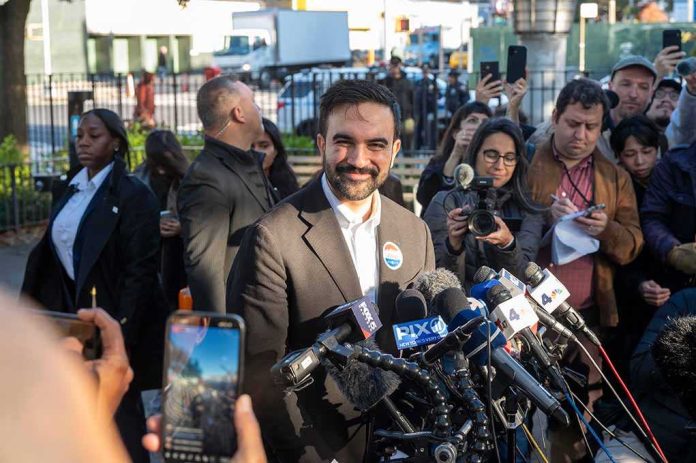
"On Monday, New York City Mayor Zohran Mamdani announced he is shutting down what is known as the NYPD’s Strategic Response Group.
It is a roughly 500-officer unit that the city has sent to protests for years, and it will be gone by spring. In a video, Mamdani stated:…
— Lorraine Evanoff (@LorraineEvanoff) November 19, 2026
What History and Comparative Practice Suggest
Comparative models illuminate the stakes. France’s crowd management is anchored in national, specialized formations whose entire raison d’être is public order; their cohesion is an asset when violence erupts, though their posture can feel implacable to demonstrators. U.S. departments that have invested in dialogue teams coupled to clear, tiered enforcement plans report fewer flashpoints and faster isolation of provocateurs, but they still keep trained arrest teams and protective details staged and under a single incident commander to avoid the “who’s in charge now?” lag. The lesson is not that one model is always superior; it is that clarity of roles, joint training, and the ability to upshift without confusion are non-negotiables.
How to Judge Whether This Works
Strip away the slogans and the evaluation framework is plain. For the counterterrorism transfer: measure staffing, training parity (weapons qualifications, critical-infrastructure drills), dispatch-to-arrival times, and exercise performance before and after consolidation. For protest facilitation: track event outcomes longitudinally—injuries (public and officer), property damage, arrests, and complaints—while controlling for event size and threat level. For command integration: audit incident logs from mixed-risk events to see whether handoffs between civilians, FAST, patrol, and counterterror units are crisp or muddled. Publish the protocols. Run joint exercises. Let the data, not talking points, decide.
Bottom Line
The city has not abolished armed response; it has redrawn the lines between facilitation and force. The promise of this design is fewer unnecessary confrontations and better legitimacy at the many protests that end without incident. Its risk is slower, more fractured action in the rare minutes when violence or terror bursts into a crowd. Both outcomes are foreseeable; neither is fated. The difference will be made by preparation: real joint training, clear thresholds for escalation, disciplined supervision, and honest reporting against public benchmarks. Absent that rigor, the argument will be won by anecdotes and fear. With it, New Yorkers can judge whether this reform delivers what it claims.
Sources:
facebook.com, cbsnews.com, amny.com, nbcnews.com, hidabroot.com, cnycentral.com, brooklyn.news12.com, gothamist.com, columbus.gov, lemonde.fr