
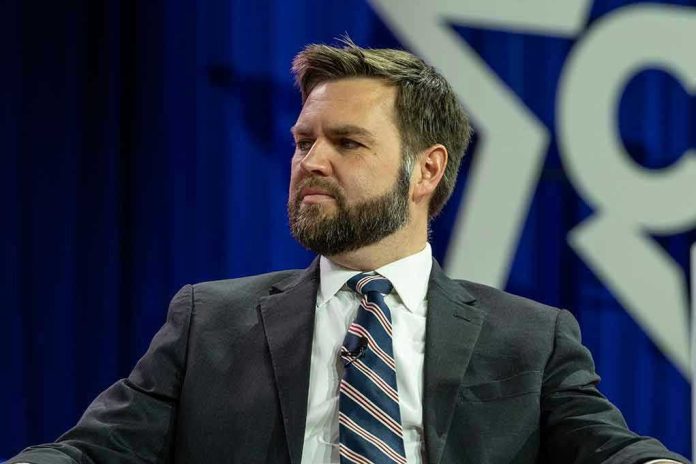
A sitting vice president who refuses to say yes is not necessarily saying no — and nowhere is that truer than in the quiet, calculated ambiguity JD Vance has maintained about 2028. “When I make a decision, Laura, I will be all in on whatever that decision is,” he has said, a line that reveals more about his temperament than any poll number does: he is not hiding a plan, he is genuinely weighing one, and he wants everyone to know the weighing is real.
Key Points
- Vance has repeatedly said he has not decided whether to run for president in 2028, telling CBS News “of course there’s a chance” he stays out entirely.
- Republican midterm losses in November 2026 scrambled the succession picture, with Vance blaming the Iran war and a “Draft Marco” movement gaining traction on Capitol Hill.
- President Trump has publicly muddied the waters, saying he doesn’t know if Vance will run even as Vance insists Trump would endorse him if he does.
- Early 2028 primary polling shows Vance ahead of Rubio among GOP voters, but the political-science record shows such polls carry little predictive weight this far out.
What Vance Has Actually Said — and Why It Matters
Strip away the speculation and the record is unusually clean: Vance has not announced a candidacy, and he has said so himself, repeatedly, on the record. At a CBS News town hall in Michigan on October 17, 2026, host Tony Dokoupil asked whether there was any chance Vance would not run in 2028. “Of course there’s a chance,” Vance answered. Two days later, aboard Air Force Two, he told interviewer Mark Halperin, “I really have not made up my mind about what to do in 2028. I just haven’t focused on it”. These are not the evasions of a candidate hiding a launch date; they are the careful hedges of a man who has not finished deciding.
What makes Vance’s hedging notable is what he pairs it with. In the same breath he tells reporters he hasn’t decided, he also volunteers that “if I run, I think the president will endorse me”. That is not indecision about whether he wants the office — it’s indecision about timing, circumstance, and whether the moment is right. His own framing, that when a decision comes he will be “all in,” suggests the deliberation is genuine rather than theatrical. Vice presidents have long understood that public ambiguity protects relationships with an incumbent and keeps donors engaged without forcing an early, costly campaign posture — and Vance’s statements track that pattern precisely.
The Midterms Changed the Math
Whatever calculus Vance was running before November 2026, the midterm results forced a recalculation. Republicans suffered what multiple outlets described as a shellacking, and Vance publicly attributed much of it to the Iran war, a conflict he had opposed within the administration. That public break mattered: it put him at odds with Secretary of State Marco Rubio, who offered a differing account of the war’s political toll, and it fed a visible split inside the party over who should carry its banner next. Within days, a “Draft Marco” effort was gaining real traction among Capitol Hill Republicans looking past Vance toward Rubio as a less bruised alternative.
Rubio, for his part, has been notably disciplined about not engaging the question. He has “repeatedly” declined to discuss 2028, calling the speculation a waste of time, and later gave reporters a short, noncommittal answer when pressed directly on a potential run — this despite having previously said he’d be the “first person to sign up and support” a Vance campaign. That combination — public deference paired with a refusal to foreclose his own options — mirrors Vance’s own posture almost exactly, and it is the clearest sign that neither man has settled anything, regardless of what Capitol Hill operatives or cable panels project onto them.
Trump’s Ambiguity Is Doing Its Own Work
President Trump has added, not subtracted, uncertainty. Asked about the 2028 field, Trump said he did not know who would run, “his vice president included”, and he has separately disputed reports that he told donors Vance needed to be elected in 2028, saying only “I think he’s great, but we’re way too early to even be thinking about” succession. That is a markedly different register from Vance’s own confident prediction that Trump “would endorse” him. The gap between Vance’s stated expectation and Trump’s public non-commitment is itself a data point: it tells us the succession question is unresolved not just inside Vance’s head, but inside the Trump-Vance relationship as a whole, and that any eventual endorsement is not yet a settled fact in either direction.
Vice President J.D. Vance will reportedly decide on a potential 2028 White House run after the new year, following a midterm bloodbath that saw Republicans lose both houses of Congress. Vance could wait until late spring to announce his decision, according to… w-j.co/s/d99d4 pic.twitter.com/euQ1rAJ1AV
— The Western Journal (@WesternJournalX) November 16, 2026
Why the Early Polls Don’t Settle Anything
A New York Times/Siena poll of Republican primary voters taken October 12–19, 2026 found 33 percent would back Vance in a 2028 primary against 23 percent for Rubio. That gap looks decisive on a cable-news chyron, but the political-science record on early primary polling counsels real caution. Research spanning decades of presidential cycles shows that surveys taken more than a year out carry scant predictive value; their forecasting power rises sharply only in the final months before actual primary contests, as voters and the field itself become better defined. Vance’s current lead reflects name recognition and incumbency-adjacent visibility more than any durable electoral commitment — the same dynamic that made Rudy Giuliani the 2008 national front-runner long before actual voters weighed in.
What Comes Next
Nothing here resembles a campaign in motion — no exploratory committee, no formal announcement, no fundraising apparatus of the kind that typically signals a candidacy is underway. What exists instead is a familiar holding pattern: a plausible heir keeping every door open, a rival declining to rule himself out, and an incumbent president declining to tip his hand. Vance’s own words are the most reliable guide available, and they describe a man still deciding, not one concealing a decision already made. Until that changes, the honest account of where 2028 stands is the one Vance himself has given: undecided, genuinely so, with the outcome resting on considerations — family, timing, the shape of the field — that have not yet resolved.
Sources:
mediaite.com, thehill.com, politico.com, independent.co.uk, washingtonexaminer.com, cbsnews.com, newsweek.com, fox17.com