

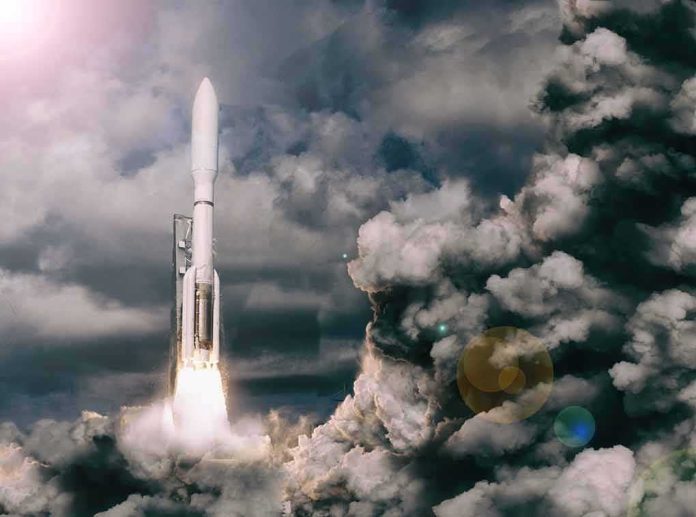
Ambition is back at the center of U.S. space policy: the sitting administration has tied America’s return to the Moon, a push to Mars, and the maturation of space-nuclear power into one coherent program of national capability, not a one-off expedition.
At a Glance
- President Trump publicly set a Moon-to-Mars agenda and linked it to sustained U.S. space leadership, not a single flag-and-footprints mission.
- The White House directed NASA and the Department of Energy to develop a nuclear-powered Mars spacecraft for a 2028 launch and a fission reactor for the lunar surface.
- Kennedy Space Center hosted the November 6 platform for the agenda, with NASA leadership positioning Artemis as the gateway to permanent lunar infrastructure.
- The policy is anchored to prior executive guidance on American space superiority and executed through an explicit NASA–DOE partnership.
What the administration has put on the table
President Trump has articulated a clear strategic arc: complete Artemis milestones to reestablish American crews on the lunar surface, use the Moon as a proving ground for permanent infrastructure, and proceed to Mars with nuclear-enabled transportation. In prepared presidential remarks from October 2026, he stated that NASA would “return American astronauts to the Moon and then push onward to Mars,” presenting the Moon not as an endpoint but as a stepping-stone to interplanetary operations. That political guidance now rides on specific institutional commitments: a NASA–Department of Energy partnership to field two space-nuclear systems—Space Reactor-1, described as a nuclear-powered Mars spacecraft planned for 2028, and Lunar Reactor-1, a fission power plant for the Moon’s surface—announced in an official White House fact sheet.
NASA treated the agenda as program business, not campaign theater. The agency promoted a November 6, 2026 event at Kennedy Space Center as part of its “Max Power” programming, with President Trump delivering remarks; contemporaneous reporting identified the appearance and the role of NASA Administrator Jared Isaacman in framing Artemis and related initiatives as the pathway to infrastructure, not a single sortie. The policy through-line links back to an executive framework—“Ensuring American Space Superiority”—that situates exploration in a larger national-advantage logic spanning security, industry, and science.
How the pieces fit together: Moon, Mars, and nuclear power
The mechanism is straightforward in concept and demanding in execution. Artemis establishes the transport stack, lunar landing capacity, and surface operations norms; those, in turn, enable emplacement of durable power, habitation, and logistics, all prerequisites for routine presence. Integrating nuclear power does two jobs. On the Moon, a fission surface reactor decouples base operations from the lunar day-night cycle and shadowed regions, where solar is limited. For Mars-bound transport, nuclear propulsion—either nuclear thermal propulsion (NTP), which heats propellant directly in a reactor, or nuclear electric propulsion (NEP), which generates electrical power for high-efficiency thrusters—shortens transit or increases mass margins compared with chemical-only architectures; both approaches have long been identified by the National Academies as key enablers for crewed Mars timelines and risk reduction.
The White House’s 2026 fact sheet moves this from aspiration to a programmatic to-do list by naming a NASA–DOE division of labor and first system names. That matters. Nuclear in space is not a single-Agency domain: DOE brings reactor design, fuel cycle, and safety culture; NASA owns mission integration, systems engineering, and flight. Formalizing that partnership is how big, safety-critical technologies move from idea to flight article in U.S. government practice.
Institutional stage-setting: why Kennedy and why now
Kennedy Space Center is where national intent meets pad hardware. Hosting the President there on November 6 placed the Moon-to-Mars narrative in the agency’s operational house—alongside Artemis ground systems, human landing system integration, and commercial lander partnerships—rather than in a purely political venue. NASA’s public-facing Max Power program positioned the appearance as part of a broader aerospace and energy innovation theme, with reporting flagging Isaacman’s emphasis on a lunar base and the interplay between SpaceX and Blue Origin in Artemis III’s docking tests. That framing signals a shift from “mission as spectacle” to “infrastructure as policy,” a distinction with budget and oversight consequences: Congress funds enduring systems more readily when they are seen as national capability rather than celebratory stunts.
The administration also nested space in a continuity of presidential guidance. The space-nuclear push is explicitly linked to an executive order on American space superiority and to existing national security memoranda governing nuclear power and propulsion safety in space—bureaucratic plumbing that tells career programs what lane they are operating in and which oversight bodies are on the hook.
Where the real work lies: schedule, integration, and interdependence
Ambition alone does not put steel on the pad. Artemis is a portfolio, not a monolith: Orion, SLS, Exploration Ground Systems, Human Landing Systems, and surface mobility and power are interdependent. GAO has documented both improvements in NASA’s aggregate project cost performance since 2023 and the reality that newly initiated Artemis work—over $20 billion across nine projects—creates tight coupling in schedules; slips in one element cascade across the stack. GAO has also flagged pressure points in ground systems cost and cadence and has been explicit that earlier Artemis III timeline expectations were unlikely under prior assumptions—useful reminders that “infrastructure-first” is a discipline as much as a slogan.
Space nuclear, for its part, is a technology readiness and safety campaign more than a single milestone. The National Academies has been unambiguous: NTP and NEP can materially reduce Mars trip times or increase delivered mass relative to chemical propulsion alone, but achieving a crew-ready system on an aggressive clock demands sustained testing, fuel and materials maturation, and a clear flight-demonstration path. The NASA–DOE construct is the right one; the gating items are test infrastructure, reactor fuel availability, mission-unique safety reviews, and integration with the chosen launch and in-space stages.
Why this approach is different from one-off “flags and footprints”
The declared through-line—Artemis to base to Mars—aligns with how major civil space initiatives survive changes in political weather: programs become capabilities that multiple stakeholders rely on. A lunar base tied to a fission surface reactor is not a weekend campout; it implies routine logistics, autonomous systems, power budgets supportive of science and industry payloads, and a workforce and contractor base that plans in decades, not years. When a president says, “Our calling is to explore. Our purpose is to build, and our aim is always to win,” and pairs it with named programs and interagency roles, the policy center of gravity moves from aspiration to execution.
There is one appropriate caveat in the record: several marquee milestones are future-dated and will be judged by delivery, not description. The backbone, however—presidential direction, a NASA–DOE partnership with named systems, and an agency platform aligning Artemis with permanent infrastructure—stands on official documents and agency actions rather than rhetoric alone.
🚨 JUST IN: President Trump just dropped this line then walked off stage in Florida
"We can still proudly say that after 250 years of American freedom — THE BEST IS YET TO COME." 🇺🇸
Number one in space, number one military, number one economy and we must KEEP IT THAT WAY. pic.twitter.com/j8XfRO0Y1o
— Maurine (@Maurinel3xc) November 7, 2026
What to watch next
Three markers will reveal whether the strategy is converting to capability. First, the programmatics: contract awards, test articles, and ground-test infrastructure for space nuclear will show up quickly if 2028 is a real target. Second, Artemis integration cadence: delivery and checkout milestones across HLS, ground systems, and docking demonstrations will confirm whether the path to a base is firming up. Third, power on the Moon: requirements maturation and site selection for a fission surface plant will indicate NASA’s seriousness about permanent presence versus extended sorties. Each is measurable; each is necessary for the Moon-to-Mars arc the administration has now claimed as national policy.
Sources:
facebook.com, palmbeachpost.com, orlandosentinel.com, forth.news, washingtonexaminer.com, govinfo.gov, georgianewsnetwork.iheart.com, whitehouse.gov