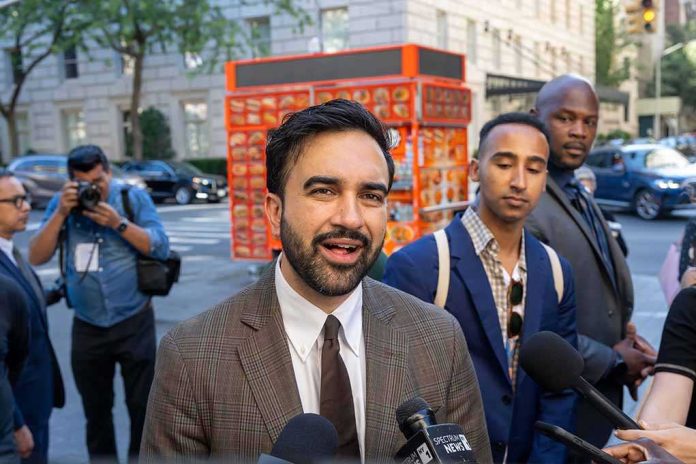
The quarrel over Mayor Zohran Mamdani’s Halloween tenant event is not really about Halloween — it is about a seventy-year-old institutional crisis that outlasts every mayor who inherits it, and about whether spotlighting villainous private landlords while a $78 billion public-housing repair backlog sits unmentioned amounts to political theater or simple message discipline.
Key Points
- NYCHA’s physical deficiencies — mold, collapsed ceilings, elevator outages lasting over 400 days — are extensively documented by city audits, federal monitors, and courts, predating Mamdani’s tenure by more than a decade.
- Tenant advocate critics argue Mamdani’s October 29 “Talk With The People” Halloween event highlighted private-landlord horror stories while never mentioning NYCHA, New York’s largest landlord by unit count.
- The administration counters with a documented $5.6 billion, five-year NYCHA capital commitment, a $607 million Nostrand Houses modernization, and new neighborhood forums for public-housing complaints.
- The dispute over conditions is settled; the dispute over attention, pace, and follow-through is not — announced funding and completed repair are two different things, and the evidence here only establishes the former.
A Crisis That Predates Any Single Mayor
NYCHA’s maintenance failures are not a talking point invented for this news cycle. In January 2013, the authority reported a backlog exceeding 420,000 work orders; by 2015 that figure had been trimmed but still sat well above the agency’s own benchmark for a manageable caseload. A 2014 court settlement in litigation over asthma-triggering mold conditions bound NYCHA to remediation timelines it has struggled to meet for a decade. The U.S. Attorney for the Southern District of New York sued the authority in 2018 over systemic lead, mold, and pest failures, and a federal monitor has overseen NYCHA ever since. By 2023, the New York Times reported the capital-needs estimate had climbed past $78 billion, a jump of more than 70 percent since 2017 — years before Mamdani took office.
That history matters because it reframes the entire argument. Mold work orders, elevator delays, and a multibillion-dollar repair gap are not evidence of neglect by this administration specifically; they are the baseline condition of an agency that has been in managed crisis since the Bloomberg era. A 2024 federal monitorship report put the open mold-and-leak backlog at more than 73,000 orders, with some cases dating back to 2018 — a figure nearly identical to the 67,782 cited in coverage of the Halloween dispute. The backlog is real, chronic, and institutional. Whether any mayor is accelerating or merely administering its decline is the actual question.
What the Halloween Event Actually Left Out
The specific criticism is narrower and more pointed than “Mamdani ignores NYCHA.” On October 29, Mamdani’s administration staged a “Talk With The People” event built around private-landlord horror stories — a tenant owed $63,000 in back rent, another left without heat — timed to Halloween’s spooky-season branding. A tenant advocate identified in coverage, McCall, put the critique plainly: the mayor devoted an entire event to landlord horror stories while NYCHA “wasn’t mentioned even once”. That is a legitimate, checkable claim about a single event’s content, and nothing in the available record contradicts it — no transcript or recap of that specific evening references NYCHA.
The rhetorical asymmetry is real. Images of black mold and caved-in ceilings carry visceral force that a line item in a capital budget cannot match, and a mayor who makes private landlords the villain of a public event, while remaining silent about the city’s own landlord role at NYCHA, invites exactly this charge of selective outrage. Separately, Mamdani has himself conceded elevator repairs in NYCHA buildings have stretched beyond 400 days — an admission that undercuts any suggestion the administration disputes the severity of what critics describe.
The Administration’s Documented Counter-Record
Where the “ignoring NYCHA” framing runs into trouble is the sheer volume of public commitments the administration has made outside that one event. Mamdani’s “Block by Block” rollout announced $5.6 billion over five years for NYCHA capital work, an expanded leak-and-mold call-center model, and a pledge to end 400-day elevator waits. His executive budget allocated $500 million for comprehensive renovations and $256 million specifically to restore vacant units. In September, the city closed $607 million in financing — described elsewhere as $610 million, a discrepancy worth flagging but not resolving the underlying dispute — to renovate 1,148 apartments across sixteen buildings at Nostrand Houses, covering heating, plumbing, elevators, security, and mold remediation. The administration also launched “NYCHA in Your Neighborhood” forums explicitly structured around resident complaints about mold, heat, pests, and lead. None of that is invisible to anyone following city housing policy; it simply wasn’t invoked at a Halloween event built around a different villain.
Announcements Are Not Outcomes
This is where honest analysis has to resist both temptations — dismissing the criticism as partisan noise, or treating a funding announcement as proof of relief delivered. A $5.6 billion commitment and a $607 million financing closing are capital-planning milestones, not completed repairs. The Nostrand Houses project itself is a six-phase, five-year undertaking; tenants there will be waiting through most of a mayoral term before renovation touches their units. Large sums committed on a press release do not, by themselves, shrink a work-order backlog that has accumulated across three prior administrations and survived a federal lawsuit, a monitorship, and a court settlement. The gap between financing close and tenant-level completion is precisely the space in which political credit gets claimed years before results are verifiable — a pattern NYCHA’s history shows recurs regardless of who occupies City Hall.
The fairest reading of the record is this: the underlying conditions critics cite are real, chronic, and substantially predate Mamdani’s administration, so there is no basis for treating them as evidence he personally caused them. But the charge that his public messaging foregrounds private-landlord villainy while underplaying the city’s own role as NYCHA’s landlord is also supported by the specific event in question, and the administration’s defenders have not pointed to NYCHA having been raised at that event — only to separate announcements made elsewhere. Both things are true simultaneously, which is the least satisfying but most accurate conclusion available.
What to Watch
The durable test is not the next press conference but the next monitorship report, the next comptroller audit, and whether the mold-and-leak work-order count actually falls rather than merely shifts in presentation. Capital commitments are promises with price tags; closed work orders, completed elevator repairs, and physical-needs assessments that shrink rather than grow are the only evidence that converts a five-year plan into a resolved crisis.
Sources:
nyc.gov, us.headtopics.com, nrdc.org, comptroller.nyc.gov, hrw.org, nytimes.com