

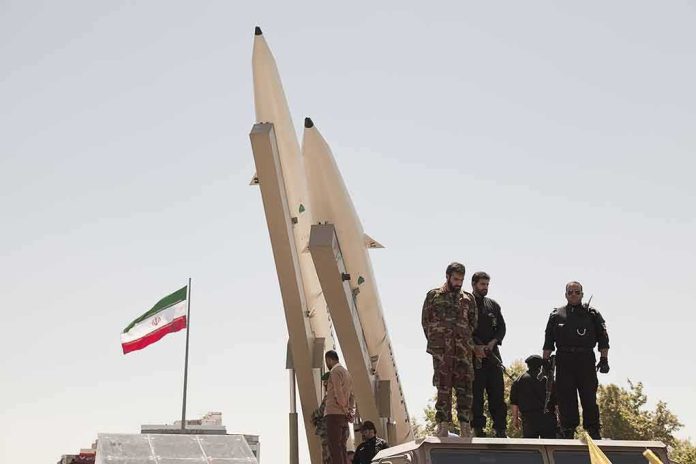
When Tehran vows retaliation “without geographic limits,” it is issuing a deterrent signal designed to shape an adversary’s calculus, not unveiling a war plan; the language is expansive by design, but in practice Iran calibrates how, where, and when it hits back.
The Short Version
- The directive came from the top: Iran’s Supreme Leader publicly ordered immediate retaliation to “any” threat, expanding potential targets beyond a single front.
- The order paired rhetoric with scope: U.S. and Israeli “physical and non-physical” assets were explicitly placed in reach, a formulation that includes cyber and proxy tools alongside missiles and drones.
- Talk of U.S. strikes after the midterms created the escalation frame, though U.S. officials repeatedly emphasized no final decision had been made.
- History suggests a pattern: maximalist words, selective and controlled actions aimed at deterrence without uncontrolled war.
What Tehran actually said—and why it matters
The center of gravity is clear: a public statement attributed to Iran’s Supreme Leader directed the armed forces to respond immediately, “without geographical limits,” to any enemy threat, and to refresh the target set so that U.S. and Israeli assets—physical and non-physical—are within reach. The phrasing matters for two reasons. First, it signals that Iran will not accept a confined battlefield; if hit in one theater, it reserves the right to impose costs elsewhere. Second, the inclusion of “non-physical” widens the menu to cyber systems, logistics, and perhaps financial infrastructure, areas where plausibly deniable pressure can be applied at varied tempos. Translations differ on whether the response must be “forceful,” “effective,” or both; the strategic intent is the same: broaden deterrence options and complicate an adversary’s risk assessment.
The timing of the message intersected with reporting that Washington had alerted regional partners to prepare for a short, intense round of post‑election strikes, potentially as soon as the day after the midterms. Whether or not such a strike window was ultimately authorized, the leak—and the Supreme Leader’s directive in response—functioned in the classic action–reaction cycle: each side tries to deter the other by advertising capability, resolve, and escalation pathways.
Signaling versus operations: how Iran turns threats into leverage
Iranian doctrine blends deterrence by punishment—ballistic and cruise missiles, long‑range drones, proxy attacks, cyber tools—with escalation management. The Islamic Republic has learned over four decades that it cannot win a prolonged conventional war against a superior adversary; instead, it builds options to raise costs in ways that are painful yet bounded. That is why “without geographic limits” should be read as a permission structure rather than an order of battle. It enables action from Lebanon or Yemen, from the Gulf to the Mediterranean, or in cyberspace—without committing to a particular ladder rung in advance. Analysts who study Iran’s escalation patterns point to repeated cycles where sweeping threats were followed by calibrated operations that proved the point while avoiding a spiral into general war.
This gap between rhetoric and execution is a feature, not a bug. Ambiguity sustains deterrence: if opponents cannot predict the domain or the direction of the next blow, they must account for more risk. Yet Tehran also keeps moves proportional to preserve options. Deterrence that explodes into total war is deterrence that failed.
Capabilities and reach: what “no geographic limits” can plausibly mean
The public directive did not disclose weapons, timelines, or authorities—and it did not need to. Iran’s demonstrated toolset includes medium‑range ballistic missiles capable of striking U.S. and allied facilities across the Gulf, land‑attack cruise missiles and one‑way attack drones used with increasing precision, naval mines and anti‑ship systems to threaten chokepoints, cyber units with a track record against regional infrastructure, and a network of partners and proxies that provide depth and deniability from Lebanon to Iraq and Yemen. The phrase “physical and non‑physical” maps cleanly onto this portfolio. It also exploits the seam where attribution is slow and thresholds for overt retaliation are high. None of this proves capacity everywhere; it does establish credible options across multiple theaters and domains, which is the core of the signal.
What the available reporting does not show is an accompanying set of public mobilization orders, visible unit movements, or a published operational concept. That absence does not invalidate the threat—militaries rarely declare such preparations in real time—but it does mark the line between deterrent language and evidence of imminent action. In other words: intent signaled, execution undisclosed.
The U.S. post‑midterm window: planning, not a decision
On the other side of the ledger, multiple outlets describe U.S. officials warning regional allies to prepare for potential renewed action against Iran after the midterms, while underscoring that President Trump had not made a final decision. The reporting includes candidate target sets—missile and drone nodes, energy infrastructure, nuclear facilities—and cautions about possible Iranian retaliation against energy assets and critical infrastructure. The White House declined to confirm specific plans, reiterating that all options remain on the table to prevent an Iranian nuclear weapon. The operative word across these accounts is potential. Contingency preparation is the coin of the realm; public confirmation is not how sensitive timelines are managed.
Put together, the exchange of signals fits a familiar pattern: Washington calibrates pressure and prepares options; Tehran broadcasts a wide aperture for retaliation to deter the worst‑case scenario. Neither side benefits from broadcasting specifics, and both sides talk past one another with messages aimed as much at allies and domestic audiences as at the opposing war room.
Reading the translations—and the intent—correctly
Non‑identical renderings of the Supreme Leader’s language—“without geographical limits,” “without geographic restriction,” “immediate” and “effective” or “forceful”—invite hair‑splitting over exact semantics. That is a dead end. Strategic meaning resides in consistent elements across versions: immediacy, breadth of domains, and the removal of geographic constraint. Whether the adjective is “forceful” or “effective,” the directive’s thrust is to authorize rapid reprisal outside a single front, including non‑kinetic means.
This is deterrence by uncertainty. The target set refresh that reportedly includes U.S. and Israeli assets is a bureaucratic way of operationalizing that uncertainty—ensuring the staff work exists to translate a political order into strikes, cyber actions, or proxy tasking when, and only when, leaders decide the threshold is crossed.
What to watch next: indicators, not headlines
For serious readers tracking risk rather than rhetoric, three indicators matter more than viral phrases. First, force posture shifts: satellite imagery of missile brigades, unusual naval deployments, air defense readiness, and proxy mobilization patterns on known fronts. Second, communications hygiene: spikes in encrypted traffic among Iran’s partners and observable changes in cyber targeting that precede kinetic action. Third, diplomatic choreography: back‑channel traffic and third‑party shuttle diplomacy that often bracket real decisions to strike or stand down. Public statements set the stage; these quieter movements cue the act that follows.
The durable insight is that Iran’s “no geographic limits” language is best understood as a strategic umbrella—broad enough to deter, flexible enough to control. It does not promise what Tehran will do; it promises that Tehran will choose from a wider menu than its adversaries prefer. In a region where miscalculation, not malice, most often lights the fuse, that promise is consequential enough.
Threats of worldwide retaliation and maximum military readiness raise the risk of a wider regional and international conflict. Any attack on civilians or civilian infrastructure would be unacceptable under international law. The US, Israel and Iran must avoid further escalation.…
— Ibadat Ullah (@iukhalil1) October 31, 2026
Sources:
mediaite.com, en.ilsole24ore.com, yahoo.com, haaretz.com, aljazeera.com, timesofisrael.com, ntn24.com, noticiassin.com, indiatoday.in, independent.co.uk, cfr.org