

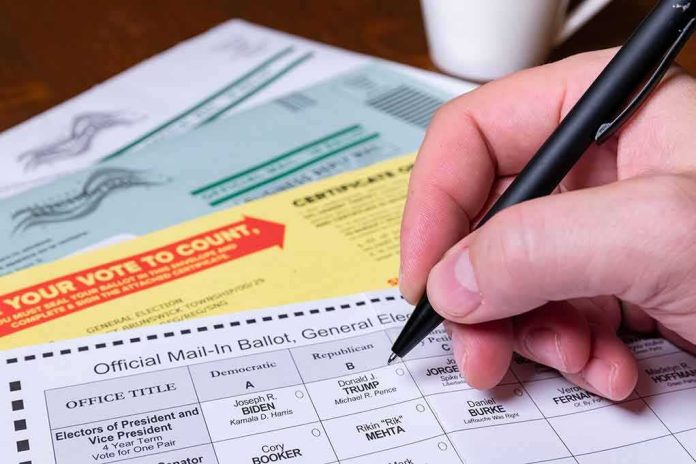
Ballot design and campaign hardball collided in Alaska when Democratic-aligned operatives pursued a same-name “ballot composition” gambit—recruiting a second Dan Sullivan to appear alongside Republican Senator Dan S. Sullivan—an episode that reveals how modern campaigns probe the seams of election rules for advantage and how ranked-choice voting changes, but does not erase, the logic behind spoiler strategies.
At a Glance
- Multiple outlets report Democratic-aligned aides linked to Mary Peltola and national party officials worked to recruit Daniel J. Sullivan to the Alaska Senate race, a tactic internally dubbed a “ballot composition project.”
- The reported objective was vote diversion via name similarity with incumbent Sen. Dan S. Sullivan; Daniel J. Sullivan later qualified for the general-election ballot under Alaska’s top-four primary and ranked-choice system.
- A former Peltola campaign manager is quoted as saying Peltola was “definitely aware” of the project, while also saying she was not directly involved. Peltola’s campaign and the DSCC deny recruiting anyone.
- The case highlights a familiar tactic—ballot stacking—operating within Alaska’s distinct election architecture, where ranked-choice voting dampens, but can’t fully nullify, first-choice spoiler effects.
What happened, in plain terms
Published reporting describes a coordinated effort by personnel connected to Democrat Mary Peltola’s Senate campaign and senior aides at the Democratic Senatorial Campaign Committee to recruit candidates—most notably a retired Petersburg teacher, Daniel J. Sullivan—to influence the composition of Alaska’s Senate ballot. According to these accounts, the effort carried an internal label, the “ballot composition project,” and aimed to siphon votes from incumbent Republican Sen. Dan S. Sullivan by placing a same-name candidate on the ballot. Those reports cite interviews with a dozen sources, text messages, and documents prepared for potential litigation as their evidentiary base. Peltola’s campaign and the DSCC categorically deny recruiting candidates.
The same-name candidate ultimately filed and advanced through Alaska’s top-four primary into the ranked-choice general election, placing him side by side with the incumbent on every November ballot. Separate coverage emphasizes that this was part of a broader recruitment push, not a one-off name ploy. A former Peltola campaign manager is quoted saying Peltola was not directly involved but was “definitely aware” of the project.
Mechanism: how a same-name candidacy can matter under Alaska’s rules
Alaska runs a nonpartisan top-four primary, followed by a ranked-choice general election. Ranked choice mitigates classic “spoiler” math: if the lowest finisher is eliminated, those ballots transfer to the next-ranked choice, buffering against vote-splitting. Yet the first round still matters. A same-name candidate can skim first-choice marks from inattentive or hurried voters—particularly if ballot cues are weak—nudging who gets eliminated first or how close a frontrunner sits to the 50 percent threshold. If the same-name entrant survives the first elimination while a rival doesn’t, or if ballot exhaustion (when voters do not rank further choices) is uneven, the tactic can alter the path of transfers and, in close contests, the outcome. That is why campaigns test this edge even in RCV environments.
In this case, Daniel J. Sullivan qualified for the general election by finishing in the top four out of the August primary. That ensured the same-name juxtaposition persisted into the decisive ranked-choice rounds, exactly where maximal name-recognition friction could occur—even if mitigated by ballot labels such as party and incumbent status.
How we got here: the “ballot composition project” and its evidence
Outlets summarizing the New York Times’ investigation report that the activity was organized, named, and documented. CNBC’s account cites 12 sources, text messages, and documents tied to contemplated litigation. Good Morning America relays the internal “ballot composition project” moniker and its purpose: recruit a spoiler to bleed support from the Republican incumbent. While campaign-level denials have been unequivocal, a former Peltola campaign manager is quoted as placing Peltola’s awareness within the frame, while still distancing her from operational control. That split—awareness without direct order—is common in modern campaigns that firewall candidate principals from more aggressive ballotcraft.
Multiple reports identify Daniel J. Sullivan as a retired Petersburg schoolteacher who entered after the recruitment effort reportedly began; he then advanced to the November ballot. One publicly available Alaska Division of Elections document contains Daniel J. Sullivan’s candidate statement—standard fare that neither proves nor disproves any recruitment, but situates him formally in the race.
Competing statements and what they amount to
Peltola’s campaign has said it had “no involvement with either Sullivan campaign,” and the DSCC has also denied involvement. Those statements sit opposite reporting that attributes recruitment work to Peltola-linked personnel and DSCC aides. The divergence is typical: campaigns and party committees fiercely contest the line between official direction and activities by lawyers, outside operatives, or aligned strategists—especially when legal exposure or reputational harm looms. The most specific, sourced thread in the public record is the claim from a former campaign manager that Peltola was “definitely aware” of the project but not directly involved; that assertion, if accurate, characterizes knowledge, not authorization.
It is also relevant that coverage frames the recruitment drive as broader than one name match; in other words, the alleged program sought to shape the entire ballot. That context supports the existence of a strategic apparatus aimed at vote diversion, even as it complicates a monocausal narrative focused solely on name confusion from Daniel J. Sullivan.
Why campaigns do this: ballot stacking as an old tactic in a new system
Recruiting a candidate to fracture an opponent’s coalition—ballot stacking—predates ranked choice and has appeared across jurisdictions. It leverages predictable voter heuristics: name recognition, partisan labels, and ballot order. Alaska’s RCV regime restrains the purest version of the spoiler effect, but it does not erase incentives to manage ballot composition. The first-choice tally can still shape momentum and elimination order; exhausted ballots can still magnify early skims; and the administrative act of juxtaposing two near-identical names can generate enough friction to matter at the margins. In an era when close races are decided at the edges, campaigns treat those edges as worthy targets.
What it means going forward
Three implications stand out. First, transparency and ballot-design hygiene matter. Clear party labels, incumbent tags, and unambiguous candidate identifiers are the first defense; Alaska’s election authorities have leaned into such cues in prior cycles, and this episode underscores why those cues should be prominent and consistent. Second, ranked-choice processes should be coupled with robust voter education about ranking beyond first choice; the more voters complete rankings, the less leverage any first-round skim provides. Third, enforcement and disclosure regimes need to keep pace with ballotcraft. While “ballot stacking” is generally legal, documented coordination, material support, or misrepresentation can cross lines into illicit coordination or fraud; vigorous, even-handed scrutiny protects both voter intent and candidate legitimacy.
Finally, this case demonstrates how campaigns adapt to institutions rather than rail against them. Alaska’s RCV did not invite the tactic; competitive incentives did. The best policy response is not to abolish systems that broaden voter choice, but to refine design, disclosure, and education so that tactical creativity cannot outpace voter clarity.
Sources:
pjmedia.com, washingtonexaminer.com, newsnationnow.com, cleveland.com, cnbc.com, us.cnn.com, alaskapublic.org, elections.alaska.gov, thehill.com